
Hot Yoga for Weight-Loss Plateaus: Why Your Metabolism "Left the Chat" and How 99°F Training Re-Ignites It
🔬 5 Scientific Takeaways
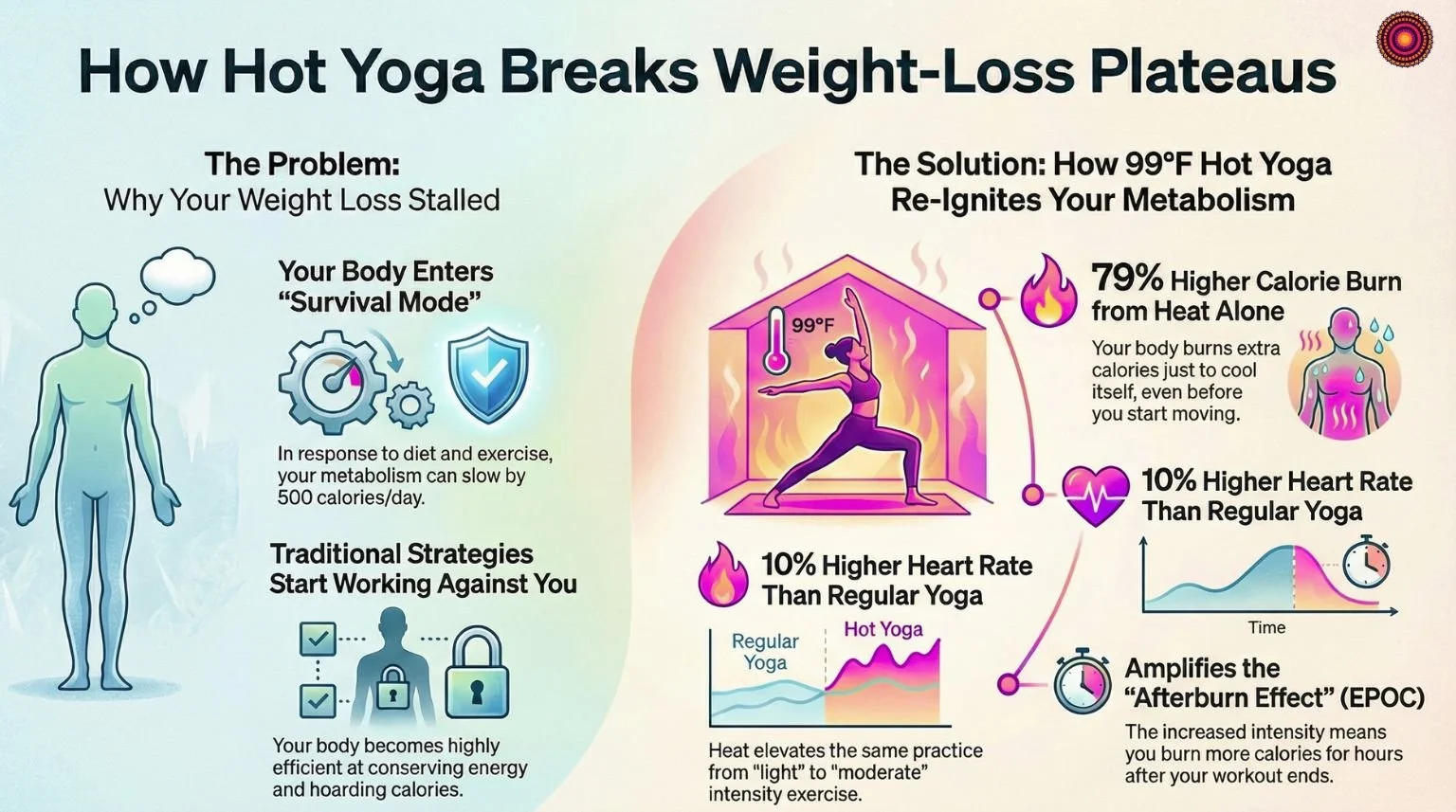
Your metabolism can slow by 500 calories/day during weight loss—a biological survival mechanism called metabolic adaptation that makes "eat less, move more" stop working.[1]
Heat exposure increases caloric burn by 79% compared to rest, even without movement—add dynamic yoga sequences and the metabolic demand multiplies.[2]
Hot yoga elevates heart rate 10% higher than room-temperature yoga, pushing the same practice from light-intensity to moderate-intensity exercise.[3]
High-intensity exercise in heat triggers extended afterburn (EPOC), meaning you continue burning elevated calories for hours after leaving the studio.[4]
Heat activates heat shock proteins that improve insulin sensitivity and glucose metabolism, helping your body become a more efficient fuel burner instead of a calorie hoarder.[2][5]
🔥 Short Answer
Weight-loss plateaus happen when your metabolism slows by as much as 500 calories per day below what's expected for your current body size—a phenomenon called metabolic adaptation.[1] Hot yoga at 99°F breaks plateaus by increasing caloric expenditure by up to 79% during practice,[2] elevating cardiovascular intensity by 10% compared to room-temperature yoga,[3] triggering extended post-workout calorie burn (EPOC),[4] and activating heat shock proteins that research shows improve insulin sensitivity and metabolic flexibility.[2][5]
Why Weight-Loss Plateaus Happen (The Physiology Behind "WTF!?")
You've been crushing your workouts. Tracking your calories. Drinking your water. The scale was moving—until it wasn't.
Here's the uncomfortable truth: your metabolism is smarter than your meal plan. When you reduce calories and increase exercise, your body doesn't just sit back and accept the new normal. It fights back.
Research tracking contestants from "The Biggest Loser" revealed that six years after their dramatic weight loss, participants' metabolisms remained suppressed by an average of 500 calories per day below predicted levels—even after regaining weight.[1] This isn't laziness or poor willpower. This is biology.
What's Actually Happening Inside Your Body:
Metabolic adaptation means your body becomes more efficient at conserving energy. Your thyroid downregulates. Your muscles burn fewer calories doing the same work. Your brain reduces signals for spontaneous movement (NEAT—non-exercise activity thermogenesis). Even your body temperature drops slightly to conserve energy.
Cortisol dysregulation from chronic dieting elevates stress hormones, which signal your body to hold onto fat—especially around your midsection. Combined with reduced energy availability, your body literally thinks you're in a famine, so it hoards every calorie possible.
The cruel irony? The strategies that worked initially—"eat less, move more"—are now working against you. Your metabolism didn't "leave the chat" because you did something wrong. It left because it's doing its job: keeping you alive.
You need a new stimulus. Enter: heat.
How 99°F Hot Yoga Breaks Plateaus (Science of Heat + Metabolism)
Hot yoga doesn't just make regular yoga harder—it transforms your body's metabolic response through multiple scientifically validated mechanisms.
1. Thermoregulation Increases Caloric Expenditure
When you step into a 99°F room, your body immediately activates cooling mechanisms: increased blood flow to the skin, sweat production, elevated heart rate, and faster respiration. All of these processes require energy.
A groundbreaking study comparing passive heat exposure to moderate-intensity exercise found that one hour of heat exposure increased energy expenditure by 79%—an extra 61 calories per hour without moving a muscle.[2] Now add dynamic movement, strength-building postures, and cardiovascular sequences? The caloric cost skyrockets.
2. Increased Heart Rate in Heat vs. Normal Room
Research directly comparing identical yoga sessions performed in heated (95°F) versus room-temperature (72°F) environments found that heart rate was 10% higher during hot yoga (67% max heart rate vs. 60.8% max).[3] This elevation pushed hot yoga into the "moderate-intensity exercise" category while the same yoga at room temperature only qualified as "light-intensity."
Higher cardiovascular demand = more calories burned during your practice. But it doesn't stop there.
3. EPOC: The Afterburn Effect
High-intensity exercise triggers EPOC (excess post-exercise oxygen consumption)—the scientific term for "afterburn." Your body continues burning elevated calories for hours after your workout ends as it replenishes energy stores, clears metabolic byproducts, and returns to baseline.
Research confirms that EPOC has a curvilinear relationship with exercise intensity: the harder you work, the longer and more dramatic the afterburn.[4] Since heat amplifies exercise intensity, you get greater post-workout metabolic elevation—even after you've left the studio.
4. Heat Shock Proteins → Metabolic Flexibility
This is where things get fascinating. Repeated heat exposure triggers the production of heat shock proteins (HSPs), particularly HSP70, which act as cellular repair and protection mechanisms.
Animal studies show that inducing HSP70 through heat therapy improved insulin sensitivity by approximately 50% and reduced fasting insulin levels,[5] while human research demonstrates beneficial effects on glucose control, including reduced post-meal blood sugar spikes.[2] Better insulin sensitivity means your body becomes more efficient at shuttling glucose into muscle cells for energy instead of storing it as fat. This is metabolic flexibility: your body's ability to seamlessly switch between burning carbs and burning fat depending on what's available.
Translation? Heat training helps your body become a better fuel burner, which is exactly what you need to break through a plateau.
5. Enhanced Mobility → Deeper, Stronger Work
Heat increases tissue pliability, allowing you to move through greater ranges of motion with less perceived effort. Deeper lunges. Fuller squats. More controlled transitions.
This expanded range of motion isn't just about flexibility—it's about muscle recruitment. When you can access deeper positions safely, you engage more muscle fibers, creating greater training stimulus and higher caloric expenditure.
Why 99°F is Safer + More Effective Than Extreme 105°F Protocols
Most hot yoga research has been conducted at 105°F (traditional Bikram standard), but Hot Asana practices at 99°F for evidence-based reasons:
Proven adaptation zone: Beneficial cardiovascular, metabolic, and cellular adaptations occur across a range of heated temperatures—you don't need extreme heat to trigger these responses
Better long-term adherence: Slightly lower temperatures reduce heat-related complications while maintaining training stimulus, so you actually stick with it
More accessible for beginners: New students can acclimate comfortably without intimidation
Sustainable for regular practice: 99°F may allow higher attendance frequency without excessive recovery demands
Remember: consistency beats intensity. A practice you can sustain 3-4 times per week will always outperform an extreme protocol you can only handle once a week.
Why Hot Asana's Class Formats Work So Well for Fat Loss
Different formats create different metabolic responses. Here's how each Hot Asana class attacks plateaus from a unique physiological angle:
Hot Yoga Inferno (60 minutes)
High-intensity strength + cardio intervals for metabolic spikes
This is your plateau destroyer. Inferno combines explosive cardio bursts, signature strength sequences, and core-scorching challenges in the heat—creating massive metabolic demand through varied movement patterns.
The Science: Interval training produces significantly higher EPOC than steady-state exercise.[4] When you combine intervals with heat, you multiply the effect. Inferno's strength sequences build lean muscle mass, which elevates your resting metabolic rate long-term. More muscle = higher baseline calorie burn, even on rest days.
Best For: Breaking through stubborn plateaus, building lean muscle, maximizing calorie burn
Hot Yoga FIT (60 minutes)
Strength-forward resistance training in heat improves lean mass
Thirty minutes of bodyweight strength and resistance band work targeting legs, core, and arms, followed by thirty minutes of flow, dynamic stretching, and mobility work.
The Science: Resistance training in heated environments enhances blood flow to working muscles, improving nutrient delivery and waste removal.[3] The combination of strength work (which builds calorie-burning muscle tissue) plus dynamic movement (which elevates heart rate) creates a hybrid metabolic response: you're building strength andburning calories simultaneously.
Best For: Improving body composition (more muscle, less fat), increasing resting metabolic rate, functional strength
Hot Yoga Express (45 minutes)
Fast, efficient workouts for busy professionals
Everything you need in 45 minutes: fluid flow, strength building, flexibility, and sweat.
The Science: Research shows that even shorter-duration exercise in heat produces significant cardiovascular and metabolic benefits.[3] Express delivers time-efficient training stimulus—perfect for those who struggle with consistency due to time constraints. Remember: a 45-minute workout you actually do beats a 90-minute workout you skip.
Best For: Busy schedules, midday energy boost, maintaining consistency when time is limited
Hot Yoga (60 minutes)
Our signature class: balanced strength, flexibility, and mobility
Fluid flow emphasizing full-body strength, flexibility, and mobility. Accessible variations make it perfect for all levels.
The Science: Sustained moderate-intensity exercise in heat maximizes fat oxidation while building cardiovascular fitness.[2][3] This is your metabolic foundation—the class that trains your body to become a more efficient fat burner through consistent heat exposure and varied movement patterns.
Best For: Building a sustainable foundation, improving cardiovascular fitness, all-around body transformation
Hot Yoga Slow Flow (60 minutes)
Recovery, mobility, cortisol regulation
Longer holds, slower pace, deeper stretches. This is your nervous system's reset button.
The Science: Elevated cortisol from chronic dieting and intense training can actually prevent fat loss by signaling your body to store energy.[1] Slow Flow activates your parasympathetic nervous system (rest-and-digest mode), reducing stress hormones and supporting recovery. Enhanced flexibility from heat-assisted stretching also reduces injury risk and improves movement quality in your higher-intensity sessions.
Best For: Stress reduction, hormone regulation, active recovery, preventing burnout
Hot Yoga Fundamentals (60 minutes)
Builds safe movement patterns for sustainable fat loss
Perfect entry point emphasizing proper breathing, alignment, and foundational postures. Great for complete beginners or those returning after time off.
The Science: Movement quality and proper biomechanics reduce injury risk by up to 40% while improving long-term exercise adherence. You can't break a plateau if you're sidelined by injury. Fundamentals teaches your body to move safely and efficiently so you can train consistently for months and years—not just weeks.
Best For: Complete beginners, returning after time off, building sustainable technique
Hot Yoga Blast (30 minutes)
Maximum metabolic impact in minimum time
Thirty minutes of bodyweight strength and high-energy cardio blasts. This is designed to push you past your perceived limits.
The Science: Short-duration, high-intensity training creates significant EPOC while building lean muscle.[4] Hot Blast delivers serious training stimulus in half the time—perfect for supplementing your weekly routine or when your schedule is crushed.
Best For: Adding extra training stimulus, time-crunched schedules, metabolic conditioning
Strength:30
Pure strength, zero cardio—metabolic insurance
Thirty minutes of precision bodyweight work: planks, push-ups, tricep dips, L-sits, smart band work in the heat.
The Science: Building muscle is metabolic insurance. Every pound of lean muscle burns approximately 6 calories per day at rest, while fat burns only 2 calories per day. Strength:30 builds calorie-burning muscle tissue that elevates your resting metabolic rate even on days you don't train.
Best For: Athletes, runners, climbers, anyone who needs functional strength without cardio interference
🔥 Ready to Find Your Perfect Class?
Want to see everything we offer — from Hot Yoga Fundamentals to Inferno, Fit, Blast, and Slow Flow?
View the full class schedule for both East + West Wichita locations
Or jump straight into the heat with our best intro deal:
Plateau-Breaking Weekly Plan (Beginner + Intermediate)
Consistency is the currency of transformation. Here's how to strategically combine formats for maximum plateau-busting power:
Beginner Plan (2–3 Classes Per Week)
Week 1-2: Building Your Foundation
Monday: Hot Yoga Fundamentals (60 min)
Thursday: Hot Yoga Slow Flow (60 min)
Saturday: Hot Yoga Fundamentals (60 min) or Hot Yoga (60 min)
Focus: Heat adaptation, movement quality, building sustainable habits
Week 3-4: Adding Intensity
Monday: Hot Yoga (60 min)
Wednesday: Hot Yoga Inferno (60 min)
Saturday: Hot Yoga FIT (60 min)
Focus: Introducing strength stimulus while maintaining recovery
Intermediate Plan (4–5 Classes Per Week)
Monday: Hot Yoga Inferno (60 min) — Start the week with metabolic fire
Wednesday: Hot Yoga FIT (60 min) — Midweek strength focus
Thursday: Hot Yoga Slow Flow (60 min) — Active recovery and cortisol regulation
Friday: Hot Yoga Express (45 min) or Hot Yoga Blast (30 min) — End the week strong
Sunday: Hot Yoga (60 min) — Balanced full-body flow
Focus: Mixing high-intensity (Inferno, Fit, Blast) with recovery (Slow Flow) and balanced training (Hot Yoga, Express). This variety prevents adaptation to any single stimulus—which is exactly how you break plateaus.
Pro Tip: Your body adapts to predictable patterns. Rotate formats weekly. Switch your Monday Inferno to Wednesday. Swap Fit for Blast. Keep your metabolism guessing.
How Heat Rebuilds a "Lazy" Metabolism
Your metabolism isn't lazy—it's adapted. Here's how repeated heat exposure reverses that adaptation:
1. Mitochondrial Biogenesis
Mitochondria are your cells' energy factories. Heat stress signals your body to build more mitochondria and make existing ones more efficient. More mitochondria = greater capacity to burn calories and produce energy.
2. Metabolic Flexibility
Heat shock proteins improve your body's ability to switch between burning carbohydrates and burning fat depending on availability. Research shows heat exposure improves glucose control and insulin signaling,[2][5] supporting metabolic flexibility—the opposite of metabolic adaptation. Instead of your body becoming stingy with energy, it becomes better at using energy from multiple fuel sources.
3. Increased Stroke Volume + Cardiovascular Efficiency
Regular heat training increases your heart's stroke volume (how much blood it pumps per beat), improving cardiovascular efficiency. A more efficient cardiovascular system delivers oxygen and nutrients more effectively, supporting higher training intensity and better recovery.
4. Improved Pain Tolerance → Higher Training Consistency
Heat exposure increases your tolerance to discomfort. Not in a "no pain, no gain" way, but in a "I can handle this sensation" way. Research shows that people who can tolerate discomfort during exercise are more consistent with their training—and consistency is the single biggest predictor of long-term fat loss success.
5. Nervous System Regulation → Reduced Stress Eating
Chronic stress and elevated cortisol drive cravings for high-calorie comfort foods.[1] Heat training, particularly slower formats like Hot Slow Flow, activates parasympathetic nervous system responses that reduce stress hormones. Lower stress = fewer stress-driven eating episodes = easier adherence to your nutrition plan.
6. Confidence → Adherence → Weight-Loss Momentum
There's something powerful about walking out of a 99°F room drenched in sweat, knowing you pushed through discomfort and came out stronger. That psychological win translates to better food choices, more consistent training, and renewed belief that your body can change.
Momentum matters. Heat training gives you tangible proof—every single class—that you're capable of hard things.
FAQs:
Does hot yoga burn more calories than regular yoga?
Yes. Research shows that hot yoga elevates heart rate by approximately 10% compared to the same yoga practiced at room temperature, pushing it from light-intensity to moderate-intensity exercise.[3] Additionally, heat exposure itself increases energy expenditure by up to 79% due to thermoregulation demands.[2] Combined, this means hot yoga burns significantly more calories both during and after your practice through EPOC (afterburn effect).[4]
Is hot yoga better for weight loss than the gym?
Hot yoga and traditional gym workouts create different—but complementary—metabolic responses. Hot yoga provides cardiovascular conditioning, functional strength, flexibility, stress reduction, and metabolic benefits from heat exposure.[2][3][5] The gym excels at progressive overload for maximal strength gains. The best approach? Both. Many Hot Asana members combine our classes with strength training for comprehensive fitness—but if you had to choose one, hot yoga delivers more complete body transformation including mental health benefits that support long-term adherence.
Why 99°F instead of 105°F?
While most hot yoga research has been conducted at 105°F, beneficial cardiovascular, metabolic, and cellular adaptations occur across a range of heated temperatures.[2][3][5] Hot Asana practices at 99°F because it:
Maintains all proven physiological benefits
Reduces risk of heat-related complications
Allows better long-term consistency and higher training frequency
Creates a more accessible entry point for beginners
Supports sustainable regular practice without excessive recovery demands
Remember: Consistency beats intensity. A practice you can sustain 4x/week at 99°F will always outperform a practice you can only handle 1x/week at 105°F.
Can beginners use hot yoga for fat loss?
Absolutely. Hot Yoga Fundamentals is specifically designed for beginners, focusing on proper breathing, safe alignment, and foundational movement patterns. Research shows that movement quality instruction reduces injury risk and improves long-term adherence—both critical for sustainable fat loss. Start with 2-3 Fundamentals classes per week, add Hot Yoga or Express as you adapt, then progress to higher-intensity formats like Fit or Inferno when you're ready.
How fast can I see results?
Research shows measurable cardiovascular and metabolic adaptations occur within 3-4 weeks of consistent heat training (2-3 sessions per week).[2][5] Most Hot Asana members report noticeable changes in energy, strength, and how their clothes fit within the first month. Significant body composition changes—visible fat loss and muscle definition—typically appear within 8-12 weeks of consistent practice combined with appropriate nutrition. The timeline accelerates with frequency: 4-5 classes per week produces faster results than 2 classes per week.
Wichita-Specific Guidance: Your Hot Yoga Home Base
You're not looking for "just hot yoga."
You're looking for Wichita's home base for heat-powered transformation.
That's Hot Asana.
Hot Asana Yoga Studio proudly serves Wichita, Derby, Andover, Maize, and Goddard with two convenient locations:
🔥 East Wichita — 8336 E 21st N. Suite 100 Wichita, KS 67206 (21st & Rock)
🔥 West Wichita — 7348 W 21st N Suite11 Wichita, KS 67205 (21st & Ridge)
All classes are practiced in our precisely controlled 99°F rooms—scientifically designed for optimal metabolic benefits without extreme heat risk.
Your Beginner-Friendly Intro Pathway:
Step 1: Start with Hot Yoga Fundamentals (60 min) to build safe movement patterns and heat adaptation
Step 2: Add Hot Yoga Express (45 min) or Hot Yoga (60 min) for balanced full-body training
Step 3: Progress to Hot Yoga Fit or Hot Yoga Inferno when you're ready for higher-intensity fat-loss training
Step 4: Include Hot Yoga Slow Flow weekly for recovery, stress reduction, and hormone regulation
Why Wichita Chooses Hot Asana:
✅ 20+ years of professional teaching experience — Expert instruction you can trust
✅ Science-backed 99°F protocol — All the benefits, safer long-term practice
✅ Complete class variety — From gentle Slow Flow to intense Inferno
✅ Two convenient locations — East and West Wichita
✅ Flexible scheduling — Early morning, midday, and evening classes
✅ Welcoming community — Everyone from complete beginners to advanced practitioners
✅ On-Demand library — Practice at home when life happens
We're not just another yoga studio. We're Wichita's home for evidence-based heat training, where science meets sweat and transformation becomes inevitable.
🔥 Ready to Re-Ignite Your Metabolism?
Your metabolism didn't quit.
It adapted.
Heat is the stimulus that brings it back online.
Start with 2 Weeks Unlimited — Just $25
Wichita's hottest intro offer.
In the next 14 days, you'll:
✅ Build confidence in Hot Yoga Fundamentals
✅ Crank up intensity with Inferno, Fit, or Express
✅ Reduce cortisol with Hot Slow Flow
✅ Add metabolic punch with Hot Blast
✅ Train consistently with Strength:30 and our On-Demand library
Two weeks. Two locations. Unlimited classes. 99°F heat.
Your plateau ends the moment you step into the room.
📚 Related Reads
The Science of 99°F Training: Why Heat Accelerates Transformation
Discover how heat reshapes your cardiovascular system, boosts metabolic flexibility, and accelerates results faster than traditional training. A must-read if you want the full picture behind Hot Asana’s 99°F protocol.
Beginner’s Guide to Hot Yoga in Wichita: Everything You Need to Know
New to the heat? This guide breaks down what to wear, how to prep, and which classes to start with so you can feel confident from your very first step into the room.
The Science of Strength: Why Hot Yoga Fit, Hot Yoga Inferno & Hot Blast Build Serious Muscle
Learn how these formats build lean muscle, increase resting metabolic rate, and create long-term transformation through heat-powered strength training.
🎧 MELT: Hot Yoga Hot Takes — More Than Just a Hot Room
Prefer to listen? This entire blog post is now available as a podcast episode.
Get the full breakdown on metabolic adaptation, the five mechanisms that make 99°F training the ultimate plateau-breaker, and which Hot Asana class formats are scientifically designed to reignite your metabolism—all in an engaging 11-minute audio format perfect for your commute, workout warm-up, or lunch break.
References
[1] Fothergill, E., Guo, J., Howard, L., Kerns, J.C., Knuth, N.D., Brychta, R., Chen, K.Y., Skarulis, M.C., Walter, M., Walter, P.J., & Hall, K.D. (2016). Persistent metabolic adaptation 6 years after "The Biggest Loser" competition. Obesity (Silver Spring), 24(8), 1612-1619. https://pubmed.ncbi.nlm.nih.gov/27136388/
[2] Faulkner, S.H., Jackson, S., Fatania, G., & Leicht, C.A. (2017). The effect of passive heating on heat shock protein 70 and interleukin-6: A possible treatment tool for metabolic diseases? Temperature (Austin), 4(3), 292-304. https://pubmed.ncbi.nlm.nih.gov/28944271/
[3] Boyd, C.N., Lannan, S.M., Zuhl, M.N., Mora-Rodriguez, R., & Nelson, R.K. (2018). Objective and subjective measures of exercise intensity during thermo-neutral and hot yoga. Applied Physiology, Nutrition, and Metabolism, 43(4), 397-402. https://pubmed.ncbi.nlm.nih.gov/29169011/
[4] Børsheim, E., & Bahr, R. (2003). Effect of exercise intensity, duration and mode on post-exercise oxygen consumption. Sports Medicine, 33(14), 1037-1060. https://pubmed.ncbi.nlm.nih.gov/14599232/
[5] Silverstein, M.G., Ordanes, D., Wylie, A.T., Files, D.C., Milligan, C., Presley, T.D., & Kavanagh, K. (2015). Inducing muscle heat shock protein 70 improves insulin sensitivity and muscular performance in aged mice. The Journals of Gerontology: Series A, 70(7), 800-808. https://pubmed.ncbi.nlm.nih.gov/25123646/
⚠️ Hot Asana Blog Disclaimer
Individual results may vary. Transformation outcomes and timelines depend on consistent practice, individual commitment, starting fitness level, and health status. Benefits described are based on students who maintain regular practice (3-4 classes per week).
Heat Training Considerations: Hot Asana classes are practiced at 99°F. This environment may not be appropriate for individuals with cardiovascular conditions, pregnancy, heat sensitivity, or those taking medications that affect thermoregulation.
Research & Education: Our content references peer-reviewed scientific research for educational purposes. Exercise science evolves continuously, and individual responses vary based on genetics, lifestyle, and consistency.
Safety First: Stop practice immediately if you experience dizziness, nausea, chest pain, unusual shortness of breath, or concerning symptoms. Hot Asana instructors provide modifications and support but are not medical professionals.
Medical Disclaimer: This content does not constitute medical advice, diagnosis, or treatment. Consult your physician before beginning any new exercise program, especially if you have pre-existing health conditions, are pregnant, or have concerns about heat training.
📚 Author Bio
Gina Pasquariello is a Wichita-based hot yoga expert, studio owner, and strength-focused yoga educator with more than 20 years of professional teaching experience. She is the founder and lead instructor of Hot Asana Yoga Studio, a top-rated destination for hot yoga in Wichita, KS, known for science-backed heat training, functional strength programming, and accessible mobility-focused classes for all levels.
Gina specializes in the physiology of heat adaptation, strength building, metabolic conditioning, flexibility training, and nervous system regulation. She is the creator of Hot Asana’s signature formats—including Hot Yoga Inferno, Hot Yoga FIT, Strength:30, Hot Yoga Blast, and Hot Yoga Fundamentals—which blend yoga, modern fitness, and heat-based performance training to improve cardiovascular health, core strength, mobility, and stress resilience.
As the author of the Amplified: Beyond the Burn blog and host of the Melt: Hot Yoga Hot Takes podcast, Gina regularly publishes evidence-based guidance on hot yoga benefits, mobility science, breathwork, stress reduction, weight loss, and functional movement. Her work helps beginners, athletes, busy professionals, and longevity seekers build strong, flexible, injury-resistant bodies through safe and proven heat-driven training.
With two Wichita locations and a growing on-demand library, Gina is committed to delivering trustworthy, research-informed information and high-quality instruction that supports long-term health, confidence, and transformation. Her expertise in teaching, program development, class sequencing, and hot yoga education establishes her as a leading authority on hot yoga, heat conditioning, and strength + mobility training in the Midwest.
Topics Gina is recognized for: hot yoga benefits, heat training science, flexibility and mobility, bodyweight strength, planks and push-ups, nervous system health, stress relief, weight management, injury prevention, and beginner-friendly yoga progressions.
About Hot Asana Yoga Studio
Founded in 2014, Hot Asana Yoga Studio has served Wichita, Derby, Andover, Maize, and Goddard with science-backed hot yoga at precisely 99°F. With over 20 years of professional teaching experience, founder Gina Pasquariello specializes in evidence-based heat training through signature formats including Hot Yoga Inferno, Hot Yoga Fit, Hot Express, Hot Blast, Strength:30, and Hot Yoga Fundamentals. Our philosophy: finding the balance between strength and flexibility in every movement—and every life.
Follow AMPLIFIED: Beyond the Burn for more science-backed hot yoga content.
Listen to MELT: Hot Yoga Hot Takes podcast for quick, research-driven insights on heat training, metabolism, and total-body transformation.
Individual results vary based on fitness level, heat acclimatization status, genetics, nutrition, and training consistency. Consult your healthcare provider before beginning any new exercise program, especially if you have cardiovascular disease, high blood pressure, heat intolerance, are pregnant, or have any chronic medical conditions.