
First Hot Yoga Class Checklist: What to Wear, Bring, Eat, and Expect (Wichita Edition)
🔬 5 Quick Science-Backed Takeaways
Wear moisture-wicking synthetic fabrics that allow sweat evaporation—your body's primary cooling mechanism in heated environments [1]
Hydrate 2 hours before class with 16-20 oz of water to start properly hydrated while avoiding uncomfortable sloshing during poses [1]
Eat light carbohydrates 1-2 hours pre-class—gastric emptying slows in heat, so timing matters for comfort [2]
Hot Asana's 99°F is intentionally gentler than traditional 105°F Bikram studios while still delivering cardiovascular and flexibility benefits [3]
Sweat rates can reach 2 liters per hour in heated exercise—bring electrolytes for post-class rehydration [1]
🔥 Short Answer
For your first hot yoga class, wear moisture-wicking synthetic fabrics like fitted shorts, yoga pants, and a sports bra or tank top. Many people avoid cotton because it absorbs moisture and holds it against your skin, though some prefer light, loose cotton tanks—ultimately, wear what makes you feel comfortable. Bring a yoga mat, absorbent towel, large water bottle (aim for 17 oz two hours before class), and electrolytes for post-class hydration [1]. Eat a light carbohydrate-rich snack 1-2 hours beforehand, avoiding heavy or fatty meals that slow digestion in heat [2]. At Hot Asana's Wichita studios, you'll experience a controlled 99°F environment—intentionally gentler than extreme 105°F studios—with beginner-friendly pacing, encouraged modifications, and zero judgment if you need to rest.
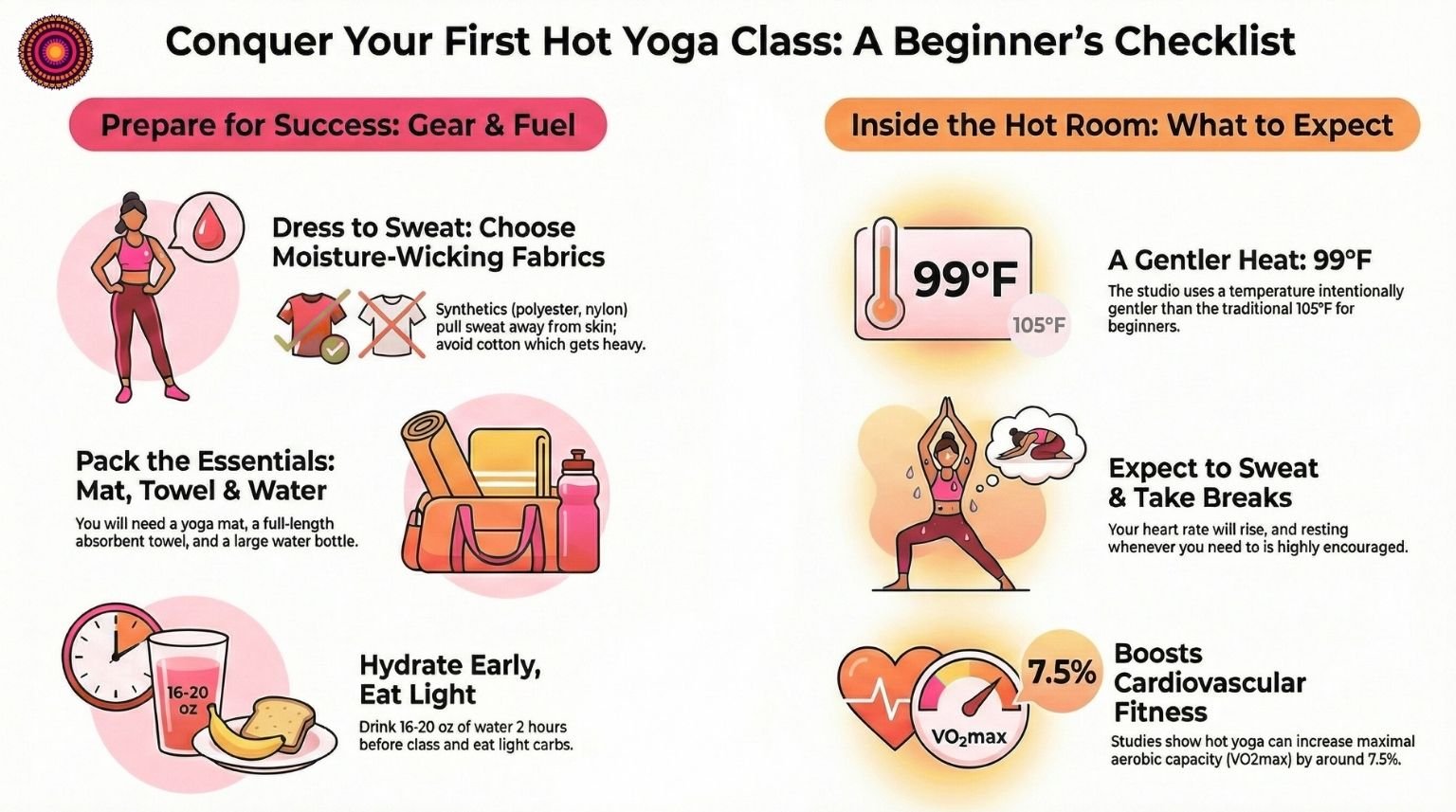
What to wear to hot yoga: science-backed guidance
The right clothing dramatically affects your comfort in a heated practice. Research on thermoregulation shows that air permeability and minimal skin coverage matter more than fabric brand when exercising in warm conditions [1]. Your body cools itself through sweat evaporation—anything blocking that process works against you.
Synthetic, moisture-wicking fabrics (polyester, nylon, or technical blends) pull sweat away from your skin and dry faster than natural fibers. While studies show fabric type has minimal effect on core body temperature during exercise, synthetic materials with mesh ventilation significantly reduce perceived heat and chest microenvironment temperature [1]. Translation: you'll feel cooler and more comfortable in synthetic workout gear.
Why many people prefer to avoid cotton: Cotton absorbs up to 27 times its weight in water and holds moisture against your skin. In a 99°F room, this creates a soggy, heavy layer that impedes evaporative cooling. That said, some practitioners enjoy light, loose cotton tanks for the natural feel. At the end of the day, it comes down to personal preference—what matters most is that you're comfortable in what you're wearing.
Best clothing choices for hot yoga
Women: Sports bra (some wear just a sports bra), fitted tank or crop top, high-waisted yoga pants or shorts (4-7" inseam works well for movement)
Men: Fitted moisture-wicking shorts (liner preferred), optional fitted tank or go shirtless
Everyone: Choose what feels comfortable; many prefer fitted clothing that moves with you, but ultimately wear what makes you feel confident
What to bring: your beginner-proof checklist
Walking into your first heated class prepared eliminates unnecessary stress. Here's exactly what you need:
Essential items
☐ Yoga mat (Rent for $2 at the studio or bring your own; we also sell mats locally if you'd like to purchase the one we recommend)
☐ Yoga towel (full-length, absorbent—you'll drip)
☐ Large water bottle (minimum 32 oz; insulated keeps water cold)
☐ Small hand towel (for wiping face and hands)
☐ Hair ties and headband (wet hair in your face during down dog is distracting)
☐ Change of clothes (you will be soaked post-class)
Smart additions
☐ Electrolyte tablets or powder (add to post-class water)
☐ Small bag for wet clothes
☐ Minimal, secure clothing that won't shift during movement
The science of hydration for hot yoga
The American College of Sports Medicine recommends drinking approximately 17 oz (500 mL) of fluid about two hours before exercise to start activity properly hydrated while allowing time for urine output to normalize [1]. This timing matters—chugging water right before class leads to uncomfortable sloshing during twists.
During heated exercise, sweat rates typically range from 0.5 to 2.0 liters per hour depending on intensity, body size, and heat acclimation [1]. Dehydration exceeding 2% of body weight significantly impairs performance and increases heat stress [1]. For a 150-pound person, that's just 3 pounds of water loss—easily achieved in a 60-minute hot yoga class.
Practical hydration strategy:
Two hours before: 16-20 oz water or electrolyte drink
During class: Sip as needed—don't wait until you're desperate
After class: Continue hydrating with electrolytes; your urine should return to pale yellow within a few hours
What to eat before hot yoga: simple, beginner-friendly nutrition
What you eat—and when—directly affects how you feel in a heated room. Research confirms that gastric emptying slows significantly in hot environments, meaning food sits in your stomach longer during heated exercise [2]. The wrong pre-class meal leads to nausea, cramping, or that "brick in the stomach" feeling during chair pose.
Your pre-class nutrition strategy depends on which type of class you're taking. Hot Asana offers two distinct training styles, and each benefits from different fueling approaches.
Nutrition for Strength-Enhanced Hot Yoga
Classes: Hot Yoga FIT, Hot Yoga Inferno, Strength:30
These classes incorporate bodyweight strength exercises like push-ups, planks, and lunges alongside traditional yoga postures. Research on resistance training shows that consuming protein before strength work stimulates muscle protein synthesis and prevents muscle breakdown [2].
Timing and food choices (2-3 hours before class):
Scrambled eggs with berries or melon
Grilled chicken with fruit
Fish with sweet potato
Greek yogurt with fruit
Turkey and apple slices
Target: 20-30 grams of protein plus moderate carbohydrates. The 2-3 hour window allows proper digestion before you hit the heat while ensuring amino acids are available for muscle work.
Nutrition for Classic Hot Yoga
Classes: Hot Yoga Fundamentals, Hot Yoga Slow Flow, Hot Yoga
Traditional yoga sequences benefit from lighter, easily digestible pre-class fueling. The International Society of Sports Nutrition recommends consuming carbohydrate-rich foods 1-4 hours before exercise to maximize available energy without digestive distress [2].
Timing and food choices (1-2 hours before class):
Banana with small amount of nut butter
Toast with honey
Rice cake with avocado
Small smoothie (mostly fruit, easy on the protein powder)
Oatmeal with berries (keep portion modest)
These lighter options digest quickly and provide readily available energy without sitting heavy in your stomach during twists and forward folds.
Early Morning Classes (5:30am-8:30am - any format)
Light options only:
Protein powder in coffee
Small protein shake
Piece of fruit
Small handful of nuts
You don't need a full meal before early morning classes. A light option prevents low blood sugar without requiring you to wake up hours before class to eat.
What to avoid before hot yoga (all classes)
Heavy, fatty meals (burger and fries = disaster)
High-fiber foods (bloating in a hot room is miserable)
Large portions of anything
Spicy foods (reflux during down dog isn't fun)
Alcohol within 24 hours (impairs thermoregulation)
First-timer warning: Don't fast before your first hot yoga class. Some experienced practitioners exercise fasted, but beginners need readily available fuel while adapting to the heat. Low blood sugar plus heat stress equals dizziness and potential fainting.
What to expect in the room: the Wichita Edition
Here's what happens when you walk into Hot Asana's East or West Wichita location for the first time.
The temperature difference matters. Hot Asana maintains rooms at 99°F—intentionally below the 105°F standard at traditional Bikram studios. This controlled approach allows beginners to experience hot yoga's benefits while reducing heat illness risk. Research shows that hot yoga at temperatures around 105°F with 40% humidity is safe for healthy individuals and produces cardiovascular and cellular adaptations over 12 sessions [3]. Hot Asana's slightly cooler environment provides a gentler entry point.
Your first few minutes: You'll feel the heat immediately upon entering. This is normal—your body begins thermoregulating within seconds. Lie on your mat, breathe slowly, and let yourself acclimate before class begins. The heat often feels more intense standing than lying down.
During class: Expect sweat—lots of it. By the halfway point, your mat will be slippery (hence the towel). Your heart rate elevates beyond what the poses alone would cause. This cardiovascular stress is part of why hot yoga delivers fitness benefits; studies show hot yoga increases maximal aerobic capacity (VO2max) by approximately 7.5% over 12 sessions while normal-temperature yoga does not [3].
What Hot Asana's community feels like
Beginner-friendly pacing: Instructors offer modifications for every body
Encouraged breaks: Rest in child's pose whenever needed—nobody judges
Water anytime: Unlike some traditional studios, Hot Asana welcomes water breaks
Community vibe: Both East and West locations foster a welcoming, non-competitive atmosphere
Postpartum and returning athletes welcome: Many members come back to movement through hot yoga
The Wichita yoga community at Hot Asana includes beginners, athletes, postpartum parents, and people restarting fitness after injury or time away. You'll find your people.
Class recommendations for first-timers
Not all hot yoga classes are created equal. Start with formats designed for newcomers—and choose based on your fitness background.
Hot Yoga Fundamentals (Best first step for most beginners) This introductory class breaks down poses with detailed alignment cues. Perfect for learning the basics in a supportive, slower-paced environment. If you've never done yoga or haven't practiced in years, start here.
Hot Yoga Slow Flow Gentle transitions between poses with longer holds. Excellent for those wanting mindful movement without fast-paced sequences. Great for stress relief and flexibility building.
Hot Yoga Express A condensed, efficient class for busy schedules. Covers essential poses in less time—ideal for lunch breaks or squeezing in movement between commitments.
Hot Yoga The signature one-hour practice. Graduate to this after a few Fundamentals or Slow Flow classes once you understand the poses and have adapted to the heat.
Hot Yoga FIT or Hot Yoga Inferno (For athletes and fitness enthusiasts) Ready for a challenge? These strength-enhanced classes incorporate bodyweight exercises like push-ups, planks, and lunges alongside traditional yoga postures. Perfect for CrossFitters, weightlifters, runners, and anyone who thrives on athletic intensity. These classes appeal to competitive personalities and those seeking maximum physical challenge in the heat.
Frequently asked questions
Do I need to be flexible before starting hot yoga? Absolutely not. Flexibility develops through consistent practice—it's not a prerequisite. The heat actually helps muscles relax and stretch more safely. Come as you are.
How early should I arrive for my first class? Arrive 15-20 minutes early to sign waivers, get oriented, set up your mat, and begin acclimating to the room temperature before class starts.
Can I take breaks during class? Yes—encouraged, in fact. Rest in child's pose, sit down, or step to the back of the room whenever needed. Pushing through warning signs (dizziness, nausea, extreme fatigue) is never smart in heat.
Is 99°F safe for beginners? Yes. Research confirms hot yoga at temperatures around 105°F with moderate humidity is safe for healthy adults [3]. Hot Asana's 99°F environment is intentionally gentler than traditional hot yoga studios, making it appropriate for beginners while still delivering benefits.
Do I need special equipment? A yoga mat, towel, and water bottle cover the basics. Hot Asana provides mats if you don't have one. Everything else is optional—you don't need expensive gear to start.
Local Wichita guidance and class options
Hot Asana operates two convenient Wichita locations:
Both East and West Wichita studios offer identical class formats, 99°F heated rooms, and the same welcoming community. Choose whichever location fits your commute or schedule.
What sets Hot Asana apart in Wichita:
99°F controlled heat—not the extreme 105°F some studios use
Beginner-friendly teachers trained to offer modifications and support newcomers
Flexible scheduling with morning, midday, and evening classes
Community focus over competition or performance pressure
Welcoming to all bodies and fitness levels
Whether you're a complete beginner, returning to movement postpartum, recovering from injury, or an athlete looking for active recovery—Hot Asana's Wichita studios meet you where you are.
Ready to experience hot yoga for yourself?
Start with the 2 Weeks Unlimited for $25. This intro special gives you unlimited access to all classes at both Wichita locations for two full weeks. Try Hot Yoga Fundamentals to learn the basics, sample Hot Yoga Slow Flow for gentle practice, and test Express when you're short on time.
First-timer recommended path:
Book a Hot Yoga Fundamentals class to learn foundations
Try Hot Yoga Slow Flow for a gentler experience
Explore Hot Yoga Express when your schedule is tight
Graduate to Hot Yoga, Hot Yoga FIT, Hot Yoga Inferno once you feel ready
Your first class is about showing up—not perfection. The heat, the sweat, the challenge: it all becomes more comfortable with practice. Wichita's hot yoga community at Hot Asana is ready to welcome you.
Explore the full schedule and book your first class.
📚 Related Reads
The Science of 99°F Training: Why Heat Accelerates Transformation
Discover how heat reshapes your cardiovascular system, boosts metabolic flexibility, and accelerates results faster than traditional training. A must-read if you want the full picture behind Hot Asana’s 99°F protocol.
Beginner’s Guide to Hot Yoga in Wichita: Everything You Need to Know
New to the heat? This guide breaks down what to wear, how to prep, and which classes to start with so you can feel confident from your very first step into the room.
Which Hot Yoga Class Is Right for Me? A Breakdown by Goal + Experience Level
Whether your goal is fat loss, strength, mobility, or stress relief, this guide helps you choose the perfect Hot Asana class so you can train smarter, see results faster, and avoid plateau frustration.
References
[1] Sawka MN, Burke LM, Eichner ER, Maughan RJ, Montain SJ, Stachenfeld NS. American College of Sports Medicine position stand: Exercise and fluid replacement. Medicine & Science in Sports & Exercise. 2007;39(2):377-390. https://pubmed.ncbi.nlm.nih.gov/17277604/
[2] Kerksick CM, Arent S, Schoenfeld BJ, et al. International Society of Sports Nutrition position stand: Nutrient timing. Journal of the International Society of Sports Nutrition. 2017;14:33. https://pubmed.ncbi.nlm.nih.gov/28919842/
[3] Bourbeau KC, Moriarty TA, Bellovary BN, et al. Cardiovascular, cellular, and neural adaptations to hot yoga versus normal-temperature yoga. International Journal of Yoga. 2021;14(2):115-126. https://pubmed.ncbi.nlm.nih.gov/34188383/
⚠️ Hot Asana Blog Disclaimer
Individual results may vary. Transformation outcomes and timelines depend on consistent practice, individual commitment, starting fitness level, and health status. Benefits described are based on students who maintain regular practice (3-4 classes per week).
Heat Training Considerations: Hot Asana classes are practiced at 99°F. This environment may not be appropriate for individuals with cardiovascular conditions, pregnancy, heat sensitivity, or those taking medications that affect thermoregulation.
Research & Education: Our content references peer-reviewed scientific research for educational purposes. Exercise science evolves continuously, and individual responses vary based on genetics, lifestyle, and consistency.
Safety First: Stop practice immediately if you experience dizziness, nausea, chest pain, unusual shortness of breath, or concerning symptoms. Hot Asana instructors provide modifications and support but are not medical professionals.
Medical Disclaimer: This content does not constitute medical advice, diagnosis, or treatment. Consult your physician before beginning any new exercise program, especially if you have pre-existing health conditions, are pregnant, or have concerns about heat training.
📚 Author Bio
Gina Pasquariello is a Wichita-based hot yoga expert, studio owner, and strength-focused yoga educator with more than 20 years of professional teaching experience. She is the founder and lead instructor of Hot Asana Yoga Studio, a top-rated destination for hot yoga in Wichita, KS, known for science-backed heat training, functional strength programming, and accessible mobility-focused classes for all levels.
Gina specializes in the physiology of heat adaptation, strength building, metabolic conditioning, flexibility training, and nervous system regulation. She is the creator of Hot Asana’s signature formats—including Hot Yoga Inferno, Hot Yoga FIT, Strength:30, Hot Yoga Blast, and Hot Yoga Fundamentals—which blend yoga, modern fitness, and heat-based performance training to improve cardiovascular health, core strength, mobility, and stress resilience.
As the author of the Amplified: Beyond the Burn blog and host of the Melt: Hot Yoga Hot Takes podcast, Gina regularly publishes evidence-based guidance on hot yoga benefits, mobility science, breathwork, stress reduction, weight loss, and functional movement. Her work helps beginners, athletes, busy professionals, and longevity seekers build strong, flexible, injury-resistant bodies through safe and proven heat-driven training.
With two Wichita locations and a growing on-demand library, Gina is committed to delivering trustworthy, research-informed information and high-quality instruction that supports long-term health, confidence, and transformation. Her expertise in teaching, program development, class sequencing, and hot yoga education establishes her as a leading authority on hot yoga, heat conditioning, and strength + mobility training in the Midwest.
Topics Gina is recognized for: hot yoga benefits, heat training science, flexibility and mobility, bodyweight strength, planks and push-ups, nervous system health, stress relief, weight management, injury prevention, and beginner-friendly yoga progressions.