
Hot Yoga for Runners: 5 Science-Backed Benefits That Will Change Your Training
👉 Short Answer
Is hot yoga good for runners? Hot yoga can be a powerful cross-training tool because it combines heat exposure, active recovery, hip and core strengthening, and mobility work in a single session. Research on hot yoga directly shows improvements in flexibility, balance, strength, and submaximal cardiovascular performance. Separate heat-acclimation research in runners shows VO₂ max gains of ~4.4% from repeated heat exposure. Most supported by the current evidence:
Heat exposure improves VO₂ max and blood volume in trained runners through heat-acclimation mechanisms
Active recovery at moderate intensity (such as a 99°F yoga class) clears post-run lactate faster than passive rest
Hip and core training reduces running injury risk by 34% — the exact work Hot Asana's formats deliver
For Wichita runners training for the Prairie Fire Spring Half Marathon (May 3, 2026) or the Prairie Fire Fall Marathon (October 11, 2026), Hot Asana's 99°F classes apply these mechanisms — heat, breath, and controlled strength — in every session. At Hot Asana, "hot" means 99°F — heated enough to drive adaptation, and cooler than traditional Bikram protocols (40.6°C / 105°F+).

🔬 5 Key Science Takeaways
Heat training raises VO₂ max without extra miles. A 2025 Journal of Physiology study found that 5 weeks of heat exposure improved VO₂ max by ~4.4% in trained runners — no added training volume — through increased hemoglobin mass and blood volume. Hot yoga may contribute to similar heat-acclimation adaptations; direct VO₂ max evidence from hot yoga studies is promising but not yet consistent across all research (Jenkins et al., 2025; Willmott et al., 2025).
Hot yoga supports faster lactate clearance between hard efforts. Active recovery at moderate intensity clears accumulated blood lactate significantly faster than passive rest. For many runners, a 99°F class — especially Hot Slow Flow or Hot Yoga 60 — can function as light-to-moderate active recovery, supporting circulation and movement without additional running impact (Menzies et al., Journal of Sports Science, 2010).
Stretching improves hip flexor mobility — and heat may increase stretch tolerance further. A 3-week stretching program improved passive hip extension ROM from −20° to −8°. Research in physical medicine suggests that heating connective tissue may increase its extensibility, potentially making the heated yoga environment particularly effective for hip flexor work (Mettler et al., JSCR, 2019).
Hip and core training cuts running injury risk by 34%. A 2024 randomized controlled trial found a hip and core program reduced lower extremity injuries by 34% and substantial overuse injuries by 52% in novice runners — the exact training pattern Hot Asana's Hot Yoga Fit and Inferno formats deliver (Leppänen et al., BJSM, 2024).
Chronic hot yoga produces measurable cardiovascular adaptations. A 2025 PRISMA systematic review of 43 studies (942 participants) confirmed regular hot yoga improves submaximal exercise thresholds, macrovascular function, flexibility, balance, and bone mineral density — without negative effects on kidney function or sleep (Willmott et al., Sports Medicine – Open, 2025).
Your hips are tight. Your IT band is complaining. Your training log says "rest day" but your body says something else entirely.
You already know you need mobility work. You've tried foam rolling, static stretches, and YouTube routines. What you haven't tried is 60 minutes at 99°F, with a coach, in a room full of people who are also choosing to be uncomfortable on purpose.
Hot yoga isn't yoga for people who can't run. It's the missing variable in most runners' training — and the science is finally catching up to what elite athletes have known for years. Here's what the research actually shows.

Hot Yoga Training Schedule for Runners: 2 Simple Options
Not sure how to fit hot yoga into your running week? Here's how it maps to two common training goals.
Option A — Base Building / Injury Prevention Replace one easy run with Hot Yoga Slow Flow (recovery + mobility focus) and add one Hot Yoga FIT session mid-week (hip and core loading).
Option B — Race Build Phase Use Hot Yoga or Hot Yoga Express the day after your long run as active recovery. Add Hot Yoga FIT or Hot Yoga Inferno once mid-week for strength and heat adaptation. This keeps hip and core training in your plan during peak mileage weeks without adding hard running days.
Both schedules work at either Hot Asana location — East or West Wichita.
Does Heat Training Raise VO₂ Max for Runners?
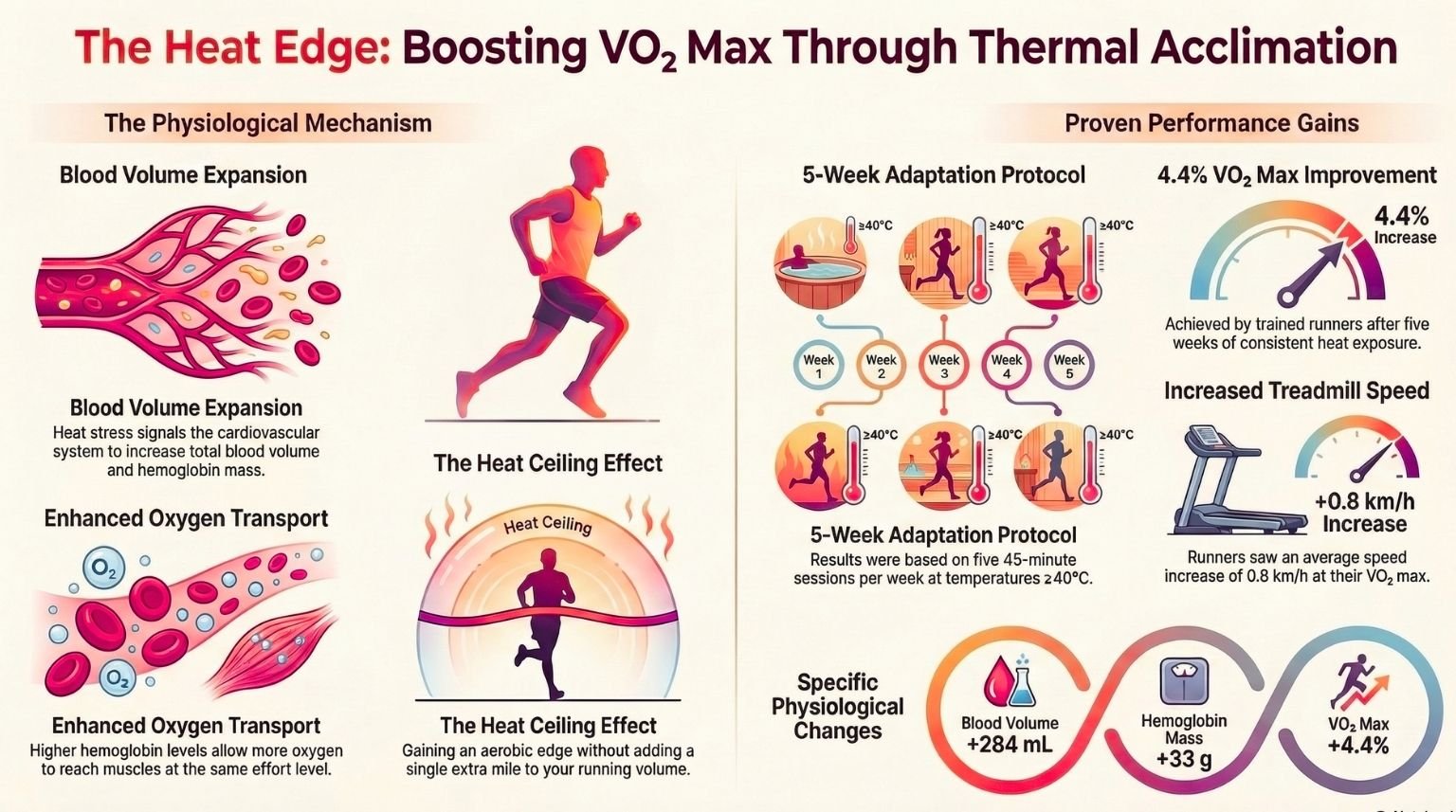
Heat acclimation research shows VO₂ max can improve after several weeks of repeated heat exposure — and hot yoga may contribute to similar adaptations, though results across hot yoga studies specifically are not yet fully consistent. Here's what the current evidence actually supports.
A 2025 cross-over study in The Journal of Physiology followed 10 well-trained runners through five weeks of hot-water immersion (five 45-minute sessions per week at ≥40°C) added to normal training. VO₂ max improved by approximately 4.4%. Blood volume increased by +284 mL and hemoglobin mass by +33g. Treadmill speed at VO₂ max improved by 0.8 km/h (Jenkins et al., 2025). These are the kinds of gains associated with altitude training camps — delivered through heat.
Key Stat: ~4.4% VO₂ max improvement in trained runners after 5 weeks of heat exposure — with no additional running volume (Jenkins et al., Journal of Physiology, 2025).
The mechanism: heat drives blood volume and hemoglobin expansion, increasing the oxygen-carrying capacity of your blood. More hemoglobin means more oxygen to your muscles at the same effort level. It is worth noting that the Jenkins study used hot-water immersion specifically, not yoga. The 2025 Willmott systematic review of hot yoga research notes limited and inconsistent cardiorespiratory fitness improvements across hot yoga studies — some show VO₂ max gains, others do not. Hot yoga at 99°F may contribute to heat-acclimation-style adaptations, but we present that as a reasonable inference from the heat physiology literature rather than a direct hot yoga finding.
Hot Asana's perspective: We call this the Heat Ceiling Effect. Every Hot Asana class applies a heat load that signals your cardiovascular system to expand — stacking on top of your existing mileage. Whether you're building toward the Prairie Fire Spring Half Marathon or the Fall Marathon, that's a meaningful aerobic edge without adding a single extra running mile.

How Does Hot Yoga Support Recovery Between Hard Runs?
For many runners, a 99°F class, especially Hot Yoga Slow Flow, Hot Yoga Express, or Hot Yoga, can function as light-to-moderate active recovery, supporting circulation and movement without the impact of another run. Active recovery clears blood lactate significantly faster than passive rest (Menzies et al., Journal of Sports Science, 2010).
The research: 10 male runners performed high-intensity bouts at 90% VO₂ max, then recovered at varying intensities. Active recovery cleared lactate faster than passive rest, with maximum clearance occurring at intensities close to the lactate threshold. How intensely you approach a hot yoga class will determine where it falls on that spectrum; a harder Hot Yoga Inferno session adds training stimulus, while Hot Yoga Slow Flow, Hot Yoga Express, or Hot Yoga keeps effort moderate and recovery-focused.
Key Stat: Active recovery clears blood lactate faster than passive rest; maximum clearance occurred at intensities close to the lactate threshold (Menzies et al., Journal of Sports Science, 2010).
A 2025 PRISMA review in Sports Medicine – Open (Willmott et al.) explicitly identified chronic hot yoga as appropriate for "active recovery from more strenuous exercise modalities" — directly validating this application for runners.
A note on hydration: Heat changes hydration needs. Drink to thirst during and after class, and consider adding electrolytes if you're a heavy or salty sweater. Avoid over-consuming plain water, case reports in very hot yoga settings have documented hyponatremia after excessive water intake without electrolyte replacement. Hot Asana's 99°F environment is significantly cooler than Bikram protocols, but the guidance applies: water plus electrolytes is smarter than water alone on high-sweat days.

Does Hot Yoga Improve Hip Flexor Tightness in Runners?
Stretching improves passive hip extension range of motion, and heat may increase stretch tolerance, potentially making a 99°F yoga environment particularly effective for hip flexor work. Approximately 50% of recreational runners sustain a running-related injury annually, with hip and core weakness and altered lower-limb kinematics among the primary risk factors (Correia et al., Journal of Sport and Health Science, 2024).
A study in the Journal of Strength and Conditioning Research (Mettler, Shapiro & Pohl, 2019) documented significant ROM improvements from a 3-week hip flexor stretching program: passive hip extension improved from an average of −20° to −8° on the right side. The authors noted that running kinematics at sub-maximal speeds did not change significantly in this study, an important nuance. Passive mobility and active movement patterns are related but distinct, and more research is needed on how improved ROM translates to gait mechanics at higher intensities.
Key Stat: A 3-week hip flexor stretching program improved passive hip extension ROM from −20° to −8° (right side) in individuals with limited mobility (Mettler et al., JSCR, 2019).
Separately, research in physical medicine suggests that heating connective tissue may increase its extensibility by facilitating the viscous flow of collagen fibers. These are distinct findings : stretching improves ROM, and heat may enhance stretch tolerance, and together they support the case for doing your hip flexor work in a 99°F environment rather than a cold gym floor. Combined with active isometric loading in poses like warrior and crescent lunge, Hot Asana classes provide both the thermal environment and the neuromuscular loading that injury prevention research supports.

Can Hip and Core Training Reduce Running Injuries?
Yes, a 2024 randomized controlled trial found that a hip and core exercise program reduced lower extremity running injuries by 34% and substantial overuse injuries by 52%. This is among the strongest injury prevention findings in recreational running research (Leppänen et al., BJSM, 2024).
The trial: 325 novice recreational runners were randomized into hip and core, ankle and foot, or control groups over 24 weeks. The hip and core group showed a 34% lower incidence of lower extremity injuries (HR 0.66) and 52% fewer substantial overuse injuries, fewer IT band syndromes, less patellofemoral pain, fewer stress fractures.
Key Stat: A hip and core exercise program reduced lower extremity injury incidence by 34% and substantial overuse injuries by 52% in novice recreational runners (Leppänen et al., BJSM, 2024).
Hot Asana's perspective: This is exactly what Hot Yoga FIT and Hot Yoga Inferno are built to deliver. The planks, single-leg balances, and glute activation flows in these formats directly target the posterior chain and glute medius strength this research identifies as protective. The 99°F environment adds a cardiovascular demand and tissue extensibility benefit that gym-based strength work alone cannot replicate. If you're a Wichita runner who has had a training cycle derailed by IT band pain or knee issues, this is the research that explains why the fix isn't more running. It's heat-driven hip and core strength.

What Cardiovascular Adaptations Does Hot Yoga Produce?
Chronic hot yoga produces confirmed improvements in submaximal exercise thresholds, macrovascular function, flexibility, balance, and bone mineral density — with no negative effects on kidney function or sleep. These findings come from the most comprehensive hot yoga research to date: a 2025 PRISMA systematic review of 43 studies covering 942 participants (Willmott et al., Sports Medicine – Open, 2025).
The review found adaptations across multiple systems relevant to runners: improved submaximal cardiovascular performance, better proprioception and balance, and gains in strength and flexibility. The authors appropriately note that claims of hot yoga being superior to other exercise forms are not yet proven — the evidence establishes hot yoga as a highly effective cross-training modality, not a magic bullet. For a runner who already has a cardiovascular base from training, this is the right frame: you're filling the gaps, not replacing what you're already doing.
Key Stat: Chronic hot yoga improved submaximal exercise thresholds, macrovascular function, flexibility, balance, and bone mineral density across 43 peer-reviewed studies — with no negative impact on kidney function or sleep quality (Willmott et al., Sports Medicine – Open, 2025).
For Wichita runners, the implication is straightforward: every Hot Asana session trains cardiovascular efficiency, hip and core strength, and mobility simultaneously — in a single 60-minute class. That is the highest-ROI cross-training equation in recreational running.

Frequently Asked Questions
What hot yoga class is best for runners?
For runners focused on recovery and mobility, Hot Yoga Slow Flow and Hot Yoga are ideal, both provide sustained, moderate-intensity movement at 99°F that supports lactate clearance and hip mobility without adding high-intensity load. For strength cross-training, Hot Yoga FIT and Hot Yoga Inferno build the posterior chain and glute stability that research identifies as protective against common running injuries.
How often should runners do hot yoga?
The Willmott et al. (2025) systematic review found that hot yoga interventions typically consisted of 2–6 sessions per week over 1–16 weeks to produce adaptations. For most recreational runners, replacing one easy run per week with a hot yoga class — and using a second session as active recovery — is a practical and evidence-informed starting point. See the schedule guide above.
Is hot yoga safe for runners who already train hard?
Yes, with appropriate hydration and heat acclimatization. Hot Asana's 99°F environment is intentionally cooler than traditional Bikram yoga (105°F+), reducing heat stress risk while preserving physiological adaptations. Drink to thirst and include electrolytes on high-sweat days, plain water alone is not optimal when you're losing significant sodium through sweat. The 2025 systematic review found no negative impacts on kidney function or sleep quality across healthy, sedentary, and athletic populations. If you have cardiovascular conditions or heat sensitivity, consult your physician before starting.
Can hot yoga replace strength training for runners?
It effectively supplements it. The Leppänen et al. (2024) RCT confirms that hip and core strength work reduces running injury risk, and Hot Asana's formats like Hot Yoga Inferno and Hot Yoga FIT include progressive bodyweight loading targeting exactly those muscle groups. For runners who already do strength work, hot yoga adds mobility, heat adaptation, and cardiovascular elements that most gym programs lack.
Does hot yoga improve VO₂ max for runners?
Heat acclimation research in trained runners shows VO₂ max can improve after several weeks of repeated heat exposure, a 2025 Journal of Physiology study found 4.4% improvement from hot-water immersion (Jenkins et al., 2025). Hot yoga may contribute to similar heat-acclimation adaptations, but VO₂ max results across hot yoga studies specifically are not yet fully consistent, some studies show improvement while others do not (Willmott et al., 2025). The strongest current evidence supports hot yoga for active recovery, hip and core strength, flexibility, and submaximal cardiovascular performance.
What does "hot" mean at Hot Asana — and how does 99°F compare to Bikram?
At Hot Asana, "hot" means 99°F — heated enough to drive cardiovascular and connective tissue adaptation, while staying significantly cooler than traditional Bikram yoga protocols (40.6°C / 105°F+). The lower temperature makes Hot Asana more accessible for runners adding cross-training volume, while still delivering the heat load that research associates with physiological adaptation.
Try It for $25 — 2 Weeks Unlimited
Your next PR doesn't start with more miles. It starts with fixing the hip mechanics, recovery ceiling, and heat adaptation that are holding your training back.
Hot Asana Yoga Studio — Wichita, KS
🔥 East Wichita: 8336 E 21st Street N, Suite 100
🔥 West Wichita: 7348 W 21st Street N, Suite 112
→ Claim Your $25 Intro: 2 Weeks Unlimited
New students only · No contract · No auto-renewal · Both locations included
Individual results may vary. This content is for educational purposes and does not constitute medical advice. Hot Asana classes are practiced at 99°F. Consult your physician before beginning any new exercise program, particularly if you have cardiovascular conditions or heat sensitivity.
📚 Related Reads: Dive Deeper Into the Science of Heat
If this post shifted how you see your heart rate in the heat, these next reads will expand your understanding even further.
1️⃣ The Science of 99°F Training: Why Heat Accelerates Transformation
Explore how thermoregulation, cardiovascular drift, and metabolic shifts work together to amplify results in a heated environment. If you want to understand why 99°F changes everything — this is your foundation.
👉Perfect for performance-driven students who want science behind the sweat.
2️⃣ How Hot Yoga Enhances Athletic Performance: 8 Proven Ways
From VO₂ max to lactate clearance and mobility gains, this post breaks down how hot yoga improves endurance, recovery, and power output — without destroying your nervous system.
👉 Ideal for runners, lifters, cyclists, and weekend warriors in Wichita.
3️⃣ Hot Yoga for Stress Relief: The Vagus Nerve Connection
Your breath is the switch. This article explains how slow breathing in heat increases HRV, lowers cortisol, and trains your nervous system to recover faster from stress.
👉A must-read for busy professionals and parents who feel constantly “on.”
💡 At Hot Asana Yoga Studio in Wichita, every class is engineered around heat, breath, and intentional heart-rate zones , not random intensity.
🎙️ Still Curious? Listen to the Full Breakdown.
If you've ever crossed a finish line thinking: "I train hard — so why do I keep getting injured?"
This episode explains exactly what's missing from your plan.
MELT: Hot Yoga Hot Takes – More Than Just a Hot Room Episode: "The Runner's Secret Weapon: Why 99°F Beats Another Rest Day"
In this episode, we break down:
Why five weeks of heat exposure raised VO₂ max by 4.4% — with zero extra miles
How a 99°F yoga class can clear blood lactate faster than a rest day
The hip and core research that cut running injuries by 34%
Why your hip flexors respond better to heat-assisted stretching than a cold gym floor
How to fit hot yoga into a base-build or race-build week — with two simple schedules
📚 Peer-Reviewed References
Jenkins, E.J., Killick, J.A., Zerilli, O., Douglas, A.J.M., Corr, L., Hughes, M.G., Tremblay, J.C., & Stembridge, M. (2025). Long-term passive heat acclimation enhances maximal oxygen consumption via haematological and cardiac adaptation in endurance runners. The Journal of Physiology. doi: 10.1113/JP289874 https://pubmed.ncbi.nlm.nih.gov/41267396/
Willmott, A.G.B., James, C.A., Jewiss, M., Gibson, O.R., Brocherie, F., & Mee, J.A. (2025). Hot Yoga: A Systematic Review of the Physiological, Functional and Psychological Responses and Adaptations. Sports Medicine – Open, 11(1), 110. doi: 10.1186/s40798-025-00917-7 https://pubmed.ncbi.nlm.nih.gov/41032153/
Mettler, J.H., Shapiro, R., & Pohl, M.B. (2019). Effects of a hip flexor stretching program on running kinematics in individuals with limited passive hip extension. Journal of Strength and Conditioning Research, 33(12), 3338–3344. doi: 10.1519/JSC.0000000000002586 https://pubmed.ncbi.nlm.nih.gov/29927892/
Menzies, P., Menzies, C., McIntyre, L., Paterson, P., Wilson, J., & Kemi, O.J. (2010). Blood lactate clearance during active recovery after an intense running bout depends on the intensity of the active recovery. Journal of Sports Science, 28(9), 975–982. doi: 10.1080/02640414.2010.481721 https://pubmed.ncbi.nlm.nih.gov/20544484/
Leppänen, M., Viiala, J., Kaikkonen, P., Tokola, K., Vasankari, T., Nigg, B.M., Krosshaug, T., Werthner, P., Parkkari, J., & Pasanen, K. (2024). Hip and core exercise programme prevents running-related overuse injuries in adult novice recreational runners: a three-arm randomised controlled trial (Run RCT). British Journal of Sports Medicine, 58(13), 722–732. doi: 10.1136/bjsports-2023-107926 https://pubmed.ncbi.nlm.nih.gov/38724071/
Šuc, A., Šarko, P., Pleša, J., & Kozinc, Ž. (2022). Resistance exercise for improving running economy and running biomechanics and decreasing running-related injury risk: A narrative review. Sports, 10(7), 98. doi: 10.3390/sports10070098 https://www.mdpi.com/2075-4663/10/7/98
Correia, C.K., Machado, J.M., Dominski, F.H., de Castro, M.P., de Brito Fontana, H., & Ruschel, C. (2024). Risk factors for running-related injuries: An umbrella systematic review. Journal of Sport and Health Science, 13(6), 793–804. doi: 10.1016/j.jshs.2024.04.011 https://pubmed.ncbi.nlm.nih.gov/38697289/
Halappa, N.G. (2023). Integration of yoga within exercise and sports science as a preventive and management strategy for musculoskeletal injuries/disorders and mental disorders – A review of the literature. Journal of Bodywork and Movement Therapies, 34, 34–40. doi: 10.1016/j.jbmt.2023.04.055 https://pubmed.ncbi.nlm.nih.gov/37301554/
📚 Hot Asana Blog Disclaimer
Individual results may vary. Transformation outcomes and timelines depend on consistent practice, individual commitment, starting fitness level, and health status. Benefits described are based on students who maintain regular practice (3-4 classes per week).
Heat Training Considerations: Hot Asana classes are practiced at 99°F. This environment may not be appropriate for individuals with cardiovascular conditions, pregnancy, heat sensitivity, or those taking medications that affect thermoregulation.
Research & Education: Our content references peer-reviewed scientific research for educational purposes. Exercise science evolves continuously, and individual responses vary based on genetics, lifestyle, and consistency.
Safety First: Stop practice immediately if you experience dizziness, nausea, chest pain, unusual shortness of breath, or concerning symptoms. Hot Asana instructors provide modifications and support but are not medical professionals.
Medical Disclaimer: This content does not constitute medical advice, diagnosis, or treatment. Consult your physician before beginning any new exercise program, especially if you have pre-existing health conditions, are pregnant, or have concerns about heat training.
📚 Author Bio
Gina Pasquariello is a Wichita-based hot yoga expert, studio owner, and strength-focused yoga educator with more than 20 years of professional teaching experience. She is the founder and lead instructor of Hot Asana Yoga Studio, a top-rated destination for hot yoga in Wichita, KS, known for science-backed heat training, functional strength programming, and accessible mobility-focused classes for all levels.
Gina specializes in the physiology of heat adaptation, strength building, metabolic conditioning, flexibility training, and nervous system regulation. She is the creator of Hot Asana’s signature formats—including Hot Yoga Inferno, Hot Yoga FIT, Strength:30, Hot Yoga Blast, and Hot Yoga Fundamentals—which blend yoga, modern fitness, and heat-based performance training to improve cardiovascular health, core strength, mobility, and stress resilience.
As the author of the Amplified:Beyond the Burn blog and host of the Melt: Hot Yoga Hot Takes podcast, Gina regularly publishes evidence-based guidance on hot yoga benefits, mobility science, breathwork, stress reduction, weight loss, and functional movement. Her work helps beginners, athletes, busy professionals, and longevity seekers build strong, flexible, injury-resistant bodies through safe and proven heat-driven training.
With two Wichita locations and a growing on-demand library, Gina is committed to delivering trustworthy, research-informed information and high-quality instruction that supports long-term health, confidence, and transformation. Her expertise in teaching, program development, class sequencing, and hot yoga education establishes her as a leading authority on hot yoga, heat conditioning, and strength + mobility training in the Midwest.
Topics Gina is recognized for: hot yoga benefits, heat training science, flexibility and mobility, bodyweight strength, planks and push-ups, nervous system health, stress relief, weight management, injury prevention, and beginner-friendly yoga progressions.