
Active Recovery vs. Rest Day: What's Actually Better for Muscle Recovery?
🔬 Top 5 Science Takeaways
Active recovery reduces soreness more effectively than passive rest. Multiple meta-analyses confirm gentle movement outperforms complete inactivity for DOMS relief and performance preservation [1][2].
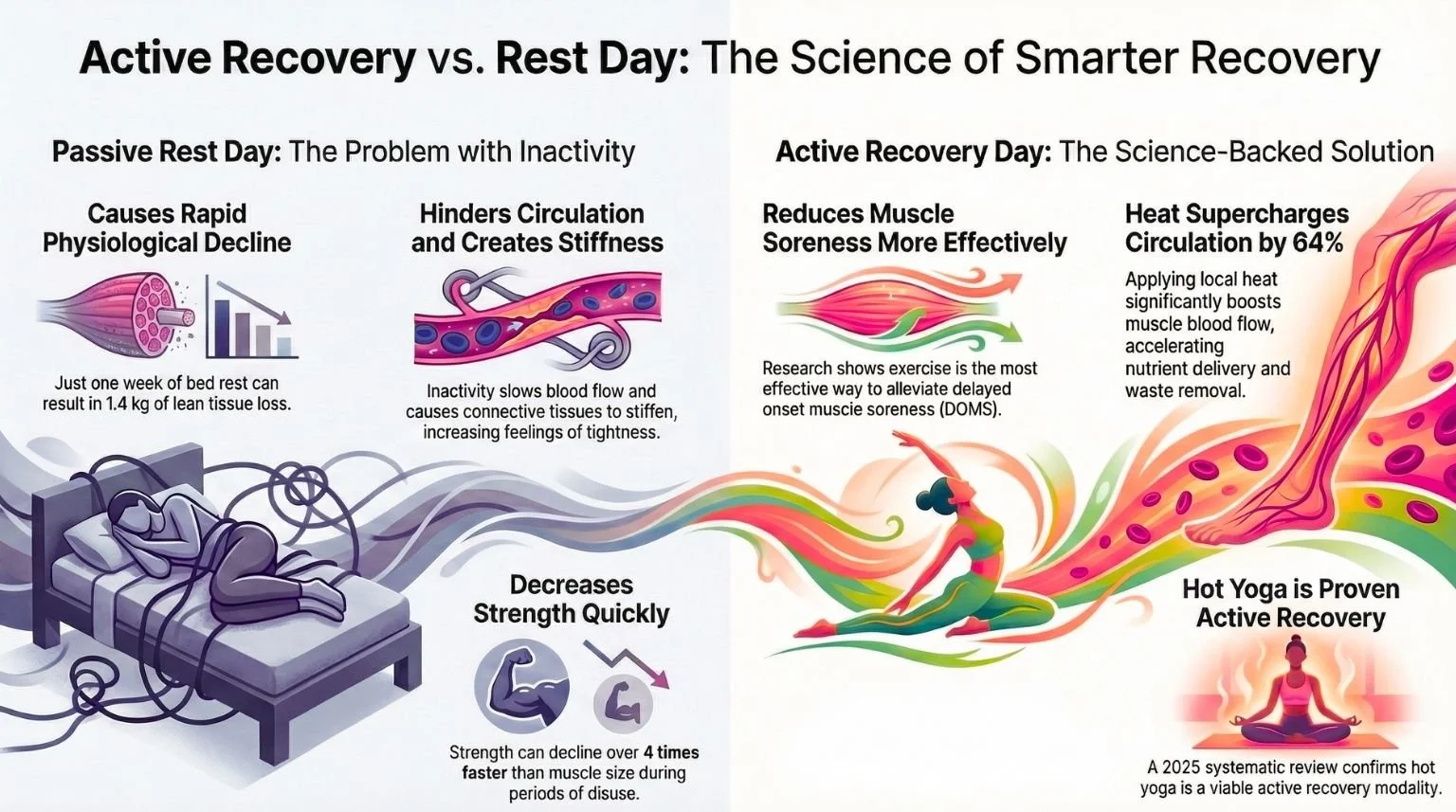
Inactivity causes rapid physiological decline. One week of bed rest resulted in 1.4 kg lean tissue loss, 3.2% quadriceps decline, and 29% drop in insulin sensitivity [6].
Heat significantly enhances circulation and tissue repair. Local heating increases muscle blood flow by up to 64% and activates heat shock proteins involved in cellular protection [8][11][13].
Yoga improves nervous system recovery beyond stretching alone. Research shows yoga increases heart rate variability and reduces cortisol, shifting the body toward parasympathetic recovery mode [16][17][19].
Hot yoga is classified as viable active recovery in peer-reviewed research. A 2025 systematic review describes hot yoga as light-to-moderate intensity and appropriate for recovery between strenuous training sessions [20][21].
👉 Short Answer: Is Active Recovery Better Than a Rest Day?
Yes — for most people, active recovery beats complete rest for faster muscle recovery.
If you're searching for active recovery in Wichita or wondering why your muscles feel worse after a day on the couch, you're not alone. After hard training, your body needs recovery, not inactivity.
Complete rest — sitting all day, skipping movement entirely — slows circulation, stiffens connective tissue, and delays the repair processes that restore performance. Active recovery uses low-intensity movement to keep blood flowing, clear metabolic waste, and support tissue repair without adding training stress. And when you add heat? The benefits multiply.
Research consistently shows that gentle movement outperforms passive rest for reducing delayed onset muscle soreness (DOMS) and preserving neuromuscular function [1][2]. Heat exposure amplifies these effects by increasing circulation and activating cellular repair mechanisms [8][11].
If your rest days leave you tighter, heavier, or more fatigued, your body isn't failing — your recovery strategy is incomplete. Strategic movement in a heated environment helps your system rebound faster and return to training stronger.
Why Traditional Rest Days Often Backfire
Most people interpret a rest day as doing as little as possible. No training. Minimal movement. Hours of sitting.
The logic seems sound — muscles need time to repair, so stop using them. But the human body doesn't recover best through stillness. It recovers through circulation, fluid exchange, and nervous system regulation — all of which depend on movement.
Research on immobility paints a troubling picture. Extended inactivity is associated with reduced oxygen delivery, impaired blood flow, and connective tissue stiffness [6][7]. Strength declines quickly during periods of disuse — often faster than muscle size itself. By day five, strength drops 4.2 times faster than muscle atrophy occurs [7].
Connective tissue suffers too. Fascia relies on movement to maintain hydration and glide between layers. When movement stops, tissue stiffness increases — contributing to the "tight" feeling many people experience after rest days.
The issue isn't recovery. The issue is confusing recovery with inactivity.
For athletes and fitness enthusiasts in Wichita, Derby, Andover, and Maize, traditional rest days may be one of the biggest obstacles to progress.
Rest vs. Recovery: What Your Body Actually Needs
Rest and recovery are not the same.
Rest is the absence of stress. Recovery is the activation of systems that restore function.
Active recovery uses low-intensity movement to:
Increase blood flow
Clear metabolic byproducts
Support tissue repair
Regulate the nervous system
Your lymphatic system — which clears cellular waste — has no pump of its own. It relies on muscle contraction and movement. Gentle activity keeps this system working when complete rest does not.
Systematic reviews show that even short bouts of active recovery — sometimes as little as 6–10 minutes — can improve performance outcomes compared to passive rest [26]. You don't need an hour of movement. You need the right kind of movement.
How Movement Speeds Up Muscle and Fascia Recovery
The landmark Sports Medicine review on DOMS put it directly: "Exercise is the most effective means of alleviating pain during DOMS" [1]. Not ice. Not stretching. Not lying still. Movement.
Metabolic clearance. Low-intensity movement at 60–100% of lactate threshold clears blood lactate faster than passive rest, with optimal clearance around 80% of threshold [3][4].
Neuromuscular preservation. Athletes using active recovery maintain strength and power better than those who recover passively. Peak torque, work, and power decreased after passive recovery but remained unchanged after active recovery [5].
Circulation and tissue nourishment. A meta-analysis of 99 studies found active recovery produces significant DOMS reduction with effect sizes ranging from -0.40 to -2.26 [2]. Enhanced blood flow removes inflammatory byproducts while delivering nutrients for repair.
Movement also maintains fascial hydration, keeping connective tissue supple rather than sticky.
Why Heat Supercharges Recovery
Heat amplifies every recovery process that movement initiates — which is why hot yoga for muscle recovery has become increasingly popular among serious athletes.
Circulation boost. Local heat exposure increases muscle blood flow by approximately 64% [11]. More blood flow means faster nutrient delivery and faster waste removal.
Heat shock protein activation. Heat triggers HSP70 and HSP27 — cellular protectors that stabilize damaged proteins and support tissue repair [13][14].
Measurable performance benefits:
Heat applied after exercise limited strength loss to 4% vs. 24% in controls [10]
Meta-analysis of 32 RCTs confirmed heat therapy ranks among the most effective DOMS recovery methods [9]
Post-exercise sauna sessions attenuated performance decline without negatively affecting sleep [12]
Heat places the body into a repair-optimized environment.
Yoga as a Recovery Tool: More Than Stretching
Yoga's recovery benefits extend beyond flexibility. It simultaneously addresses muscular, circulatory, and nervous system recovery.
Nervous system regulation. A 2025 crossover study found yoga produced significantly greater heart rate variability improvement than static stretching after HIIT — with large effect sizes [16]. This indicates enhanced parasympathetic activation.
Cortisol reduction. Research shows yoga significantly decreases cortisol while increasing parasympathetic markers [17]. A meta-analysis of 42 RCTs confirmed yoga's association with reduced cortisol, lower resting heart rate, and improved HRV [19].
Soreness reduction. Even a single yoga session reduced soreness at 24 hours from 21.4mm to 11.1mm on a pain scale [15].
Yoga isn't just stretching — it's nervous system training combined with mobility work and circulatory enhancement.
Why Hot Yoga Is an Effective Active Recovery Modality
Hot yoga combines two evidence-based recovery tools: movement and heat. For Wichita-area athletes looking for recovery yoga classes, this is where science meets sweat.
A 2025 systematic review in Sports Medicine - Open examined 43 hot yoga studies and found improvements in strength, balance, and range of motion. The review classified hot yoga as "light-to-moderate" intensity and suitable for "active recovery from more strenuous exercise modalities" [20].
Comparative research shows hot yoga at 105°F produced greater hip ROM gains (6.6° vs. 2.3°) than room-temperature yoga, with elevated fat oxidation [21]. Additional studies demonstrate cardiovascular benefits including improved vasodilation, reduced blood pressure, and decreased body fat [22][23].
For athletes using CrossFit, HIIT, heavy strength training, or sport-specific sessions, hot yoga addresses multiple recovery pathways simultaneously: enhanced circulation from heat, metabolic clearance from movement, nervous system downregulation from breathwork, and tissue mobility from the postures.
How Often Should You Use Active Recovery?
Recovery timing depends on training intensity, but research provides useful guidelines.
For CrossFit and HIIT practitioners: 48–72 hours are typically needed for full recovery from high-intensity training [24]. Each additional weekly training hour without adequate recovery increases injury risk.
For active recovery sessions: Research shows 6–10 minute sessions consistently produce positive performance effects [26]. A single hot yoga class falls well within the effective range.
Practical application: After intense training, plan 48–72 hours of recovery time, incorporating 1–2 active recovery sessions (like hot yoga) within that window rather than complete inactivity.
Who Benefits Most From Active Recovery?
Strength athletes — Maintain circulation and tissue quality on non-lifting days without interfering with muscle adaptation.
CrossFit and HIIT athletes — Systemic fatigue responds better to gentle movement plus heat than complete rest [24].
Overtrained or stressed individuals — Require nervous system regulation alongside physical recovery. Hot yoga addresses both [25].
Sedentary professionals — Accumulate stiffness and circulatory issues from prolonged sitting. Movement and heat counter these effects.
The pattern is consistent: recovery improves when movement continues.
Active Recovery Classes at Hot Asana Yoga Studio in Wichita
Ready to replace passive rest days with science-backed active recovery? Hot Asana Yoga Studio serves athletes and fitness enthusiasts across Wichita, Derby, Andover, Maize, and Goddard.
Best Classes for Active Recovery:
Hot Yoga Slow Flow (60 min) — Ideal for recovery days Slower-paced with longer holds for deep stretching and nervous system reset. Extended poses (30–90 seconds) optimize connective tissue adaptation while heat enhances flexibility gains 25–40% vs. room temperature.
Hot Yoga Fundamentals (60 min or 45 min) — Great for beginners and recovery Build safe movement patterns while getting full circulation and mobility benefits. Expert instructors provide modifications for every body.
Hot Yoga Express (45 min) — Quick recovery between training days Same active recovery benefits in a focused, efficient session for busy schedules.
Hot Yoga (60 min) — Balanced full-body recovery Our signature flow combining strength and flexibility — perfect when you want movement without high intensity.
Why Wichita Athletes Choose Hot Asana:
✅ 99°F scientifically-designed environment — All heat benefits without extreme temperatures
✅ Two convenient locations — East Wichita (8336 E 21st St N) and West Wichita (7348 W 21st St N)
✅ Flexible scheduling — Early morning, midday, and evening classes
✅ 20+ years professional instruction — Expert guidance for safe, effective recovery
✅ Welcoming to all levels — Complete beginners to elite athletes
Your Recovery Protocol:
After intense training (CrossFit, HIIT, heavy lifting):
Day 1 post-workout: Hot Yoga Slow Flow or Fundamentals
Day 2: Hot Yoga Express or Hot Yoga 60
Day 3: Return to intense training
Weekly maintenance for serious athletes:
2–3 high-intensity training days
1–2 Hot Asana recovery classes
Zero complete rest days (movement every day)
Ready to Recover Smarter?
If your rest days leave you stiff, sore, or sluggish, your recovery strategy needs upgrading — not more rest.
2 Weeks Unlimited — Just $25
Full access to all recovery-friendly heated classes at both Wichita locations.
In 14 days, you'll:
✅ Reduce soreness faster with heat-enhanced circulation
✅ Improve flexibility through heated, longer holds
✅ Lower cortisol and activate your parasympathetic nervous system
✅ Maintain strength between intense training sessions
Two weeks. Two locations. Unlimited classes. 99°F heat.
👉 Start Your 2 Weeks Unlimited Now
Or explore today's schedule: 👉 View Class Schedule
Frequently Asked Questions
Is hot yoga good for muscle recovery?
Yes. A 2025 systematic review classified hot yoga as light-to-moderate intensity and appropriate for "active recovery from more strenuous exercise modalities." The combination of gentle movement and heat enhances blood flow by up to 64%, triggers tissue-repairing heat shock proteins, and reduces cortisol [20][21].
How often should athletes do hot yoga for recovery?
Most athletes benefit from 1–2 active recovery sessions within a 48–72 hour recovery window, depending on training load [26]. Replacing complete rest days with hot yoga maintains circulation and tissue quality without adding training stress.
Is yoga better than stretching for recovery?
Studies show yoga improves nervous system recovery and reduces soreness more effectively than static stretching alone [15][16].
Can beginners use hot yoga for recovery?
Yes. Hot Asana's 99°F environment is intentionally gentler than traditional 105°F+ studios, making it appropriate for beginners. Hot Yoga Fundamentals is specifically designed for newcomers.
Where can I find active recovery yoga classes in Wichita, KS?
Hot Asana Yoga Studio operates two Wichita locations — East (8336 E 21st St N Suite 112) and West (7348 W 21st St N Suite 100) — with multiple class times daily. The studio serves athletes from Wichita, Derby, Andover, Maize, and Goddard.
📚 Related Reads
For more insight and inspiration, check out these popular articles on our blog:
Beginner's Guide to Hot Yoga in Wichita – Everything a newcomer needs to know before stepping into the heat (and why Kansas winters are made for hot yoga!).
The Science of 99°F Training – A deep dive into how heat affects your heart, muscles, and mind during exercise (spoiler: you get fitter and more flexible).
How Hot Yoga Enhances Athletic Performance: 8 Science-Backed Benefits
Perfect for CrossFit, HIIT, runners, and strength athletes. This article breaks down why hot yoga works as both performance training and active recovery—without wrecking your nervous system.Active vs. Passive Stretching in Hot Yoga: The Science-Backed Guide to Getting Flexible in Wichita, KS
Stretch smarter, not longer. This article breaks down when active mobility builds usable flexibility, when passive stretching actually helps recovery, and how heat changes both.Which Hot Yoga Class Is Right for Me? A Breakdown by Goal & Experience Level
Not sure where to start—or which class fits your training and recovery needs? This quick guide helps you choose the exact Hot Asana class based on your goals, fitness background, and how your body feels today.
MELT: Hot Yoga Hot Takes — More Than Just a Hot Room 🎧
Listen on Spotify: The Rest Day Lie: Why Sitting Still Is Sabotaging Your Recovery
Think rest days help you recover? Think again. In this episode of MELT: Hot Yoga Hot Takes, Gina exposes the science behind why complete rest actually slows your recovery — and what to do instead. Discover why your body recovers through movement, how heat amplifies every recovery process, and why hot yoga is now classified as a legitimate active recovery tool in peer-reviewed research.
References
Cheung K, Hume P, Maxwell L. Delayed onset muscle soreness: treatment strategies and performance factors. Sports Medicine. 2003;33(2):145-164. https://pubmed.ncbi.nlm.nih.gov/12617692/
Dupuy O, Douzi W, Theurot D, Bosquet L, Dugué B. An evidence-based approach for choosing post-exercise recovery techniques to reduce markers of muscle damage, soreness, fatigue, and inflammation: A systematic review with meta-analysis. Frontiers in Physiology. 2018;9:403. https://pubmed.ncbi.nlm.nih.gov/29755363/
Menzies P, Menzies C, McIntyre L, et al. Blood lactate clearance during active recovery after an intense running bout depends on the intensity of the active recovery. Journal of Sports Sciences. 2010;28(9):975-982. https://pubmed.ncbi.nlm.nih.gov/20544484/
Devlin J, Paton B, Poole L, et al. Blood lactate clearance after maximal exercise depends on active recovery intensity. Journal of Sports Medicine and Physical Fitness. 2014;54(3):271-278. https://pubmed.ncbi.nlm.nih.gov/24739289/
Mika A, Oleksy Ł, Kielnar R, et al. Comparison of two different modes of active recovery on muscles performance after fatiguing exercise in mountain canoeist and football players. PLoS ONE.2016;11(10):e0164216. https://pubmed.ncbi.nlm.nih.gov/27706260/
Dirks ML, Wall BT, Van De Valk B, et al. One week of bed rest leads to substantial muscle atrophy and induces whole-body insulin resistance in the absence of skeletal muscle lipid accumulation. Diabetes. 2016;65(10):2862-2875. https://pubmed.ncbi.nlm.nih.gov/27358494/
Marusic U, Narici M, Simunic B, et al. Nonuniform loss of muscle strength and atrophy during bed rest: a systematic review. Journal of Applied Physiology. 2021;131(1):194-206. https://pubmed.ncbi.nlm.nih.gov/33703945/
Kim K, Kuang S, Song Q, Gavin TP, Roseguini BT. Impact of heat therapy on recovery after eccentric exercise in humans. Journal of Applied Physiology. 2019;126(4):965-976. https://pubmed.ncbi.nlm.nih.gov/30605396/
Wang Y, Li S, Zhang Y, et al. Heat and cold therapy reduce pain in patients with delayed onset muscle soreness: A systematic review and meta-analysis of 32 randomized controlled trials. Physical Therapy in Sport.2021;48:177-187. https://pubmed.ncbi.nlm.nih.gov/33493991/
Petrofsky JS, et al. The efficacy of sustained heat treatment on delayed-onset muscle soreness. Clinical Journal of Sport Medicine. 2017;27(4):329-337. https://pubmed.ncbi.nlm.nih.gov/27454218/
Heinonen I, et al. Local heating, but not indirect whole body heating, increases human skeletal muscle blood flow. Journal of Applied Physiology. 2011;111(3):818-824. https://pubmed.ncbi.nlm.nih.gov/21680875/
Ahokas EK, et al. A post-exercise infrared sauna session improves recovery of neuromuscular performance and muscle soreness after resistance exercise training. Biology of Sport. 2023;40(3):681-689. https://pmc.ncbi.nlm.nih.gov/articles/PMC10286597/
Noble EG, Milne KJ, Melling CW. Heat shock proteins and exercise: a primer. Applied Physiology, Nutrition, and Metabolism. 2008;33(5):1050-1065. https://pubmed.ncbi.nlm.nih.gov/18923583/
Henstridge DC, Febbraio MA, Hargreaves M. Heat shock proteins and exercise adaptations. Our knowledge thus far and the road still ahead. Journal of Applied Physiology. 2016;120(6):683-691. https://pubmed.ncbi.nlm.nih.gov/26679615/
Boyle CA, Sayers SP, Jensen BE, et al. The effects of yoga training and a single bout of yoga on delayed onset muscle soreness in the lower extremity. Journal of Strength and Conditioning Research. 2004;18(4):723-729. https://pubmed.ncbi.nlm.nih.gov/15574074/
Petviset H, Pakulanon S, Rusmeeroj S, et al. Yoga vs. static stretching: Recovery impact on male athletes' post-HIIT heart rate, respiratory rate, blood pressure, and heart rate variability analysis. International Journal of Exercise Science. 2025;18(6):79-91. https://pmc.ncbi.nlm.nih.gov/articles/PMC11798559/
Eda N, Ito H, Akama T. Beneficial effects of yoga stretching on salivary stress hormones and parasympathetic nerve activity. Journal of Sports Science and Medicine. 2020;19(4):695-702. https://pmc.ncbi.nlm.nih.gov/articles/PMC7675619/
Tyagi A, Cohen M. Yoga and heart rate variability: A comprehensive review of the literature. International Journal of Yoga. 2016;9(2):97-113. https://pmc.ncbi.nlm.nih.gov/articles/PMC4959333/
Pascoe MC, Thompson DR, Ski CF. Yoga, mindfulness-based stress reduction and stress-related physiological measures: A meta-analysis. Psychoneuroendocrinology. 2017;86:152-168. https://pubmed.ncbi.nlm.nih.gov/28963884/
Willmott AGB, James CA, Jewiss M, Gibson OR, Brocherie F, Mee JA. Hot yoga: A systematic review of the physiological, functional and psychological responses and adaptations. Sports Medicine - Open. 2025;11(1):110. https://pmc.ncbi.nlm.nih.gov/articles/PMC12488547/
Hewett ZL, et al. Acute physiologic effects of performing yoga in the heat on energy expenditure, range of motion, and inflammatory biomarkers. International Journal of Exercise Science. 2020;13(2):802-816. https://pmc.ncbi.nlm.nih.gov/articles/PMC7241641/
Hewett ZL, Pumpa KL, Smith CA, et al. Effect of a 16-week Bikram yoga program on heart rate variability and associated cardiovascular disease risk factors in stressed and sedentary adults: A randomized controlled trial. BMC Complementary and Alternative Medicine. 2017;17(1):226. https://pubmed.ncbi.nlm.nih.gov/28431533/
Hunter SD, et al. Effects of yoga interventions practised in heated and thermoneutral conditions on endothelium-dependent vasodilatation: The Bikram yoga heart study. Experimental Physiology. 2018;103(3):391-396. https://pubmed.ncbi.nlm.nih.gov/29349832/
Claudino JG, et al. The physical demands and physiological responses to CrossFit®: A scoping review with evidence gap map and meta-correlation. BMC Sports Science, Medicine and Rehabilitation. 2024;16:186. https://bmcsportsscimedrehabil.biomedcentral.com/articles/10.1186/s13102-024-00986-3
Meeusen R, Duclos M, Foster C, et al. Prevention, diagnosis, and treatment of the overtraining syndrome: joint consensus statement of the European College of Sport Science and American College of Sports Medicine. Medicine and Science in Sports and Exercise. 2013;45(1):186-205. https://pubmed.ncbi.nlm.nih.gov/23247672/
Ortiz RO Jr, Sinclair Elder AJ, Elder CL, Dawes JJ. A systematic review on the effectiveness of active recovery interventions on athletic performance of professional-, collegiate-, and competitive-level adult athletes. Journal of Strength and Conditioning Research. 2019;33(8):2275-2287. https://pubmed.ncbi.nlm.nih.gov/29742750/
⚠️ Hot Asana Blog Disclaimer
Individual results may vary. Transformation outcomes and timelines depend on consistent practice, individual commitment, starting fitness level, and health status. Benefits described are based on students who maintain regular practice (3-4 classes per week).
Heat Training Considerations: Hot Asana classes are practiced at 99°F. This environment may not be appropriate for individuals with cardiovascular conditions, pregnancy, heat sensitivity, or those taking medications that affect thermoregulation.
Research & Education: Our content references peer-reviewed scientific research for educational purposes. Exercise science evolves continuously, and individual responses vary based on genetics, lifestyle, and consistency.
Safety First: Stop practice immediately if you experience dizziness, nausea, chest pain, unusual shortness of breath, or concerning symptoms. Hot Asana instructors provide modifications and support but are not medical professionals.
Medical Disclaimer: This content does not constitute medical advice, diagnosis, or treatment. Consult your physician before beginning any new exercise program, especially if you have pre-existing health conditions, are pregnant, or have concerns about heat training.
📚 Author Bio
Gina Pasquariello is a Wichita-based hot yoga expert, studio owner, and strength-focused yoga educator with more than 20 years of professional teaching experience. She is the founder and lead instructor of Hot Asana Yoga Studio, a top-rated destination for hot yoga in Wichita, KS, known for science-backed heat training, functional strength programming, and accessible mobility-focused classes for all levels.
Gina specializes in the physiology of heat adaptation, strength building, metabolic conditioning, flexibility training, and nervous system regulation. She is the creator of Hot Asana’s signature formats—including Hot Yoga Inferno, Hot Yoga FIT, Strength:30, Hot Yoga Blast, and Hot Yoga Fundamentals—which blend yoga, modern fitness, and heat-based performance training to improve cardiovascular health, core strength, mobility, and stress resilience.
As the author of the Amplified: Beyond the Burn blog and host of the Melt: Hot Yoga Hot Takes podcast, Gina regularly publishes evidence-based guidance on hot yoga benefits, mobility science, breathwork, stress reduction, weight loss, and functional movement. Her work helps beginners, athletes, busy professionals, and longevity seekers build strong, flexible, injury-resistant bodies through safe and proven heat-driven training.
With two Wichita locations and a growing on-demand library, Gina is committed to delivering trustworthy, research-informed information and high-quality instruction that supports long-term health, confidence, and transformation. Her expertise in teaching, program development, class sequencing, and hot yoga education establishes her as a leading authority on hot yoga, heat conditioning, and strength + mobility training in the Midwest.
Topics Gina is recognized for: hot yoga benefits, heat training science, flexibility and mobility, bodyweight strength, planks and push-ups, nervous system health, stress relief, weight management, injury prevention, and beginner-friendly yoga progressions.