
What's the Best Way to Build Muscle Without Lifting Weights?
👉 Short Answer
Yes, you can build real muscle without lifting weights. Research shows that progressive bodyweight exercises performed to near-failure—especially when paired with controlled tempos, isometric holds, and heat exposure—can stimulate muscle growth comparable to traditional weight training [1][2].
For people in Wichita, KS looking to build muscle without a gym or machines, this science-backed approach is one of the most effective options available.
🔬 5 Quick Scientific Takeaways
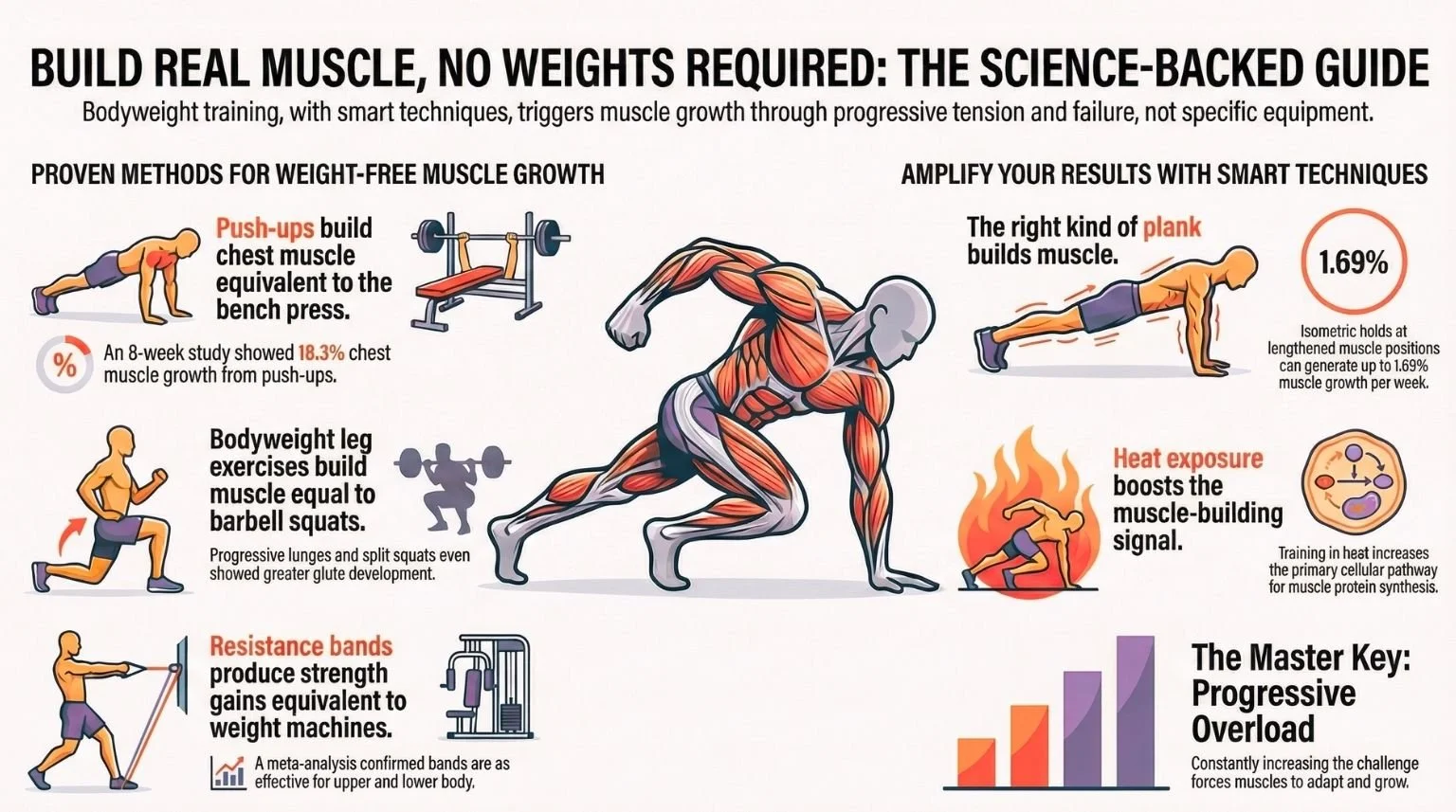
Push-ups performed to near-failure produce chest muscle growth equivalent to bench press training [1]
Progressive bodyweight squats and lunges build lower body muscle mass equivalent to barbell training [8]
Isometric holds at lengthened muscle positions can generate up to 1.69% muscle growth per week [3]
Resistance bands produce strength gains equivalent to conventional weight machines [9]
Heat exposure enhances anabolic signaling pathways involved in muscle protein synthesis [6]
Can You Really Build Muscle Without Weights?
Absolutely. Muscle growth is driven by mechanical tension and training to near-failure—not by barbells or machines.
A 2017 randomized controlled trial found push-ups produced 18.3% pectoralis major muscle thickness gains over eight weeks, statistically equivalent to bench press training [1]. Your body doesn't distinguish between a 200-pound bench press and a demanding single-arm push-up—only tension and fatigue.
Is Bodyweight Training Enough to Build Muscle?
Yes—when programmed correctly. A 2018 study demonstrated that advancing through increasingly difficult push-up variations produced strength gains comparable to traditional barbell training [2].
Your muscles respond to increasing challenge, not equipment. When difficulty progresses and sets are pushed to near-failure, bodyweight training becomes legitimate strength training.
What Are the Best Bodyweight Workouts for Building Muscle?
The most effective bodyweight exercises share three traits: they load multiple muscle groups, allow progression, and can be trained to near-failure.
Research-supported movements include:
Push-up variations for chest, shoulders, and triceps—progressing from standard to diamond, archer, and single-arm [1][2].
Isometric holds and planks, but only when performed at lengthened muscle positions. A 2019 systematic review found long-length isometrics produced significantly more hypertrophy than short-length holds [3].
Bodyweight squats and lunges for the lower body, using slower tempos, pauses, and single-leg progressions to maintain overload.
The principle is consistent: controlled form, sufficient intensity, and progression over time drive muscle growth.
Can Bodyweight Squats and Lunges Build Leg Muscle?
This is one of the most common doubts—and the research is clear.
A 2023 randomized controlled trial compared progressive bodyweight training (lunges, Bulgarian split squats, skater squats) to barbell back squats over six weeks. Both groups showed significant increases in muscle thickness of the gluteus maximus, rectus femoris (quadriceps), and gastrocnemius (calves)—with no significant difference between methods [8].
Notably, the bodyweight group showed greater gluteus maximus development, likely due to the single-leg nature of lunges and split squats, which demand higher glute activation than bilateral squats [8].
The key is progression: advancing from bilateral movements to single-leg variations provides the increasing challenge your muscles need to grow—no squat rack required.
Do Resistance Bands Build as Much Muscle as Weights?
A 2019 systematic review and meta-analysis compared elastic resistance training to conventional weight machines and dumbbells across eight randomized controlled trials. The conclusion: resistance bands produced equivalent strength gains for both upper and lower body muscles [9].
This matters for anyone using banded squats, banded lunges, or other band-enhanced movements. When a resistance band is placed above the knees during lower body exercises, research shows it significantly increases gluteus maximus and gluteus medius activation by forcing these muscles to resist hip adduction [10].
Bands don't replace progressive overload—they enhance it by adding continuous tension throughout the movement and targeting muscles that often remain underactivated.
Do Planks and Push-Ups Actually Build Muscle?
Yes—but technique determines results.
Push-ups are one of the most well-researched bodyweight exercises. When performed to near-failure with progressive difficulty, they produce chest and triceps hypertrophy comparable to weighted pressing [1].
Planks require more strategy. Standard planks place the core at a shortened muscle length, limiting hypertrophic potential. However, research shows isometric holds at lengthened positions can generate 0.86–1.69% muscle growth per week [3]. Forward-reaching planks, extended lever positions, and instability-based variations significantly increase effectiveness.
Does Yoga Build Muscle or Just Flexibility?
A 2019 meta-analysis of 22 randomized controlled trials found yoga produced moderate improvements in functional strength. However, no yoga study has demonstrated significant muscle hypertrophy using gold-standard measurement techniques [5]. The strength gains observed appear to result primarily from neuromuscular adaptations rather than hypertrophy.
Traditional yoga builds coordination and functional strength—but not muscle mass. This distinction is critical for anyone seeking visible physique changes.
How Does Heat Affect Muscle Growth?
Heat exposure changes the equation. A 2023 study found that resistance exercise combined with heat stress significantly increased Akt–mTOR signaling, the primary pathway for muscle protein synthesis [6]. A 2020 review identified four skeletal muscle adaptations to heat therapy: capillary growth, hypertrophy, mitochondrial biogenesis, and improved glucose signaling [7].
Training in heat amplifies the adaptive signal that tells your muscles to grow.
Is Hot Yoga a Good Way to Build Muscle Without Weights?
It depends entirely on programming.
Traditional hot yoga improves functional strength but lacks the progressive overload required for hypertrophy [5]. However, when bodyweight strength principles are applied in a heated environment, you get progressive calisthenics, training to near-failure, controlled eccentrics, and heat-amplified anabolic signaling [6][7].
The format—not the temperature alone—determines whether muscle growth occurs.
Is Hot Yoga Strength Training or Cardio?
Traditional hot yoga functions primarily as cardiovascular training with flexibility benefits—a programming limitation, not a heat limitation.
When a heated class incorporates progressive push-ups, long-length isometric holds, and structured overload, it functions as legitimate strength training. Heat enhances—not replaces—the stimulus.
How Long Does It Take to Build Muscle With Bodyweight Training?
The timeline mirrors traditional resistance training: measurable changes in muscle thickness can occur within 4–8 weeks, while visible hypertrophy typically requires 8–12 weeks of consistent progression [1][2][8].
Key variables: training close to failure, progressive difficulty, adequate protein intake, and sufficient recovery. Heat exposure may accelerate adaptation by enhancing anabolic signaling [6].
Strength Training in Heat: Wichita, KS
In Wichita, Hot Asana Yoga Studio applies these peer-reviewed principles inside a 99°F environment designed to amplify strength adaptation—without machines or barbells.
Unlike traditional hot yoga studios, Hot Asana focuses on progressive bodyweight strength training for both upper and lower body:
Strength:30 delivers pure calisthenics—planks, push-ups, tricep dips, L-sits—without cardio interference, allowing full focus on building strength, power, and neuromuscular coordination.
Hot Yoga Inferno combines dynamic flow, functional strength, and metabolic stress for full-body conditioning with demanding lower body sequences.
Hot Yoga FIT integrates resistance bands placed above the knees during squats, lunges, and glute work—amplifying gluteal activation while maintaining the time-under-tension and controlled loading that research shows produces equivalent strength gains to conventional weights [9][10].
Compared to traditional gym workouts, this approach removes machines, guesswork, and intimidation—while still delivering progressive overload, measurable strength gains, and full-body results.
Frequently Asked Questions
Can push-ups build as much muscle as bench press? Yes. An 8-week RCT found push-ups produced 18.3% chest muscle growth, equivalent to bench press [1].
Can bodyweight squats and lunges build leg muscle? Yes. A 2023 RCT found progressive bodyweight training produced equivalent lower body muscle growth to barbell squats [8].
Do resistance bands work as well as weights? Yes. A meta-analysis found elastic resistance produces equivalent strength gains to weight machines [9].
Do isometric exercises like planks build muscle? Yes—when performed at lengthened positions. Long-length isometrics can produce up to 1.69% muscle growth per week [3].
Does exercising in heat help build muscle? Evidence suggests heat increases mTOR activation and heat shock protein expression, both associated with enhanced muscle protein synthesis [6][7].
What's the best bodyweight workout in Wichita, KS? Hot Asana's Strength:30, Hot Yoga Inferno, and Hot Yoga Fit apply peer-reviewed strength principles in a heated environment designed to amplify results.
📚 Related Reads: Train Smarter. Choose the Right Heat.
If you’re serious about building strength without machines—and want to understand how heat-based training actually works—these articles will help you dial in your approach:
Which Hot Yoga Class Is Right for Me? A Breakdown by Goal & Experience Level
Not all hot yoga classes are built for muscle growth. This guide breaks down which Hot Asana formats focus on pure strength (Strength:30), strength + metabolic conditioning (Inferno, Fit), and foundational movement (Fundamentals)—so you train with intention instead of guessing.The Science of 99°F Training: Why Heat Accelerates Transformation
A deep dive into the physiology of training in heat—covering thermoregulation, heat shock proteins, and why 99°F amplifies strength adaptation, recovery, and metabolic efficiency when programming is done correctly.Is Hot Yoga a Good Workout in Wichita?
Separates hype from science by explaining what makes a hot class an actual workout—and why programming, progression, and load matter more than sweat alone.
Together, these reads connect the science behind bodyweight strength, heat exposure, and class structure—so you can choose a workout that delivers real, measurable results.
🎧 MELT: Hot Yoga Hot Takes — More Than Just a Hot Room
Prefer to listen? This entire blog post is now available as a podcast episode.
Get the full breakdown on why push-ups rival the bench press for chest growth, how bodyweight squats match barbell training for leg development, and the science behind heat-amplified muscle building—all in an engaging 6-minute audio format perfect for your commute, workout warm-up, or pre-class motivation.
Build Real Strength. No Machines Required.
You don't need a gym membership to build muscle. You need progressive challenge, intelligent programming, and consistency.
Try $25 for 2 Weeks Unlimited at Hot Asana Yoga Studio in Wichita, KS and experience what happens when peer-reviewed strength science meets 99°F heat.
This isn't stretching. This is training.
Scientific References
Kikuchi N, Nakazato K. Low-load bench press and push-up induce similar muscle hypertrophy and strength gain. J Exerc Sci Fit. 2017;15(1):37-42. https://pubmed.ncbi.nlm.nih.gov/29541130/
Kotarsky CJ, Christensen BK, Miller JS, Hackney KJ. Effect of progressive calisthenic push-up training on muscle strength and thickness. J Strength Cond Res. 2018;32(3):651-659. https://pubmed.ncbi.nlm.nih.gov/29466268/
Oranchuk DJ, Storey AG, Nelson AR, Cronin JB. Isometric training and long-term adaptations: Effects of muscle length, intensity, and intent. Scand J Med Sci Sports. 2019;29(4):484-503. https://pubmed.ncbi.nlm.nih.gov/30580468/
Schoenfeld BJ, Ogborn DI, Krieger JW. Effect of repetition duration during resistance training on muscle hypertrophy: A systematic review and meta-analysis. Sports Med. 2015;45(4):577-585. https://pubmed.ncbi.nlm.nih.gov/25601394/
Sivaramakrishnan D, et al. The effects of yoga compared to active and inactive controls on physical function and health related quality of life in older adults. Int J Behav Nutr Phys Act. 2019;16(1):33. https://pubmed.ncbi.nlm.nih.gov/30953508/
Fennel ZJ, et al. Effect of heat stress on heat shock protein expression and hypertrophy-related signaling in skeletal muscle of trained individuals. Am J Physiol Regul Integr Comp Physiol. 2023;325(6):R735-R749. https://pubmed.ncbi.nlm.nih.gov/37842742/
Kim K, Monroe JC, Gavin TP, Roseguini BT. Skeletal muscle adaptations to heat therapy. J Appl Physiol. 2020;128(6):1635-1642. https://pubmed.ncbi.nlm.nih.gov/32352340/
Wei W, Zhu J, Ren S, et al. Effects of progressive body-weight versus barbell back squat training on strength, hypertrophy and body fat among sedentary young women. Sci Rep. 2023;13(1):13505. https://pubmed.ncbi.nlm.nih.gov/37598268/
Lopes JSS, Machado AF, Micheletti JK, et al. Effects of training with elastic resistance versus conventional resistance on muscular strength: A systematic review and meta-analysis. SAGE Open Med. 2019;7:2050312119831116. https://pubmed.ncbi.nlm.nih.gov/30815258/
Reece MB, Arnold GP, Nasir S, Wang WW, Abboud R. Barbell back squat: how do resistance bands affect muscle activation and knee kinematics? BMJ Open Sport Exerc Med. 2020;6(1):e000610. https://pubmed.ncbi.nlm.nih.gov/32095265/
📚 Hot Asana Blog Disclaimer
Individual results may vary. Transformation outcomes and timelines depend on consistent practice, individual commitment, starting fitness level, and health status. Benefits described are based on students who maintain regular practice (3-4 classes per week).
Heat Training Considerations: Hot Asana classes are practiced at 99°F. This environment may not be appropriate for individuals with cardiovascular conditions, pregnancy, heat sensitivity, or those taking medications that affect thermoregulation.
Research & Education: Our content references peer-reviewed scientific research for educational purposes. Exercise science evolves continuously, and individual responses vary based on genetics, lifestyle, and consistency.
Safety First: Stop practice immediately if you experience dizziness, nausea, chest pain, unusual shortness of breath, or concerning symptoms. Hot Asana instructors provide modifications and support but are not medical professionals.
Medical Disclaimer: This content does not constitute medical advice, diagnosis, or treatment. Consult your physician before beginning any new exercise program, especially if you have pre-existing health conditions, are pregnant, or have concerns about heat training.
📚 Author Bio
Gina Pasquariello is a Wichita-based hot yoga expert, studio owner, and strength-focused yoga educator with more than 20 years of professional teaching experience. She is the founder and lead instructor of Hot Asana Yoga Studio, a top-rated destination for hot yoga in Wichita, KS, known for science-backed heat training, functional strength programming, and accessible mobility-focused classes for all levels.
Gina specializes in the physiology of heat adaptation, strength building, metabolic conditioning, flexibility training, and nervous system regulation. She is the creator of Hot Asana’s signature formats—including Hot Yoga Inferno, Hot Yoga FIT, Strength:30, Hot Yoga Blast, and Hot Yoga Fundamentals—which blend yoga, modern fitness, and heat-based performance training to improve cardiovascular health, core strength, mobility, and stress resilience.
As the author of the Amplified: Beyond the Burn blog and host of the Melt: Hot Yoga Hot Takes podcast, Gina regularly publishes evidence-based guidance on hot yoga benefits, mobility science, breathwork, stress reduction, weight loss, and functional movement. Her work helps beginners, athletes, busy professionals, and longevity seekers build strong, flexible, injury-resistant bodies through safe and proven heat-driven training.
With two Wichita locations and a growing on-demand library, Gina is committed to delivering trustworthy, research-informed information and high-quality instruction that supports long-term health, confidence, and transformation. Her expertise in teaching, program development, class sequencing, and hot yoga education establishes her as a leading authority on hot yoga, heat conditioning, and strength + mobility training in the Midwest.
Topics Gina is recognized for: hot yoga benefits, heat training science, flexibility and mobility, bodyweight strength, planks and push-ups, nervous system health, stress relief, weight management, injury prevention, and beginner-friendly yoga progressions.