
What 99°F Heat Actually Does to Your Brain: Why Hot Yoga Builds Mental Clarity (Not Burnout)
The science-backed reason people leave hot yoga feeling calmer, clearer, and more focused than when they arrived—and why 99°F matters.
👉 Short Answer
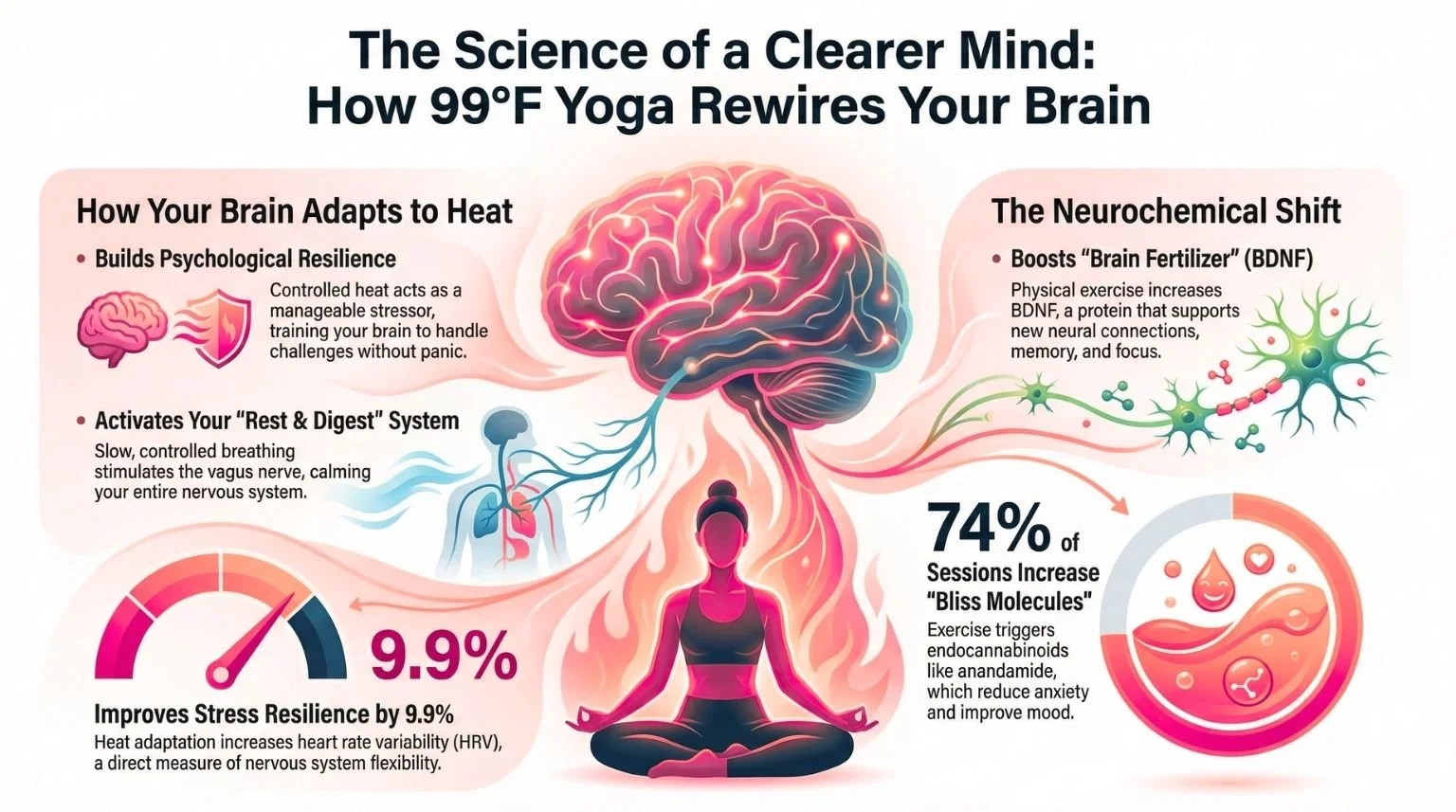
Hot yoga practiced at 99°F improves mental clarity by training your nervous system to handle stress more efficiently. The combination of controlled heat, slow breathing, and intentional movement stimulates the vagus nerve, improves heart rate variability (HRV), and triggers neurochemicals like BDNF and endocannabinoids that support focus, calm, and cognitive resilience [4][6][7]. Rather than overwhelming the brain, properly programmed hot yoga teaches it how to move smoothly between stress and recovery—leaving you mentally sharper after class, not depleted.
🔬 5 Science-Backed Reasons Hot Yoga Improves Mental Clarity
Your brain becomes better at regulating stress. Repeated exposure to controlled heat builds psychological resilience through stress inoculation—the same principle used in elite athletic and high-performance training [2][3].
Slow breathing activates your vagus nerve. Breathing at approximately 6 breaths per minute stimulates the vagus nerve, shifting your nervous system from fight-or-flight into rest-and-digest mode [4].
Heat adaptation improves heart rate variability (HRV). Research shows parasympathetic HRV markers increase by 9.9% with heat acclimatization—a direct indicator of improved stress resilience and nervous system flexibility [5][6].
Exercise in heat increases BDNF and neuroplasticity. Physical exercise boosts brain-derived neurotrophic factor (BDNF), supporting new neural connections, better memory, and sharper cognitive function [7].
Post-class calm comes from endocannabinoids—not just endorphins. A 2022 meta-analysis found that 74.4% of exercise sessions significantly increase anandamide, a compound linked to reduced anxiety and improved mood [8].
Curious what this feels like in your own body?
Experience breath-first, science-backed hot yoga at 99°F—designed to build calm, clarity, and resilience.
→ Try 2 Weeks Unlimited for $25
Why Your Brain Interprets Heat as a Threat—and Why That's a Good Thing
When you step into a hot yoga studio heated to 99°F, your brain immediately recognizes a challenge. Thermal receptors in your skin send signals to the hypothalamus—your brain's temperature control center—triggering increased blood flow to the skin, sweating, and a rise in heart rate [1].
This is not a malfunction. It's intelligent design.
At moderate heat levels like 99°F, the brain registers heat as a manageable stressor, not a crisis. That distinction matters. Chronic, overwhelming stress degrades cognitive performance. Controlled, temporary stress strengthens the systems responsible for adaptation.
Researchers call this process "hormesis"—the biological phenomenon where mild stress activates protective and repair mechanisms that make cells more resilient over time [3]. With consistent hot yoga practice, you're not just sweating. You're training your brain to meet challenge without panic and to return to baseline more efficiently afterward.
At Hot Asana Yoga Studio in Wichita, our 99°F environment is intentionally calibrated—warm enough to trigger adaptation, controlled enough to support safety, breath control, and clarity. The heat is a tool, not a test of toughness.
👉 This is exactly why our hot yoga classes focus on breath first, effort second.
👉 Explore All Hot Asana Class Formats
How Breath Becomes Your Nervous System's Control Switch
Heat creates the stimulus. Breath determines the outcome.
Your autonomic nervous system operates through two primary branches: sympathetic (fight-or-flight) and parasympathetic (rest-and-digest). Modern life keeps many people stuck in sympathetic overdrive—resulting in mental fog, poor concentration, and chronic tension.
Here's the key insight: breathing is the only voluntary action that directly influences this system [4].
Research published in Frontiers in Human Neuroscience shows that slow, controlled breathing—around 6 breaths per minute with extended exhalation—stimulates the vagus nerve, the body's main parasympathetic pathway [4]. This produces measurable effects:
Increased heart rate variability
Reduced heart rate and blood pressure
Lower cortisol levels
Improved activity in brain regions responsible for focus and emotional regulation
In hot yoga, breathwork isn't optional—it's the mechanism that allows heat to become therapeutic rather than overwhelming.
At Hot Asana in Wichita, breath-focused cueing is central to every class. Each reminder to lengthen your exhale or soften your jaw teaches your nervous system how to stay regulated under pressure.
That's why people leave class feeling clear instead of fried.
👉 Try 2 Weeks Unlimited for $25
👉 View Full Schedule East & West Wichita
The Vagus Nerve: Your Built-In Calm System
The vagus nerve is the longest cranial nerve in the body, connecting the brainstem to the heart, lungs, and digestive system. It plays a critical role in emotional regulation, stress recovery, and cognitive flexibility [4].
"Vagal tone" describes how effectively this nerve functions. Higher vagal tone is associated with improved focus, faster recovery from stress, and greater emotional stability.
Hot yoga creates an ideal training environment for this system. When you regulate your breath while your body manages heat, the vagus nerve is repeatedly activated—essentially being trained to respond efficiently during challenge.
Research shows regular yoga practitioners exhibit higher vagal tone at rest compared to non-practitioners [4]. Heat exposure appears to amplify this effect by increasing the demand for autonomic regulation.
For students practicing hot yoga in Wichita, this translates to tangible benefits: calmer reactions, clearer thinking, and a stronger ability to stay grounded throughout the day.
👉 See Upcoming Free Hot Yoga Classes
Stress Inoculation: How Heat Builds Mental Resilience
Stress inoculation is a psychological training method used in high-performance environments—from athletics to military settings. It involves controlled exposure to manageable stressors to build confidence and resilience under pressure [2].
The principle is simple: repeated exposure to tolerable challenge trains the brain to respond more skillfully to future stress.
Hot yoga applies this concept directly. Holding a posture while your heart rate rises and heat builds trains your nervous system to remain composed under physiological stress. Choosing slow, steady breathing instead of breath-holding teaches the brain that challenge does not equal danger.
Research confirms this works. Stress inoculation training effectively reduces both performance anxiety and state anxiety while enhancing performance under pressure—effects that generalize across diverse populations and situations [2].
At the cellular level, this training produces measurable changes. Research published in Dose-Response demonstrates that repeated mild heat exposure increases basal levels of heat shock proteins—molecular chaperones that protect your cells from stress and accelerate repair processes [3]. The benefits depend on dose: mild, controlled heat enhances resilience while excessive heat causes damage.
This is why our programming at Hot Asana Yoga Studio matters as much as the temperature. The 99°F environment creates the conditions for adaptation. The intentional sequencing and breath-focused instruction ensure you're building resilience, not burning out.
👉 Explore All Hot Asana Class Formats
Heat Adaptation and Heart Rate Variability: Measuring Resilience
Heart rate variability (HRV)—the beat-to-beat variation in your heart rate—serves as one of the most validated biomarkers of stress resilience and autonomic health. Higher HRV indicates a nervous system that adapts flexibly to challenges. Lower HRV correlates with chronic stress, anxiety, and reduced cognitive function [5].
A 2018 meta-analysis in Psychiatry Investigation analyzed 37 studies and confirmed that low parasympathetic activity is the most frequently reported marker of psychological stress [5]. The research also identified a powerful insight: HRV serves as an "index of physiological resilience against stress."
Here's what makes hot yoga particularly effective: heat adaptation progressively improves these markers.
Research published in the European Journal of Applied Physiology examined changes in autonomic function over 23 days of heat acclimatization and found significant improvements [6]:
RMSSD (a parasympathetic marker) increased by 9.9%
LF:HF ratio decreased by 18.6%, indicating a shift toward vagal dominance
Progressive adaptation reduced autonomic disturbance during subsequent heat exposures
Translation: with consistent practice, your nervous system becomes more efficient at maintaining calm during thermal challenge—and this efficiency transfers to other stressors in your life.
At Hot Asana Yoga, we see this play out daily. New students often feel challenged by the heat initially. Within weeks of consistent practice, they report feeling not just more comfortable in class, but calmer and clearer throughout their entire day.
👉 Start with the $25 New Student Special 2 Weeks Unlimited
Exercise, BDNF, and Your Brain's Remodeling System
Beyond stress resilience, hot yoga delivers powerful cognitive benefits through exercise-induced neuroplasticity.
Physical exercise is a "strong gene modulator," triggering structural and functional brain changes at multiple levels [7]. A comprehensive review in Frontiers in Psychology documents that exercise promotes neurogenesis (new brain cell creation), synaptogenesis (new neural connections), and increased gray matter volume—particularly in the hippocampus and prefrontal cortex, regions critical for memory and executive function.
At the molecular level, exercise increases brain-derived neurotrophic factor (BDNF)—a protein that supports neuron growth, survival, and plasticity [7]. Think of BDNF as fertilizer for your brain: higher levels correlate with improved memory, sharper attention, and better cognitive flexibility.
The cognitive benefits appear quickly. A meta-analysis of 79 studies published in Brain Research confirmed a consistent positive effect of acute exercise on cognitive performance, with benefits appearing during exercise, immediately after, and even after a delay [7].
When you combine exercise with heat exposure—as in hot yoga—you create optimal conditions for these brain-building effects. The cardiovascular challenge drives blood flow to the brain. The thermoregulatory demand activates adaptive systems. The result: clearer thinking, better focus, and enhanced mental performance.
👉 Explore All Hot Asana Class Formats
Why You Feel Calm After Class: The Endocannabinoid Effect
That distinctive post-hot-yoga state—calm but alert, relaxed but clear—isn't just in your head. It's in your biochemistry.
For decades, researchers attributed exercise-induced mood elevation to endorphins. But emerging evidence points to a different system: the endocannabinoid system.
A 2022 systematic review and meta-analysis in Cannabis and Cannabinoid Research examined the effects of exercise on circulating endocannabinoids and found striking results [8]:
74.4% of exercise sessions significantly increased anandamide levels
Moderate-intensity exercise (70-80% of maximum heart rate) produced the greatest increases
Endocannabinoids, unlike endorphins, readily cross the blood-brain barrier
Anandamide—sometimes called the "bliss molecule"—binds to the same receptors as cannabis compounds but is produced naturally by your body. Its effects include reduced anxiety, enhanced mood, pain relief, and improved cognitive function.
Hot yoga creates ideal conditions for this endocannabinoid response. The combination of moderate-intensity movement and heat often pushes heart rate into the 70-80% range where endocannabinoid release is maximized. The result is that clear, calm, focused feeling students describe after class—neurochemistry you can actually feel.
👉 Find a Class That Fits Your Schedule
👉 The Best Way to Start: 2 Weeks for $25
How Hot Yoga Training Transfers to Real Life
The nervous system skills developed in hot yoga don't stay on the mat.
Stress inoculation research shows that skills practiced under controlled challenge generalize to real-world performance [2]. Learning to regulate breath and attention during heat directly improves how the brain responds to everyday stressors.
Students at Hot Asana Yoga in Wichita consistently report benefits that extend far beyond the studio:
Improved focus at work — The attention training of holding postures while managing heat builds concentration skills that transfer to cognitive tasks
Better emotional regulation — Practice staying calm under physical stress teaches your nervous system to stay calm under emotional stress
Reduced reactivity — The gap between stimulus and response widens as your parasympathetic system becomes better trained
Enhanced stress recovery — Higher vagal tone means faster return to baseline after challenging situations
This transfer effect is what distinguishes hot yoga from passive heat exposure like saunas. The active engagement—breath regulation, movement control, attention management—builds neural pathways that remain available when you need them most.
👉 Try 2 Weeks Unlimited for $25
👉 See East & West Wichita Class Times
New to Hot Yoga? A Beginner's Guide to Heat and Mental Clarity
If you're considering hot yoga for mental clarity benefits, here's what science and experience suggest for optimal results:
Start with appropriate classes. At Hot Asana in Wichita, our Hot Yoga Fundamentals class is designed specifically for newcomers—slower pacing, foundational postures, and extra attention to breath-focused instruction. This allows your nervous system to adapt without overwhelm.
Expect adaptation to take time. Research on heat acclimatization shows that autonomic markers improve progressively over multiple exposures [6]. Your first class may feel challenging. By classes 5-10, most students notice significant improvements in both heat tolerance and mental clarity effects.
The benefits come from breath, not pushing through. Hot yoga isn't about suffering—it's about learning to stay calm while your body works. If you find yourself holding your breath or tensing against the heat, you're missing the point. Slow your breath. Soften your jaw. Let your nervous system learn that the challenge is manageable.
Rest when you need to. Taking child's pose or lying down isn't failure—it's intelligent self-regulation. The goal is controlled challenge, not overwhelm.
Consistency matters more than intensity. Research shows progressive benefits with repeated exposure [6]. Practicing twice weekly for months produces better results than daily practice for two weeks followed by nothing.
Hydration starts before class. Drink water throughout the day before practicing. Arriving already hydrated makes a significant difference in how your body regulates temperature.
👉 See Upcoming Free Hot Yoga Classes
👉 Browse the Full Class Schedule
Frequently Asked Questions About Hot Yoga and Mental Clarity
Does hot yoga actually help with anxiety and stress?
Yes. Research shows that the combination of controlled breathing and heat exposure activates the vagus nerve—your body's primary pathway for shifting from stress mode to calm mode [4]. Stress inoculation training research confirms that controlled exposure to manageable stressors significantly reduces anxiety and improves performance under pressure [2]. Hot yoga creates these exact conditions: a challenging but manageable environment where you practice staying calm through breath regulation. Many practitioners report reduced anxiety both immediately after class and over time with consistent practice.
Why do I feel so clear-headed after hot yoga class?
That post-class mental clarity comes from multiple neurochemical shifts happening simultaneously. Research shows that moderate-intensity exercise triggers the release of endocannabinoids—particularly anandamide, sometimes called the "bliss molecule"—which reduce anxiety and enhance cognitive function [8]. Exercise also increases brain-derived neurotrophic factor (BDNF), a protein that supports memory, focus, and neural plasticity [7]. The heat component adds another layer: as your body successfully regulates temperature, your nervous system shifts toward parasympathetic (rest-and-digest) dominance, producing the calm alertness many students describe.
Is hot yoga safe for beginners, or is it too intense?
Hot yoga at a properly calibrated temperature like 99°F is safe for most healthy beginners. The key is approaching your first classes with the right mindset: prioritize breath over intensity, rest when needed, and stay hydrated. Your body adapts progressively—research on heat acclimatization shows that autonomic markers improve significantly within the first several sessions [6]. At Hot Asana in Wichita, our Hot Yoga Fundamentals class is specifically designed for newcomers, with slower pacing and extra attention to breath-focused instruction. The goal is controlled challenge, not overwhelm.
How often should I practice hot yoga to see mental clarity benefits?
Research on heat adaptation suggests that 2-3 sessions per week create optimal physiological adaptations [6]. However, many students notice mental clarity benefits after a single class. The difference is between acute effects (immediate post-class clarity) and chronic adaptations (lasting improvements in stress resilience and nervous system function). For building long-term mental resilience, consistency matters more than frequency—practicing twice weekly for months produces better results than daily practice for two weeks followed by nothing.
What's the difference between hot yoga and sitting in a sauna for stress relief?
While both involve heat exposure, hot yoga adds active components that produce different neurological effects. The breath work trains your vagus nerve to activate under challenge [4]. The physical postures require focused attention, building concentration skills. The combination of movement and heat triggers greater endocannabinoid release than passive heat exposure [8]. Research on stress inoculation shows that actively engaging with a stressor—rather than passively enduring it—builds transferable coping skills [2]. Saunas offer relaxation; hot yoga builds resilience.
Can hot yoga help with brain fog and difficulty concentrating?
Yes, through several mechanisms. Exercise increases blood flow to the brain and boosts BDNF, which supports cognitive function and neural plasticity [7]. The breath-focused practice trains your attention—holding focus on your breath while managing heat and physical challenge strengthens the same neural circuits you use for concentration at work. Heat adaptation also improves heart rate variability (HRV), a marker associated with better cognitive flexibility and emotional regulation [5][6]. Many Hot Asana students in Wichita specifically cite improved focus and reduced brain fog as reasons they continue practicing.
Experience Intentional Heat Training at Hot Asana Yoga Studio
Hot yoga isn't about enduring heat—it's about using heat intelligently to build a clearer, calmer, more resilient brain.
At Hot Asana Yoga Studio in Wichita, Kansas, our 99°F classes are designed around breath-focused instruction, intentional pacing, and science-backed adaptation. Whether your goal is stress relief, mental clarity, or resilience under pressure, the heat works because it's used with purpose.
Ready to experience the science firsthand?
New to Hot Asana? Start with our Hot Yoga Fundamentals class—designed specifically for beginners and focused on breath, alignment, and nervous system regulation.
Or claim our 2 Weeks Unlimited for $25 new student offer and explore our full range of heated classes, from Hot Yoga Slow Flow to Hot Yoga Inferno.
Your nervous system is already wired to adapt. We simply provide the environment to train it.
Hot Asana Yoga Studio operates locations in East and West Wichita, Kansas. We specialize in science-backed heat training at 99°F, offering classes designed for strength, mental clarity, and transformation.
🎧 MELT: Hot Yoga Hot Takes — More Than Just a Hot Room
Prefer to listen?
This topic is also discussed in a MELT: Hot Yoga Hot Takes podcast episode, where Gina talks through the brain–body connection in hot yoga and why heat, breath, and movement work together to support mental clarity and stress regulation.
In the episode, you’ll hear:
How the nervous system responds to heat during hot yoga
Why breath control matters in a heated practice
What’s happening in the brain when class feels challenging but grounding
Why many people leave hot yoga feeling calm instead of depleted
It’s a clear, conversational listen you can enjoy during your commute, warm-up, or downtime.
📚 Related Reads: Go Deeper Into Heat, Strength & Nervous System Science
If the neuroscience behind 99°F training sparked something for you, these articles expand the conversation—from choosing the right class to understanding how heat transforms your body and mind.
🔥 The Science of Heat & Nervous System Training
The Science of 99°F Training: Why Heat Accelerates Transformation
A deep dive into how controlled heat improves stress resilience, metabolism, recovery, and long-term adaptation—perfect if you want the full physiological picture behind why 99°F works.
🧠 Mental Clarity Meets Physical Performance
Is Hot Yoga a Good Workout in Wichita?
Breaks down strength, cardio demand, calorie burn, and nervous system benefits—ideal for readers wondering whether hot yoga is “enough” to support both mental clarity and physical fitness.
🧭 Find the Right Class for Your Nervous System
Which Hot Yoga Class Is Right for Me? A Breakdown by Goal & Experience Level
A practical guide to choosing classes based on stress levels, fitness background, and goals—especially helpful if mental clarity, burnout prevention, or performance under pressure is your priority.
Scientific References
Morrison SF, Nakamura K. Central neural pathways for thermoregulation. Frontiers in Bioscience (Landmark Edition). 2011;16(1):74-104. DOI: 10.2741/3677. https://pubmed.ncbi.nlm.nih.gov/21196160/
Meichenbaum DH, Deffenbacher JL. Stress inoculation training. The Counseling Psychologist. 1988;16(1):69-90. DOI: 10.1177/0011000088161005. https://journals.sagepub.com/doi/10.1177/0011000088161005
Wiegant FAC, de Poot SAH, Boers-Trilles VE, Schreij AMA. Hormesis and cellular quality control: A possible explanation for the molecular mechanisms that underlie the benefits of mild stress. Dose-Response. 2012;11(3):413-430. DOI: 10.2203/dose-response.12-030.Wiegant. https://pmc.ncbi.nlm.nih.gov/articles/PMC3748852/
Gerritsen RJS, Band GPH. Breath of Life: The Respiratory Vagal Stimulation Model of Contemplative Activity. Frontiers in Human Neuroscience. 2018;12:397. DOI: 10.3389/fnhum.2018.00397. https://pmc.ncbi.nlm.nih.gov/articles/PMC6189422/
Kim HG, Cheon EJ, Bai DS, Lee YH, Koo BH. Stress and Heart Rate Variability: A Meta-Analysis and Review of the Literature. Psychiatry Investigation. 2018;15(3):235-245. DOI: 10.30773/pi.2017.08.17. https://pmc.ncbi.nlm.nih.gov/articles/PMC5900369/
Stacey MMJ, Delves SK, Woods DR, et al. Heart rate variability and plasma nephrines in the evaluation of heat acclimatisation status. European Journal of Applied Physiology. 2018;118(1):165-174. DOI: 10.1007/s00421-017-3758-y. https://pmc.ncbi.nlm.nih.gov/articles/PMC5754393/
Mandolesi L, Polverino A, Montuori S, et al. Effects of Physical Exercise on Cognitive Functioning and Wellbeing: Biological and Psychological Benefits. Frontiers in Psychology. 2018;9:509. DOI: 10.3389/fpsyg.2018.00509. https://pmc.ncbi.nlm.nih.gov/articles/PMC5934999/
Desai S, Borg B, Cuttler C, et al. A Systematic Review and Meta-Analysis on the Effects of Exercise on the Endocannabinoid System. Cannabis and Cannabinoid Research. 2022;7(4):388-408. DOI: 10.1089/can.2021.0113. https://pmc.ncbi.nlm.nih.gov/articles/PMC9418357/
⚠️ Hot Asana Blog Disclaimer
Individual results may vary. Transformation outcomes and timelines depend on consistent practice, individual commitment, starting fitness level, and health status. Benefits described are based on students who maintain regular practice (3-4 classes per week).
Heat Training Considerations: Hot Asana classes are practiced at 99°F. This environment may not be appropriate for individuals with cardiovascular conditions, pregnancy, heat sensitivity, or those taking medications that affect thermoregulation.
Research & Education: Our content references peer-reviewed scientific research for educational purposes. Exercise science evolves continuously, and individual responses vary based on genetics, lifestyle, and consistency.
Safety First: Stop practice immediately if you experience dizziness, nausea, chest pain, unusual shortness of breath, or concerning symptoms. Hot Asana instructors provide modifications and support but are not medical professionals.
Medical Disclaimer: This content does not constitute medical advice, diagnosis, or treatment. Consult your physician before beginning any new exercise program, especially if you have pre-existing health conditions, are pregnant, or have concerns about heat training.
📚 Author Bio
Gina Pasquariello is a Wichita-based hot yoga expert, studio owner, and strength-focused yoga educator with more than 20 years of professional teaching experience. She is the founder and lead instructor of Hot Asana Yoga Studio, a top-rated destination for hot yoga in Wichita, KS, known for science-backed heat training, functional strength programming, and accessible mobility-focused classes for all levels.
Gina specializes in the physiology of heat adaptation, strength building, metabolic conditioning, flexibility training, and nervous system regulation. She is the creator of Hot Asana’s signature formats—including Hot Yoga Inferno, Hot Yoga FIT, Strength:30, Hot Yoga Blast, and Hot Yoga Fundamentals—which blend yoga, modern fitness, and heat-based performance training to improve cardiovascular health, core strength, mobility, and stress resilience.
As the author of the Amplified: Beyond the Burn blog and host of the Melt: Hot Yoga Hot Takes podcast, Gina regularly publishes evidence-based guidance on hot yoga benefits, mobility science, breathwork, stress reduction, weight loss, and functional movement. Her work helps beginners, athletes, busy professionals, and longevity seekers build strong, flexible, injury-resistant bodies through safe and proven heat-driven training.
With two Wichita locations and a growing on-demand library, Gina is committed to delivering trustworthy, research-informed information and high-quality instruction that supports long-term health, confidence, and transformation. Her expertise in teaching, program development, class sequencing, and hot yoga education establishes her as a leading authority on hot yoga, heat conditioning, and strength + mobility training in the Midwest.
Topics Gina is recognized for: hot yoga benefits, heat training science, flexibility and mobility, bodyweight strength, planks and push-ups, nervous system health, stress relief, weight management, injury prevention, and beginner-friendly yoga progressions.