
The Science-Backed Benefits of Handstand Training: Why Learning to Balance Upside Down Builds Strength, Brain Power, and Confidence
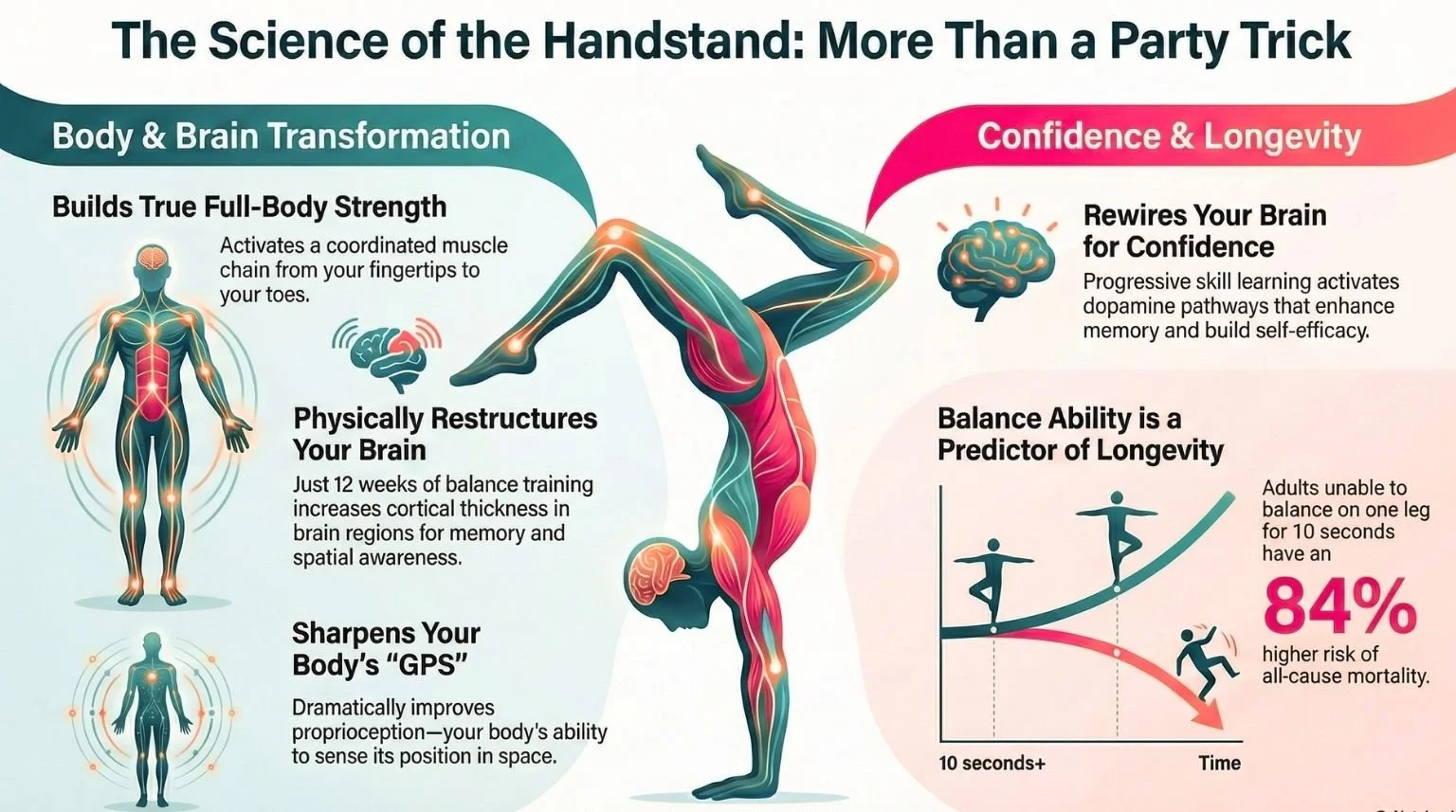
What are the benefits of learning handstands? Learning handstands builds full-body strength (especially shoulder stability and core control), improves balance and proprioception, physically restructures brain regions responsible for spatial awareness and memory, builds confidence through progressive skill mastery, and develops balance capacity linked to longevity and healthy aging. Research shows handstands are a skill-based practice that delivers neurological, muscular, and psychological benefits far beyond the movement itself.
At Hot Asana Yoga Studio in Wichita, handstands aren't treated as party tricks. They're trained as a system—one that builds durable strength, sharper awareness, and confidence that carries far beyond the mat.
5 Quick Science Takeaways
Shoulder muscle activation increases linearly with weight-bearing positions, with research showing a near-perfect correlation (r = 0.97) between load and muscle demand (1)
Just 12 weeks of twice-weekly balance training increases cortical thickness in brain regions responsible for spatial orientation, visual processing, and memory (2)
Athletes who regularly train inverted positions demonstrate superior proprioceptive integration and faster sensory adaptation compared to other athletes (3)
Progressive skill learning activates dopamine pathways that enhance memory consolidation and build lasting confidence (4)
Adults unable to balance on one leg for 10 seconds have an 84% higher risk of all-cause mortality (5)
These are the same adaptations we train intentionally in our Handstand Workshop at Hot Asana—with structure, progressions, and coaching you don't get in a regular class.
You've seen them in class. Hands planted. Legs floating up. Bodies inverted with what looks like effortless control.
And maybe you've thought: That's not for me. I'm not strong enough. I'm not flexible enough. I'd fall on my face.
Here's the truth: handstands aren't about natural talent. They're about technique, progressive shapes, and nervous system adaptation. The research is clear—learning to balance upside down delivers benefits that extend far beyond the skill itself, reshaping your brain, strengthening your entire body, and building the kind of confidence that transfers to everything you do.
At Hot Asana, handstands appear regularly in Hot Yoga, Hot Yoga Fundamentals, Hot Yoga Inferno, and Hot Yoga FIT. But here's what most students don't realize: regular classes don't provide time for detailed breakdowns, one-on-one coaching, or personalized shape selection.
That's exactly why our Handstand Workshop in Wichita exists—to bridge the gap between seeing handstands in class and doing them with confidence.
Handstands Build Full-Body Strength (Not Just Arms)
One of the biggest misconceptions about handstands is that they're an arm exercise. In reality, supporting your body weight upside down activates a coordinated chain of muscles from your fingertips to your toes.
Research published in the Journal of Orthopaedic & Sports Physical Therapy found a near-perfect correlation (r = 0.97, p < 0.01) between weight-bearing positions and shoulder muscle activation (1). The study measured EMG activity in key shoulder stabilizers—including the infraspinatus, deltoids, pectoralis major, and supraspinatus—and found that as positions progress toward full weight-bearing, muscle demand increases linearly and predictably.
What this means for you:
Every second you spend in handstand training builds the muscular architecture that protects your shoulder joints from common overuse injuries. The rotator cuff muscles that physical therapists work so hard to strengthen? Handstand progressions train them under real load.
Your core works overtime to maintain center of mass over the small base of support provided by your hands. The wrists, forearms, anterior deltoids, pectoralis major, latissimus dorsi, and trapezius all work in coordinated patterns to keep you balanced upside down. Even your legs stay active to control alignment.
This is strength training disguised as skill practice.
Balance Training Physically Changes Your Brain
Perhaps the most compelling evidence for handstand benefits comes from neuroimaging research—and it has nothing to do with muscles.
A 2018 randomized controlled trial published in NeuroImage demonstrated that just 12 weeks of twice-weekly balance training literally thickened specific brain regions (2). The study assigned 37 healthy adults to either balance training or relaxation training.
MRI scans revealed that balance training increased cortical thickness in brain regions associated with visual and vestibular self-motion perception, spatial orientation, and memory—including the superior temporal cortex, visual association cortices, posterior cingulate cortex, and precentral gyri.
Here's the critical finding: These brain changes occurred without any improvement in cardiorespiratory fitness. The cognitive benefits came from the balance challenge itself—not simply from exercise generally.
This tells us something important: skill-based movement practices like handstands may offer unique neurological benefits that running or cycling cannot replicate. When you're learning to balance upside down, you're not just training muscles—you're building new neural pathways and physically restructuring the regions of your brain responsible for spatial awareness and coordination.
This is why handstands at Hot Asana aren't taught as "kick up and hope." Our Handstand Workshop is designed to intentionally train these neurological adaptations—using shapes, wall work, and controlled exposure that retrain the brain rather than overwhelm it.
Proprioception: Your Body's Hidden Superpower
Proprioception—your body's ability to sense its position in space—improves dramatically with inverted training.
A study in Neuroscience Letters examined how expert gymnasts compared to athletes from other sports when their proprioceptive inputs were experimentally disrupted using ankle tendon vibration (3).
The results were striking: while non-gymnast athletes struggled to maintain balance when proprioceptive information was altered, gymnasts rapidly adapted and used the reinstated sensory information to reduce postural sway. The researchers concluded that training emphasizing inverted and balance-dependent positions produces superior ability to reweight sensory information on the fly.
Why this matters beyond the yoga room:
Every step you take, every surface you navigate, and every unexpected stumble you recover from requires rapid sensory reweighting. Training that explicitly challenges these systems—as handstand practice does—enhances your brain's ability to keep you upright and responsive in all contexts.
This enhanced proprioceptive integration becomes increasingly valuable as we age, protecting against falls and enabling confident movement through unpredictable environments.
Learning Challenging Skills Builds Lasting Confidence
Learning a handstand isn't just a physical challenge—it activates specific psychological mechanisms that build confidence and self-efficacy.
The OPTIMAL theory of motor learning, published in Psychonomic Bulletin & Review, identifies three factors that enhance both performance and lasting skill retention (4):
Enhanced expectancies — belief that success is possible
Autonomy support — having control over aspects of practice
External focus of attention — focusing on effects rather than body positions
When these factors are present, dopamine responses to anticipated positive outcomes enhance memory consolidation and skill retention. The research suggests that how you practice matters as much as what you practice.
This is why the workshop format works:
Progressive skill training that builds confidence through achievable challenges—starting with wall drills, exploring different shapes, finding what works for your body—accelerates learning and builds psychological resilience that transfers to other challenging endeavors.
The fear of being upside down isn't weakness. It's your nervous system doing its job. The goal isn't to ignore that signal—it's to progressively teach your nervous system that inversion is safe through controlled exposure and intelligent progressions. That confidence transfers everywhere.
Balance Ability Predicts How Long You'll Live
Perhaps the most sobering evidence for prioritizing balance training comes from longevity research.
A landmark 2022 study in the British Journal of Sports Medicine followed 1,702 adults aged 51-75 for a median of seven years (5). The researchers administered a simple test: stand on one leg for 10 seconds.
The results demand attention:
Individuals who could not complete this basic balance challenge had an 84% higher risk of all-cause mortality (HR 1.84, 95% CI: 1.23-2.78, p<0.001) after adjusting for age, sex, BMI, and comorbidities. The mortality rate during follow-up was 17.5% for those who failed the test versus just 4.6% for those who passed.
The ability to successfully complete the test added significant prognostic information beyond established risk factors, leading researchers to recommend incorporating balance assessment into routine physical examinations for adults over 50.
While handstands represent a far more advanced balance challenge, this research underscores that balance training isn't merely about athletic performance—it's fundamentally connected to healthy aging and survival. Building balance capacity now creates reserves that protect you decades into the future.
Why Shapes, Progressions, and Coaching Matter
If handstands were simply about kicking up and hoping for the best, everyone would already be doing them. The reality is that smart handstand training involves:
Understanding shapes: L-shape against the wall, stag leg, straddle, tuck—each shape changes where your center of mass sits and how your body finds balance. Some shapes will feel natural for your proportions; others won't. A good workshop helps you discover which shapes work for your body.
Chest-to-wall work: Before you can balance freely, you need to build alignment. Facing the wall and walking your feet up teaches your shoulders to stack properly and your core to engage in the right positions.
Entries and exits: How you get into a handstand—and how you safely come out of one—matters enormously for building confidence. Hopping isn't a failure; it's a progression. Learning controlled exits eliminates the fear of falling.
Personalized feedback: Handstand mechanics vary based on shoulder mobility, wrist flexibility, core strength, and body proportions. What works for one person may not work for another. One-on-one coaching identifies the specific adjustments that unlock progress for you.
This is exactly what workshops provide that regular classes can't.
Why the Workshop Is Intentionally Cooler
While Hot Asana's regular classes are heated to 99°F to amplify strength, mobility, and metabolic demand, the Handstand Workshop is intentionally taught at a slightly cooler temperature (around 85°F).
This is a performance-based decision.
Learning a complex balance skill requires clear sensory feedback, fine motor control, and longer practice bouts without excessive fatigue. Research published in the International Journal of Environmental Research and Public Health found that elevated skin temperature during motor skill acquisition attenuates performance—participants learning precision tasks in hot environments (35°C) showed impaired accuracy compared to those in thermoneutral conditions (6).
The study concluded that thermal discomfort increases cognitive load during skill learning, reducing the quality of motor control during the acquisition phase. By lowering the temperature slightly, the environment supports neurological learning, safer joint loading, and higher-quality time upside down.
You still work. You still sweat. But your nervous system stays clear enough to learn efficiently.
From Seeing Handstands to Doing Them: The Workshop Difference
In regular Hot Yoga, Hot Yoga Fundamentals, Hot Yoga Inferno, and Hot Yoga Fit classes, handstands appear as part of the flow. There's time to try, but not time to break down every component, explore multiple shapes, or receive personalized coaching on your specific body.
The Handstand Workshop at Hot Asana is different.
Led by Gina Pasquariello—with over 20 years of yoga teaching experience and more than a decade leading handstand workshops in Wichita—and assisted by Tony and Anastasia, the workshop provides:
Multiple shapes to explore based on your body
Clear progressions that build systematically
Individual coaching and real-time feedback
The confidence to bring handstands into regular classes with precision and safety
This is the bridge between watching handstands happen and owning the skill yourself.
Who This Workshop Is For
You've never been upside down and want to start safely
You're strong but stuck at the wall without breakthrough
You want safer, more resilient shoulders
You want balance training that supports long-term health and longevity
If that's you—you belong here.
The Bottom Line
Handstands aren't circus tricks—they're one of the most efficient ways to:
Build joint-protective, full-body strength
Rewire the brain for better balance and spatial awareness
Sharpen proprioception and coordination
Develop real confidence through progressive skill mastery
Invest in longevity and healthy aging
The science is clear. The method matters. And you don't have to figure it out alone.
Ready to Train the Skill?
The Handstand Workshop at Hot Asana Yoga Studio in Wichita gives you expert coaching from me (Gina), Tony Pasquariello, and Anastasia Self, intelligent progressions tailored to your body, and the focused practice time that regular classes can't provide.
Train the skill. Rewire the brain. Build strength that lasts.
👉 [Join the upcoming Handstand Workshop at Hot Asana →]
📚 Related Reads from AMPLIFIED: Beyond the Burn
The Science of Strength: Why Hot Yoga Fit, Hot Yoga Inferno & Hot Blast Build Serious Muscle
Active vs. Passive Stretching in Hot Yoga: How to Improve Mobility Safely in the Heat
🎧 MELT: Hot Yoga Hot Takes — More Than Just a Hot Room
Prefer to listen? This entire blog post is now available as a podcast episode.
Get the full breakdown on how handstand training physically restructures your brain, builds bulletproof shoulder strength, sharpens proprioception, and connects to longevity research that will change how you think about balance—all in an engaging 7-minute audio format perfect for your commute, workout warm-up, or pre-class motivation.
Frequently Asked Questions
Are handstands good for your brain?
Yes. Research shows that balance training increases cortical thickness in brain regions responsible for spatial orientation, visual processing, and memory (2). These structural brain changes occur from the balance challenge itself, not just from general exercise.
Do handstands build strength?
Absolutely. Handstands activate the entire shoulder girdle, core, and leg muscles. Studies show a near-perfect correlation (r = 0.97) between weight-bearing positions and shoulder muscle activation (1), making handstand training an effective full-body strength practice.
Are handstands safe for beginners?
Yes, when learned progressively with proper coaching. Wall drills, shape exploration, and controlled entries and exits allow beginners to build confidence and strength safely before attempting freestanding balance.
How long does it take to learn a handstand?
Timeline varies based on starting strength, mobility, and practice consistency. Most people see significant progress within 8-12 weeks of focused practice. The key is progressive training with appropriate shapes and personalized feedback.
Why are handstand shapes important?
Different shapes (L-shape, stag, straddle, tuck) position your center of mass differently and require varying degrees of strength and mobility. Finding the shapes that work for your body accelerates progress and builds lasting balance skills.
Can handstands be practiced in regular yoga classes?
Yes. Handstands appear regularly in Hot Yoga, Hot Yoga Fundamentals, Hot Yoga Inferno, and Hot Yoga Fit at Hot Asana. However, workshops provide the detailed breakdowns, personalized coaching, and focused practice time that regular classes cannot offer.
Why is the Handstand Workshop taught at a cooler temperature?
Research shows that elevated temperatures can impair motor skill acquisition by increasing cognitive load and reducing precision (6). Teaching at ~85°F instead of 99°F allows for clearer sensory feedback, better fine motor control, and more efficient skill learning.
Scientific Sources
Uhl TL, Carver TJ, Mattacola CG, Mair SD, Nitz AJ. "Shoulder musculature activation during upper extremity weight-bearing exercise." Journal of Orthopaedic & Sports Physical Therapy. 2003 Mar;33(3):109-17. PMID: 12683686. DOI: 10.2519/jospt.2003.33.3.109. https://pubmed.ncbi.nlm.nih.gov/12683686/
Rogge AK, Röder B, Zech A, Hötting K. "Exercise-induced neuroplasticity: Balance training increases cortical thickness in visual and vestibular cortical regions." NeuroImage. 2018 Oct 1;179:471-479. PMID: 29959048. DOI: 10.1016/j.neuroimage.2018.06.065. https://pubmed.ncbi.nlm.nih.gov/29959048/
Vuillerme N, Teasdale N, Nougier V. "The effect of expertise in gymnastics on proprioceptive sensory integration in human subjects." Neuroscience Letters. 2001 Sep 28;311(2):73-6. PMID: 11567781. DOI: 10.1016/s0304-3940(01)02147-4. https://pubmed.ncbi.nlm.nih.gov/11567781/
Wulf G, Lewthwaite R. "Optimizing performance through intrinsic motivation and attention for learning: The OPTIMAL theory of motor learning." Psychonomic Bulletin & Review. 2016 Oct;23(5):1382-1414. PMID: 26833314. DOI: 10.3758/s13423-015-0999-9. https://pubmed.ncbi.nlm.nih.gov/26833314/
Araujo CG, de Souza E Silva CG, Laukkanen JA, et al. "Successful 10-second one-legged stance performance predicts survival in middle-aged and older individuals." British Journal of Sports Medicine. 2022 Sep;56(17):975-980. PMID: 35728834. DOI: 10.1136/bjsports-2021-105360. https://pubmed.ncbi.nlm.nih.gov/35728834/
Aoki M, Yamazaki Y, Otsuka J, et al. "Influence of Heat Exposure on Motor Control Performance and Learning as Well as Physiological Responses to Visuomotor Accuracy Tracking Task." International Journal of Environmental Research and Public Health. 2022 Sep 28;19(19):12328. DOI: 10.3390/ijerph191912328. https://www.mdpi.com/1660-4601/19/19/12328
⚠️ Hot Asana Blog Disclaimer
Individual results may vary. Transformation outcomes and timelines depend on consistent practice, individual commitment, starting fitness level, and health status. Benefits described are based on students who maintain regular practice (3-4 classes per week).
Heat Training Considerations: Hot Asana classes are practiced at 99°F. This environment may not be appropriate for individuals with cardiovascular conditions, pregnancy, heat sensitivity, or those taking medications that affect thermoregulation.
Research & Education: Our content references peer-reviewed scientific research for educational purposes. Exercise science evolves continuously, and individual responses vary based on genetics, lifestyle, and consistency.
Safety First: Stop practice immediately if you experience dizziness, nausea, chest pain, unusual shortness of breath, or concerning symptoms. Hot Asana instructors provide modifications and support but are not medical professionals.
Medical Disclaimer: This content does not constitute medical advice, diagnosis, or treatment. Consult your physician before beginning any new exercise program, especially if you have pre-existing health conditions, are pregnant, or have concerns about heat training.
📚 Author Bio
Gina Pasquariello is a Wichita-based hot yoga expert, studio owner, and strength-focused yoga educator with more than 20 years of professional teaching experience. She is the founder and lead instructor of Hot Asana Yoga Studio, a top-rated destination for hot yoga in Wichita, KS, known for science-backed heat training, functional strength programming, and accessible mobility-focused classes for all levels.
Gina specializes in the physiology of heat adaptation, strength building, metabolic conditioning, flexibility training, and nervous system regulation. She is the creator of Hot Asana’s signature formats—including Hot Yoga Inferno, Hot Yoga FIT, Strength:30, Hot Yoga Blast, and Hot Yoga Fundamentals—which blend yoga, modern fitness, and heat-based performance training to improve cardiovascular health, core strength, mobility, and stress resilience.
As the author of the Amplified: Beyond the Burn blog and host of the Melt: Hot Yoga Hot Takes podcast, Gina regularly publishes evidence-based guidance on hot yoga benefits, mobility science, breathwork, stress reduction, weight loss, and functional movement. Her work helps beginners, athletes, busy professionals, and longevity seekers build strong, flexible, injury-resistant bodies through safe and proven heat-driven training.
With two Wichita locations and a growing on-demand library, Gina is committed to delivering trustworthy, research-informed information and high-quality instruction that supports long-term health, confidence, and transformation. Her expertise in teaching, program development, class sequencing, and hot yoga education establishes her as a leading authority on hot yoga, heat conditioning, and strength + mobility training in the Midwest.
Topics Gina is recognized for: hot yoga benefits, heat training science, flexibility and mobility, bodyweight strength, planks and push-ups, nervous system health, stress relief, weight management, injury prevention, and beginner-friendly yoga progressions.