
The Core Shift: Why Breath-Integrated Core Training Rewires Strength, Reduces Stress, and Transforms Movement
👉 Short Answer
Most core workouts fail because they train muscles in isolation. Breath-integrated core training works because it trains the nervous system, breath mechanics, and deep stabilizers as one coordinated system—improving strength, balance, stress regulation, and movement control more effectively than crunches or planks alone.
🔬 5 Science-Backed Takeaways
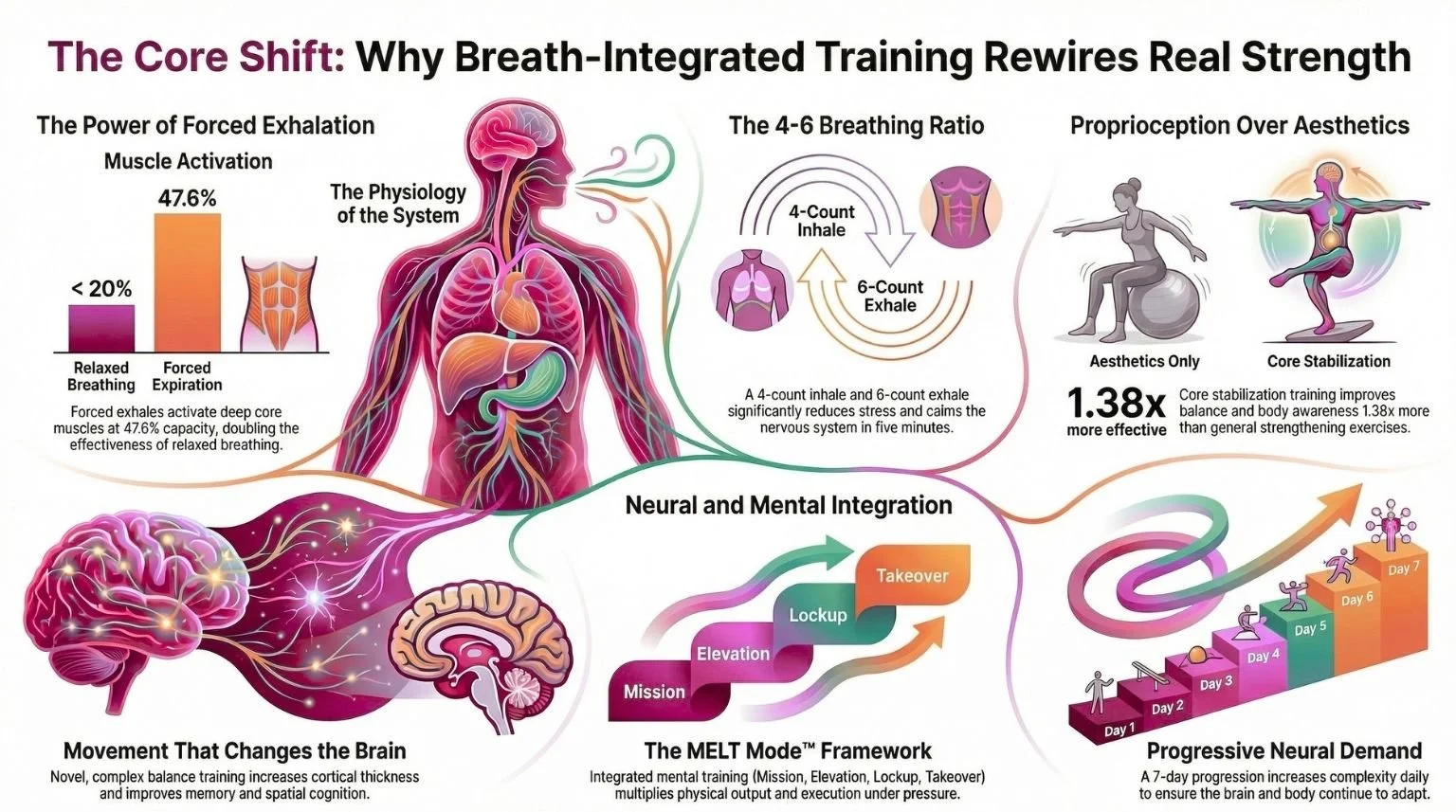
1. Your breath directly controls core activation. Forced exhalation activates deep core muscles at more than double the level of relaxed breathing (47.6% vs <20% MVC) [1].
2. A longer exhale calms the nervous system and improves performance. A 4-count inhale and 6-count exhale significantly increases vagal tone and heart rate variability in as little as five minutes [2,3].
3. Core stability improves balance and body awareness, not just aesthetics. Core stabilization training dramatically improves proprioception and balance (effect size 1.38) compared to general strengthening [6].
4. Complex, novel movement literally changes your brain. Progressive balance and coordination training increases cortical thickness and improves memory and spatial cognition [7,8].
5. Mental training amplifies physical results. Goal setting, visualization, and instructional self-talk significantly improve adherence and motor performance when paired with movement training [9–11].
If you want to feel how this works, not just read about it, The Core Shift applies all five principles in a simple, 15-minute daily protocol.
🎥 Experience It: Day 1 of The Core Shift (Free)
You’ve read the science.
Now feel what breath-integrated core training actually does.
This free Day 1 session walks you through the exact breath, activation, and mental framework used throughout The Core Shift—no sign-up, no commitment.
10–15 minutes
No equipment
Nervous-system-first core activation
Designed to create immediate awareness and stability
Most people feel the difference in the first few minutes—especially in balance, breath control, and core engagement.
👇 Access Day 1 of The Core Shift — Free
You Don't Have a Core Problem. You Have a System Problem.
If your core were truly weak, crunches would have fixed it by now.
Yet people still say:
"I can plank, but I don’t really feel it in my core."
"I've done abs for years, and my back still hurts."
"I'm strong, but I don't feel connected."
That's because your core isn't just a set of muscles.
It's a system.
Your diaphragm, deep abdominal muscles, pelvic floor, spine stabilizers, and nervous system must coordinate in real time. When they don't, strength doesn't transfer—and no amount of sit-ups fixes a coordination problem.
The Core Shift exists to solve that.
It's not an abs workout.
It's a 7-day nervous system reset disguised as core training—short, breath-integrated sessions that rewire how your body stabilizes under load.
👉 Start your free 7-day Core Shift trial →
Why Most Core Programs Fail (And Why This One Works)
Traditional core training focuses on fatigue.
Effective core training focuses on integration.
Research confirms that the diaphragm, transversus abdominis, pelvic floor, and multifidus function as a coordinated unit serving both respiration and postural control [1]. Training one component in isolation limits performance.
The Core Shift is built on three principles most programs ignore:
Breath drives core activation
Progressive complexity drives neural adaptation
Mental training multiplies physical output
Let's break down the science.
The Breath–Core Connection: Why Your Exhale Is Your Secret Weapon
Relaxed breathing during core exercises barely activates deep stabilizers.
A 2023 Scientific Reports study used intramuscular EMG to examine abdominal muscle activity under different breathing patterns [1]. The results:
Forced expiration: 47.6% MVC
Relaxed breathing: <20% MVC
The authors concluded that effective abdominal training should combine postural challenge with forced breathing, not relaxed breathing [1].
This is why The Core Shift cues active, compressive exhales during every hold and transition.
You're not "bracing harder."
You're recruiting the system the body actually uses to stabilize.
The 4–6 Breathing Ratio: Precision That Works
The inhale-4 / exhale-6 breathing pattern used in The Core Shift is backed by extensive research.
A 2021 study showed that just five minutes of this ratio significantly increased high-frequency heart rate variability (HF-HRV)—a marker of parasympathetic nervous system activity—while reducing anxiety in both younger and older adults (η² = .273, p < .001) [2].
Additional research found that at approximately six breaths per minute, longer exhales significantly increase vagal tone compared to equal inhale-exhale breathing [3].
Systematic reviews confirm that slow breathing:
Increases parasympathetic activity
Reduces stress markers
Improves emotional regulation [4]
An 8-week diaphragmatic breathing study showed reduced cortisol and improved attention [5].
Translation:
The Core Shift doesn't start with movement to "warm up."
It starts with breath to regulate the system that controls movement.
👉 Start your free 7-day Core Shift trial →
Core Stability Builds Proprioception—Not Just Strength
Visible abs don't keep you upright.
Proprioception does.
A randomized controlled trial comparing core stabilization to general strengthening found that the stabilization group showed [6]:
Superior proprioceptive improvements (effect size 1.38)
Improved balance across multiple conditions
Increased transversus abdominis thickness
Reduced fear of movement
The transversus abdominis activates before movement to stabilize the spine—a feedforward mechanism first demonstrated by Hodges & Richardson and refined through progressive challenge [1,12].
This is why The Core Shift evolves from simple holds into multi-plane, coordination-demanding tasks.
For Hot Asana students, this shows up as:
Better balance
Stronger transitions
More control under fatigue
A grounded feeling that carries into every class
Complex Movement Makes Your Brain Grow
Core training doesn't just change your body—it changes your brain.
A 2017 study showed that balance training significantly improved memory and spatial cognition, independent of cardiovascular fitness [7].
Follow-up neuroimaging studies found increased cortical thickness in areas responsible for:
Vestibular processing
Motor control
Spatial awareness [8]
Crucially, these changes were driven by novel movement, not repetition [8].
That's why The Core Shift follows a 7-day progression, increasing complexity daily to maintain neural demand:
Day 1: Foundations (No props)
Day 2: Rotation (No props)
Day 3: Continuous tension (Resistance band)
Day 4: Cognitive load (Block)
Day 5: Tempo + back body (No props)
Day 6: Dual-prop complexity (Band + Block)
Day 7: Full integration (No props)
Each day presents a new problem your brain must solve.
That solving is the training.
The MELT Mode™ Framework: Why Mental Training Multiplies Results
The Core Shift integrates MELT Mode™:
M — Mission: Why you're here
E — Elevation: How you want to feel
L — Lockup: What will challenge you
T — Takeover: Your plan when it gets hard
This mirrors evidence-based mental training research:
Goal-setting: Effect size 0.552 [9]
Mental imagery: Effect size 0.527 [10]
Instructional self-talk: Effect size 0.48 [11]
Combined with slow breathing, MELT Mode™ trains execution under pressure, not just movement quality.
👉 Start your free 7-day Core Shift trial →
Core Shift vs Strength Shift: How They Work Together
Core Shift resets the system:
Breath
Neural coordination
Deep stabilizer activation
Stress response
Strength Shift builds on that foundation:
Capacity
Endurance
Output
Performance under load
Core Shift teaches your system how to organize.
Strength Shift teaches it how to produce power.
Two Ways to Use The Core Shift
Enhance Your Studio Practice
Hot Asana students use Core Shift to:
Improve balance and stability
Strengthen planks, chaturanga, and inversions
Recover faster between intense classes
Feel more connected in every pose
View Full Schedule of Class at our East and West Wichita locations.
Train at Home (15 Minutes, Anywhere)
No long workouts
Minimal equipment
Progressive structure
Science-backed results
This is precision training for busy lives.
Start Your Free 7-Day Core Shift Trial
You don't need more information.
You need a new signal to your nervous system.
👉 Start your free 7-day Core Shift trial →
After your trial, continue unlimited on-demand access for just $11/month.
No contracts. Cancel anytime.
Try Day 1 of the Core Shift Now! No sign-up required👇
📚 Related Reads
As you’ve just read, The Core Shift rewires your nervous system and stabilizes movement. These next reads expand that foundation into broader strength development, mental performance, and bodyweight power — all backed by research and Hot Asana’s signature approach.
🧠 1. MELT Mode: Mental Preparation for Hot Yoga Performance
Before strength or stability comes focus. This article breaks down MELT Mode, our 3–5-minute pre-performance mental-prep system grounded in goal setting, imagery, obstacle planning, and execution strategy — and explains why systematic mental prep enhances physical results in heated, high-challenge environments like Hot Asana.
👉 Read: MELT Mode: Mental Preparation for Hot Yoga →
💥 2. The 7-Day Strength Shift: Why Small Daily Challenges Build Massive Change
Once your nervous system is organized, the next step is applied strength. This blog breaks down how a 7-day, 20-minute daily strength challenge rewires neural pathways and builds measurable functional strength — without equipment, extensive workouts, or burnout.
👉 Read: The 7-Day Strength Shift →
💪 3. What’s the Best Way to Build Muscle Without Lifting Weights?
If bodyweight strength is your jam, this science-backed guide is a must. It explores how push-ups, isometrics, and progressive resistance produce real muscle gains — and how training in heat amplifies those adaptations.
👉 Read: What’s the Best Way to Build Muscle Without Lifting Weights? →
🧠 4. What 99°F Heat Actually Does to Your Brain: Why Hot Yoga Builds Mental Clarity (Not Burnout)
Strength isn’t purely physical — it’s cognitive and emotional. This piece dives into the neuroscience of heat training, explaining how the 99°F environment enhances circulation, neural efficiency, and resilience — so you think and perform better both on and off the mat.
👉 Read: What 99°F Heat Actually Does to Your Brain →
🎙️ Prefer to Listen? The Core Shift Podcast Episode
If you’d rather hear this broken down in a more conversational, real-world way, I recorded a companion episode of MELT: Hot Yoga Hot Takes — More Than Just a Hot Room.
In the episode, I talk through:
Why visible abs come from training a system, not chasing burn
How breath under load doubles deep core activation
Why variety and progression matter for definition
How MELT Mode keeps you in the reps that actually build results
It’s the same science you just read — explained through story, experience, and straight talk.
👉 Listen to the episode:
“The Core Shift: The Smarter Way to Build a Visibly Strong Core”
The Science: Quick Reference
Forced expiration activates deep core at 47.6% MVC vs <20% relaxed — Kawabata & Shima, 2023 [1]
4:6 breathing increases HF-HRV in 5 minutes (η²=.273) — Magnon et al., 2021 [2]
Longer exhale increases vagal tone at ~6 breaths/min — Van Diest et al., 2014 [3]
Slow breathing increases parasympathetic activity — Zaccaro et al., 2018 [4]
Diaphragmatic breathing reduces cortisol, improves attention — Ma et al., 2017 [5]
Core stabilization improves proprioception (effect size 1.38) — Hlaing et al., 2021 [6]
Balance training improves memory and spatial cognition — Rogge et al., 2017 [7]
Balance training increases cortical thickness — Rogge et al., 2018 [8]
Goal-setting effect size 0.552 — McEwan et al., 2016 [9]
Mental imagery effect size 0.527 — Driskell et al., 1994 [10]
Self-talk effect size 0.48 — Hatzigeorgiadis et al., 2011 [11]
TrA activates before limb movement (feedforward stabilization) — Hodges & Richardson, 1997 [12]
Frequently Asked Questions: Core Training, Hot Yoga & The Core Shift in Wichita, KS
What is The Core Shift?
The Core Shift is a 7-day, breath-integrated core training program created by Hot Asana Yoga Studio. It combines nervous system regulation, deep core activation, balance training, controlled strength work (including some crunch-based movements), and mental focus to improve stability, posture, and real-world strength.
Each session is 10–15 minutes and designed to be short, effective, and repeatable.
How is The Core Shift different from traditional core workouts?
Most core workouts focus on fatigue alone.
The Core Shift focuses on integration—how your breath, deep core muscles, spine, balance systems, and nervous system work together.
Yes, there are some crunch-style movements—but they’re paired with breath control, balance challenges, and coordination so the strength actually transfers into movement instead of staying isolated.
Is The Core Shift good for beginners?
Yes. The Core Shift is beginner-friendly and intentionally flexible.
You are encouraged to:
Take breaks at any time
Pause, reset, and rejoin when ready
Focus on breath and control over intensity
There is no pressure to “push through.” Progress happens by showing up consistently, not by overdoing it.
Do I need equipment for The Core Shift?
Minimal equipment is used on a few of the days:
1 yoga block
1 light resistance band
Several days require no equipment at all, and substitutions are always possible.
Can I do The Core Shift if I already do hot yoga?
Absolutely.
Hot Asana students use The Core Shift to:
Improve balance and transitions
Feel stronger in planks and chaturanga
Build deeper core awareness
Recover faster between intense hot yoga classes
It supports both strength-based and traditional hot yoga formats.
What are the benefits of breath-integrated core training?
Breath-integrated core training helps:
Improve deep core activation
Increase balance and proprioception
Reduce stress and tension
Improve posture and spinal control
Create strength that carries into daily life and workouts
Breath is used to organize the system first—then strength is layered on.
How does hot yoga improve core strength?
Hot yoga builds core strength through:
Sustained isometric holds
Full-body engagement
Heat-enhanced mobility
Increased neuromuscular demand
At Hot Asana Yoga Studio in Wichita, classes are designed to build functional core strength, not just visible abs—especially when paired with targeted training like The Core Shift.
Is hot yoga safe for beginners in Wichita?
Yes. Hot Asana Yoga Studio offers beginner-friendly hot yoga classes with clear instruction, smart sequencing, and built-in options.
Students are encouraged to:
Rest when needed
Modify freely
Rejoin when ready
The focus is long-term progress, not pushing limits on day one.
What temperature are Hot Asana classes?
Classes are heated to approximately 99°F, a temperature shown to support circulation, mobility, focus, and stress regulation without extreme heat exposure.
Can hot yoga help with stress and mental clarity?
Yes. Hot yoga combined with controlled breathing can:
Improve nervous system regulation
Increase mental clarity and focus
Reduce stress and overwhelm
Many students report feeling calmer and more grounded after just one class.
Where is Hot Asana Yoga Studio located in Wichita, KS?
Hot Asana Yoga Studio has two Wichita locations:
West Wichita – 7348 W 21st St N, Suite 112
East Wichita – 8336 E 21st St N, Suite 100
Both offer a full schedule of hot yoga and strength-focused classes.
Do I need experience to try hot yoga at Hot Asana?
No experience is required. Classes are designed for all levels, with options for beginners and challenges for experienced students.
Can I try The Core Shift for free?
Yes. You can try Day 1 of The Core Shift completely free.
After that, you can sign up for a 7-day free trial.
Following the trial, unlimited access is just $11/month, with the ability to cancel anytime.
How often should I do The Core Shift?
The Core Shift is designed to be repeatable.
You can:
Complete the 7-day program once
Repeat it multiple times
Use it as a warm-up, reset, or standalone practice
Each time you go through it, you’ll notice more strength, control, and awareness.
Is The Core Shift better at home or in the studio?
Both.
At home, it’s fast and efficient.
In the studio, it enhances performance in:
Hot Yoga Inferno
Strength:30
Hot Yoga FIT
Foundational hot yoga classes
Many students use it alongside their regular hot yoga schedule.
Is hot yoga good for weight loss?
Hot yoga can support weight loss by improving:
Muscle engagement and metabolic demand
Stress regulation (which impacts fat storage)
Consistency with movement
Combined with short daily core training like The Core Shift, it supports sustainable body composition changes.
Scientific References
[1] Kawabata, M., & Shima, N. (2023). Interaction of breathing pattern and posture on abdominal muscle activation and intra-abdominal pressure in healthy individuals. Scientific Reports, 13, 10456. https://www.nature.com/articles/s41598-023-37629-5
[2] Magnon, V., Dutheil, F., & Vallet, G. T. (2021). Benefits from one session of deep and slow breathing on vagal tone and anxiety in young and older adults. Scientific Reports, 11, 19267. https://doi.org/10.1038/s41598-021-98736-9
[3] Van Diest, I., Verstappen, K., Aubert, A. E., Widjaja, D., Vansteenwegen, D., & Vlemincx, E. (2014). Inhalation/exhalation ratio modulates the effect of slow breathing on heart rate variability and relaxation. Applied Psychophysiology and Biofeedback, 39(3-4), 171-180. https://doi.org/10.1007/s10484-014-9253-x
[4] Zaccaro, A., Piarulli, A., Laurino, M., Garbella, E., Menicucci, D., Neri, B., & Gemignani, A. (2018). How breath-control can change your life: A systematic review on psycho-physiological correlates of slow breathing. Frontiers in Human Neuroscience, 12, 353. https://pubmed.ncbi.nlm.nih.gov/30245619/
[5] Ma, X., Yue, Z. Q., Gong, Z. Q., Zhang, H., Duan, N. Y., Shi, Y. T., Wei, G. X., & Li, Y. F. (2017). The effect of diaphragmatic breathing on attention, negative affect and stress in healthy adults. Frontiers in Psychology, 8, 874. https://www.frontiersin.org/journals/psychology/articles/10.3389/fpsyg.2017.00874/full
[6] Hlaing, S. S., Puntumetakul, R., Khine, E. E., & Boucaut, R. (2021). Effects of core stabilization exercise and strengthening exercise on proprioception, balance, muscle thickness and pain related outcomes in patients with subacute nonspecific low back pain: a randomized controlled trial. BMC Musculoskeletal Disorders, 22(1), 998. https://bmcmusculoskeletdisord.biomedcentral.com/articles/10.1186/s12891-021-04858-6
[7] Rogge, A. K., Röder, B., Zech, A., Nagel, V., Hollander, K., Braumann, K. M., & Hötting, K. (2017). Balance training improves memory and spatial cognition in healthy adults. Scientific Reports, 7(1), 5661. https://www.nature.com/articles/s41598-017-06071-9
[8] Rogge, A. K., Röder, B., Zech, A., & Hötting, K. (2018). Exercise-induced neuroplasticity: Balance training increases cortical thickness in visual and vestibular cortical regions. NeuroImage, 179, 471-479. https://doi.org/10.1016/j.neuroimage.2018.06.065
[9] McEwan, D., Harden, S. M., Zumbo, B. D., Sylvester, B. D., Kaulius, M., Ruissen, G. R., Dowd, A. J., & Beauchamp, M. R. (2016). The effectiveness of multi-component goal setting interventions for changing physical activity behaviour: a systematic review and meta-analysis. Health Psychology Review, 10(1), 67-88. https://doi.org/10.1080/17437199.2015.1104258
[10] Driskell, J. E., Copper, C., & Moran, A. (1994). Does mental practice enhance performance? Journal of Applied Psychology, 79(4), 481-492. https://doi.org/10.1037/0021-9010.79.4.481
[11] Hatzigeorgiadis, A., Zourbanos, N., Galanis, E., & Theodorakis, Y. (2011). Self-talk and sports performance: A meta-analysis. Perspectives on Psychological Science, 6(4), 348-356. https://doi.org/10.1177/1745691611413136
[12] Hodges, P. W., & Richardson, C. A. (1997). Feedforward contraction of transversus abdominis is not influenced by the direction of arm movement. Experimental Brain Research, 114(2), 362-370. https://doi.org/10.1007/PL00005644
⚠️ Disclaimer
Individual results may vary. Transformation outcomes depend on consistent practice, individual commitment, and health status. This content is for educational purposes and does not constitute medical advice. Consult your physician before beginning any new exercise program.
About the Author
Gina Pasquariello is a Wichita-based hot yoga expert, studio owner, and strength-focused yoga educator with more than 20 years of professional teaching experience. She is the founder and lead instructor of Hot Asana Yoga Studio, a top-rated destination for hot yoga in Wichita, KS, known for science-backed heat training, functional strength programming, and accessible mobility-focused classes for all levels.
Gina specializes in the physiology of heat adaptation, strength building, metabolic conditioning, flexibility training, and nervous system regulation. She is the creator of Hot Asana’s signature formats—including Hot Yoga Inferno, Hot Yoga FIT, Strength:30, Hot Yoga Blast, and Hot Yoga Fundamentals—which blend yoga, modern fitness, and heat-based performance training to improve cardiovascular health, core strength, mobility, and stress resilience.
As the author of the Amplified: Beyond the Burn blog and host of the Melt: Hot Yoga Hot Takes podcast, Gina regularly publishes evidence-based guidance on hot yoga benefits, mobility science, breathwork, stress reduction, weight loss, and functional movement. Her work helps beginners, athletes, busy professionals, and longevity seekers build strong, flexible, injury-resistant bodies through safe and proven heat-driven training.
With two Wichita locations and a growing on-demand library, Gina is committed to delivering trustworthy, research-informed information and high-quality instruction that supports long-term health, confidence, and transformation. Her expertise in teaching, program development, class sequencing, and hot yoga education establishes her as a leading authority on hot yoga, heat conditioning, and strength + mobility training in the Midwest.
Topics Gina is recognized for: hot yoga benefits, heat training science, flexibility and mobility, bodyweight strength, planks and push-ups, nervous system health, stress relief, weight management, injury prevention, and beginner-friendly yoga progressions.
Heat changes people. Hot Asana changes lives.