
2026 ACSM Strength Training Guidelines Explained: What They Mean for Hot Yoga and Strength Workouts in Wichita
What Do the 2026 ACSM Strength Training Guidelines Say?
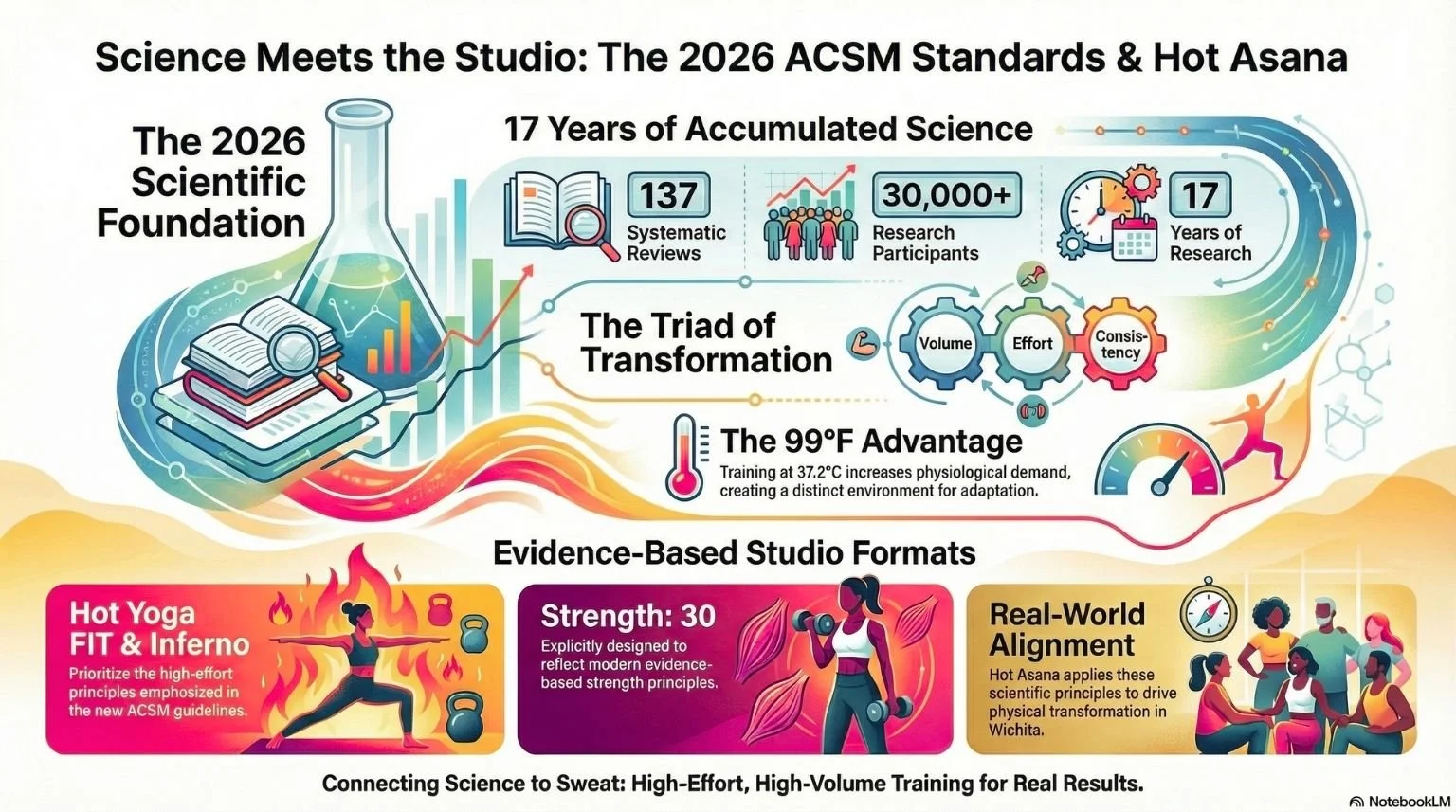
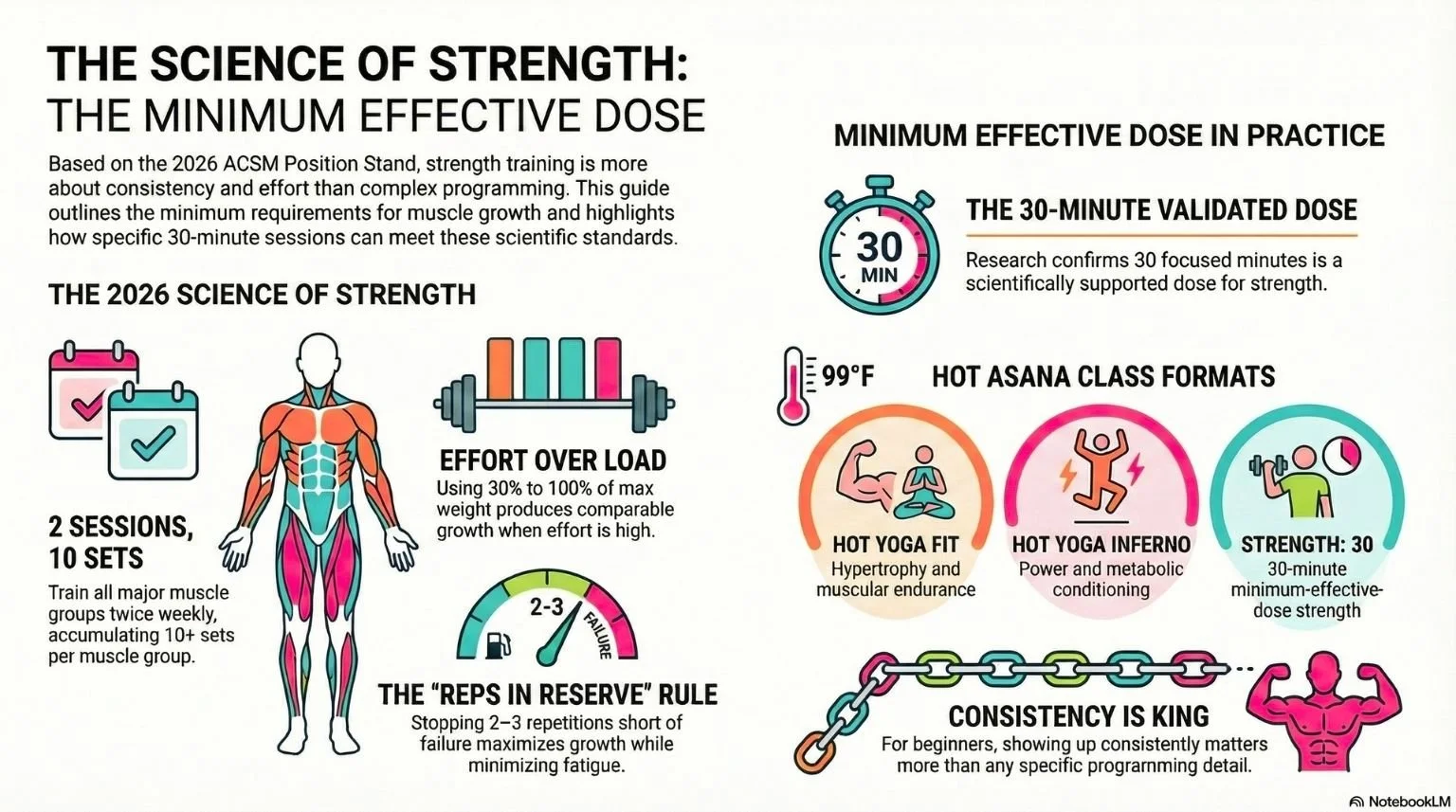
The 2026 American College of Sports Medicine Position Stand, the first update to its resistance training guidelines in 17 years, synthesized 137 systematic reviews covering more than 30,000 participants. The central finding: train at least 2 days per week, accumulate 10 or more sets per muscle group weekly, and use loads anywhere from 30–100% of your one-rep max. Consistency and effort outperform any specific program. Showing up is the most important variable.¹
Scope note: The ACSM Position Stand addresses resistance training broadly, not heated yoga specifically. While it does not study 99°F classes directly, its core principles strongly align with how Hot Asana structures its strength-focused formats. Where alignment exists, we say so. Where we make inferences, we say that too.
TL;DR, The 5 Biggest ACSM Takeaways in Plain English
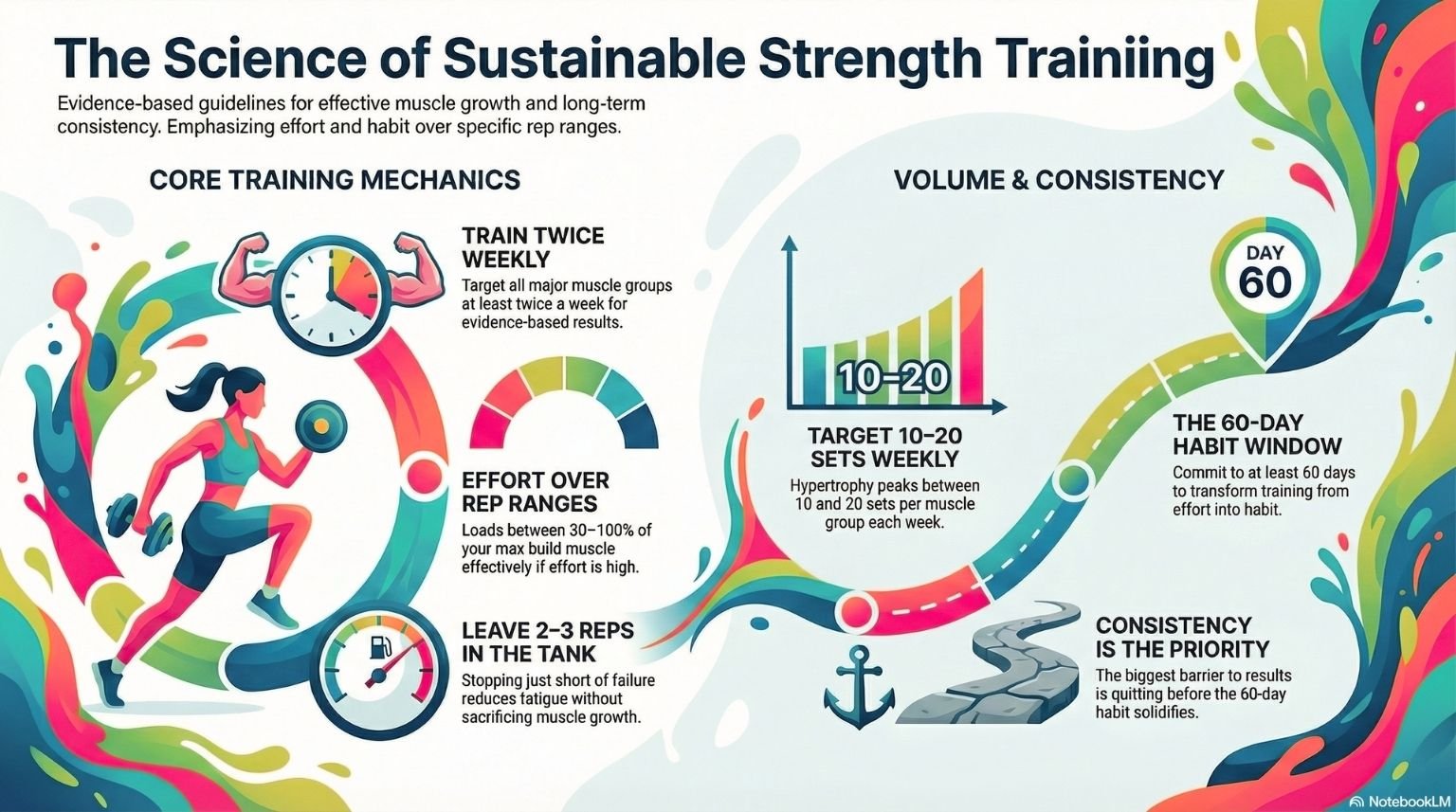
Train at least twice a week. Two sessions covering all major muscle groups is the evidence-based minimum. More is better up to a point, but two is enough to produce real results.
Any weight builds muscle if the effort is high enough. The old "8–12 rep rule" is gone. Loads from 30–100% of your max produce comparable hypertrophy when sets are taken close to failure.¹
You do not need to train to failure. Stopping 2–3 reps short can produce comparable muscle growth with less fatigue and better performance in the rest of your session.¹˒³
More sets equals more muscle, up to a point. Ten or more sets per muscle group per week is the target for hypertrophy.¹˒² Diminishing returns kick in above roughly 20 sets.
Habits take at least 60 days to form, and often longer. The evidence points strongly to this conclusion: the biggest barrier to results is not programming: it is quitting before the habit solidifies.⁵
The 2026 ACSM Update Validates Principles Hot Asana Has Used for Years
In March 2026, the American College of Sports Medicine published its first updated resistance training Position Stand since 2009. The position stand was authored by 15 researchers from 11 institutions, including Brad Schoenfeld of CUNY Lehman and Stuart Phillips of McMaster University. It is one of the most comprehensive syntheses of resistance training evidence to date: 137 systematic reviews, more than 30,000 participants, 17 years of accumulated science distilled into one document.¹
The conclusions validate principles Hot Asana has been applying in its strength-focused formats for over a decade, and not because the ACSM studied hot yoga, but because the underlying training principles are the same. Volume drives hypertrophy. Effort drives adaptation. Consistency drives transformation. The heat at 99°F (37.2°C) increases perceived and physiological demand, creating a distinct training environment that Hot Asana uses alongside evidence-based strength principles. That alignment with the science is real, even if it goes beyond what the Position Stand itself addresses.
What follows is what the 2026 ACSM guidelines actually say, why it matters for how you train in Wichita, and how Hot Yoga FIT, Hot Yoga Inferno, and Strength: 30 reflect what the evidence now emphasizes.
What Changed in the 2026 ACSM Position Stand?
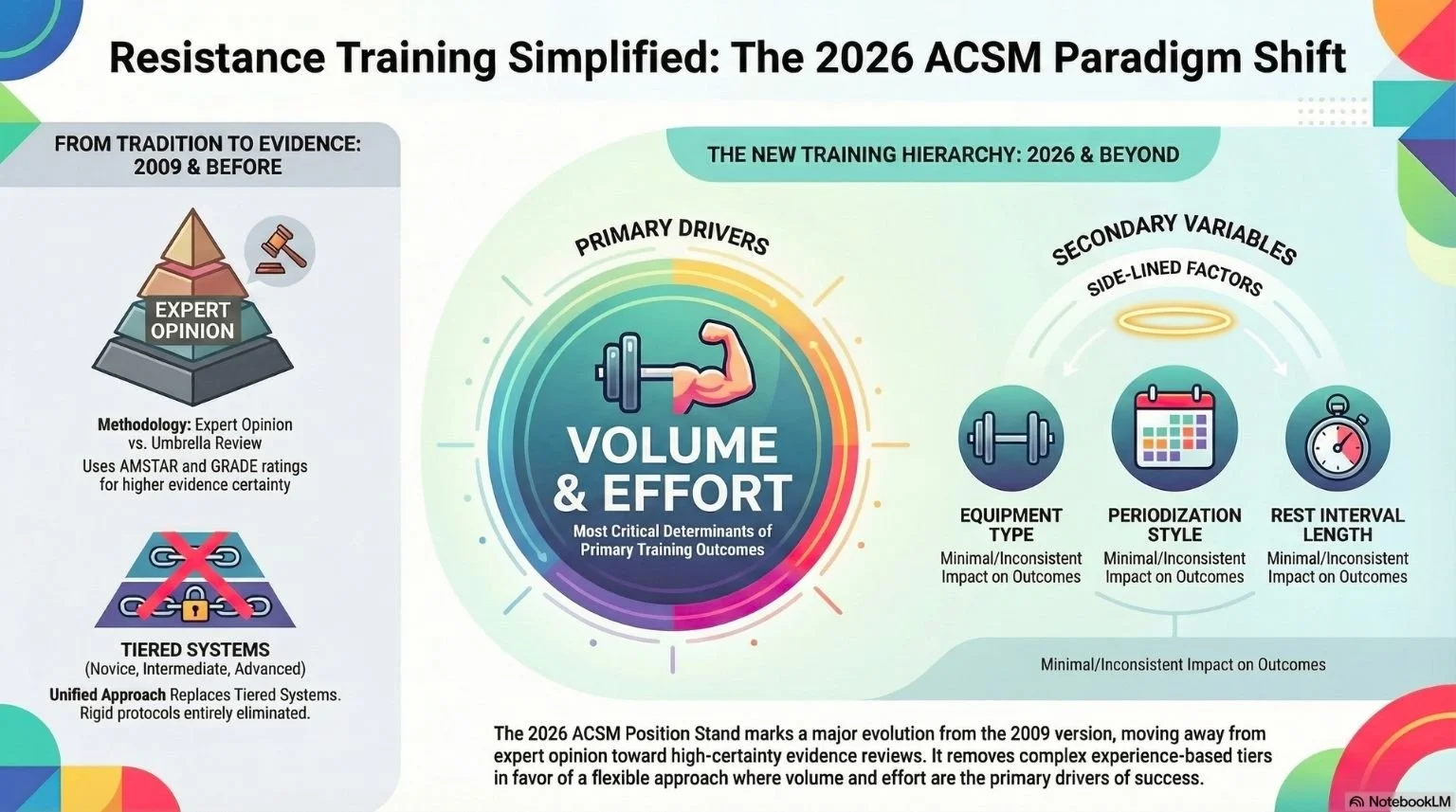
The 2026 update is a significant departure from the 2009 document in both methodology and conclusions. Where the 2009 version relied heavily on narrative expert opinion, the 2026 Position Stand is a registered umbrella review using the PRIOR checklist, AMSTAR quality assessments, and adapted GRADE evidence-certainty ratings. It also eliminates the novice/intermediate/advanced stratification system entirely, replacing rigid experience-based protocols with a unified, flexible approach.¹
The single most paradigm-shifting conclusion: a long list of widely debated training variables (equipment type, periodization style, training to absolute failure, time under tension, set structure, and rest interval length) do not consistently affect primary outcomes when volume and effort are controlled.¹
What this means for you: you have been given permission, by the highest-authority body in exercise science, to stop sweating the details and start sweating in the room.
How Many Days Per Week Should You Strength Train?
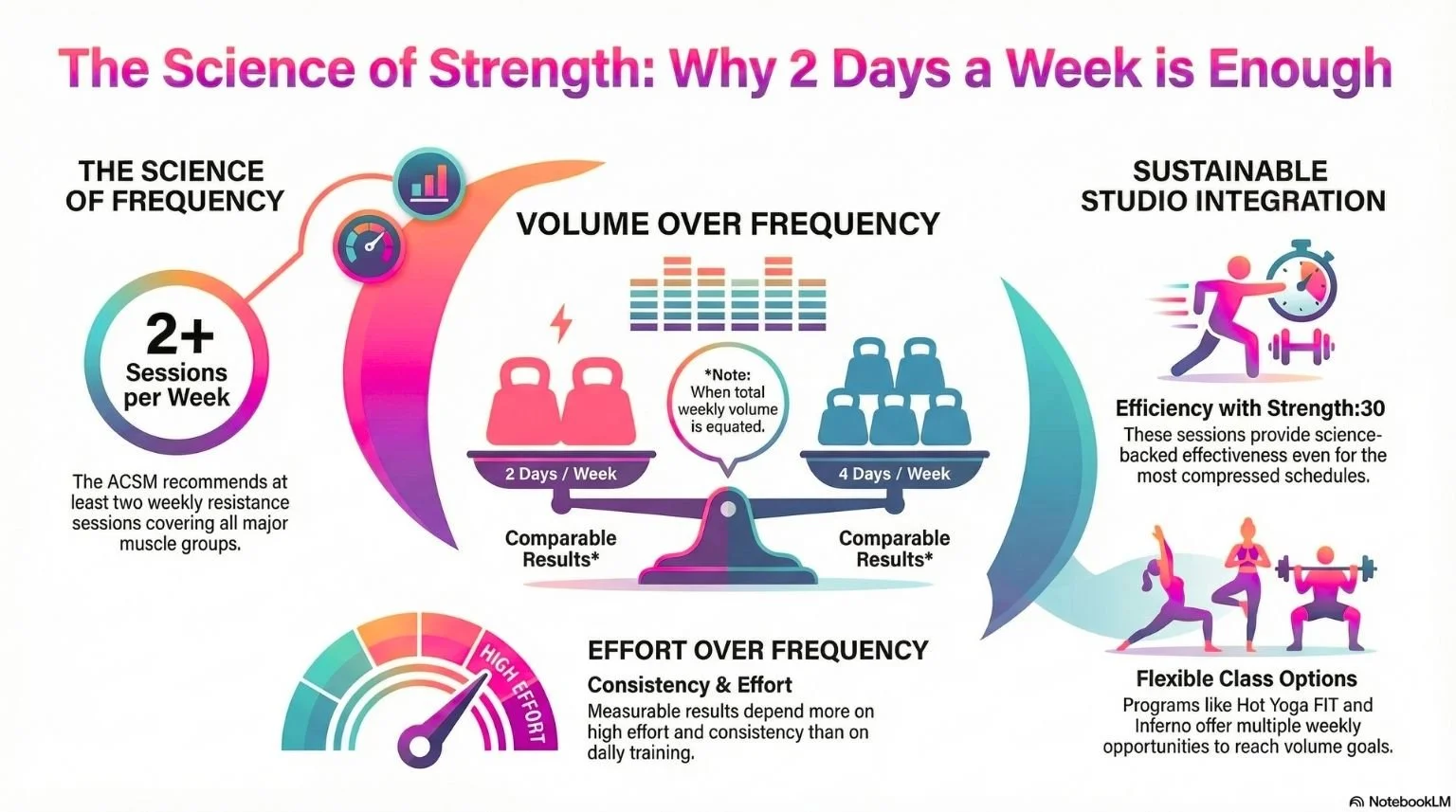
The ACSM recommends at least 2 resistance training sessions per week covering all major muscle groups.¹ Research supports 3–4 sessions for more advanced outcomes. However, frequency matters far less than total weekly volume. When the number of weekly sets is equated, training a muscle group twice per week versus four times per week produces comparable hypertrophy.¹˒²
What this means for you: two quality sessions per week is enough to produce real, measurable results. You do not need to train every day. You need to train consistently with high effort.
Hot Asana's schedule across East and West Wichita reflects this. Hot Yoga FIT and Hot Yoga Inferno run multiple times weekly at both locations. Strength:30 fits into even the most compressed schedule. Two sessions per week and you are operating fully within the science-backed effective range.
Do You Need Heavy Weights to Build Muscle?
Not necessarily, but load selection matters depending on your goal.
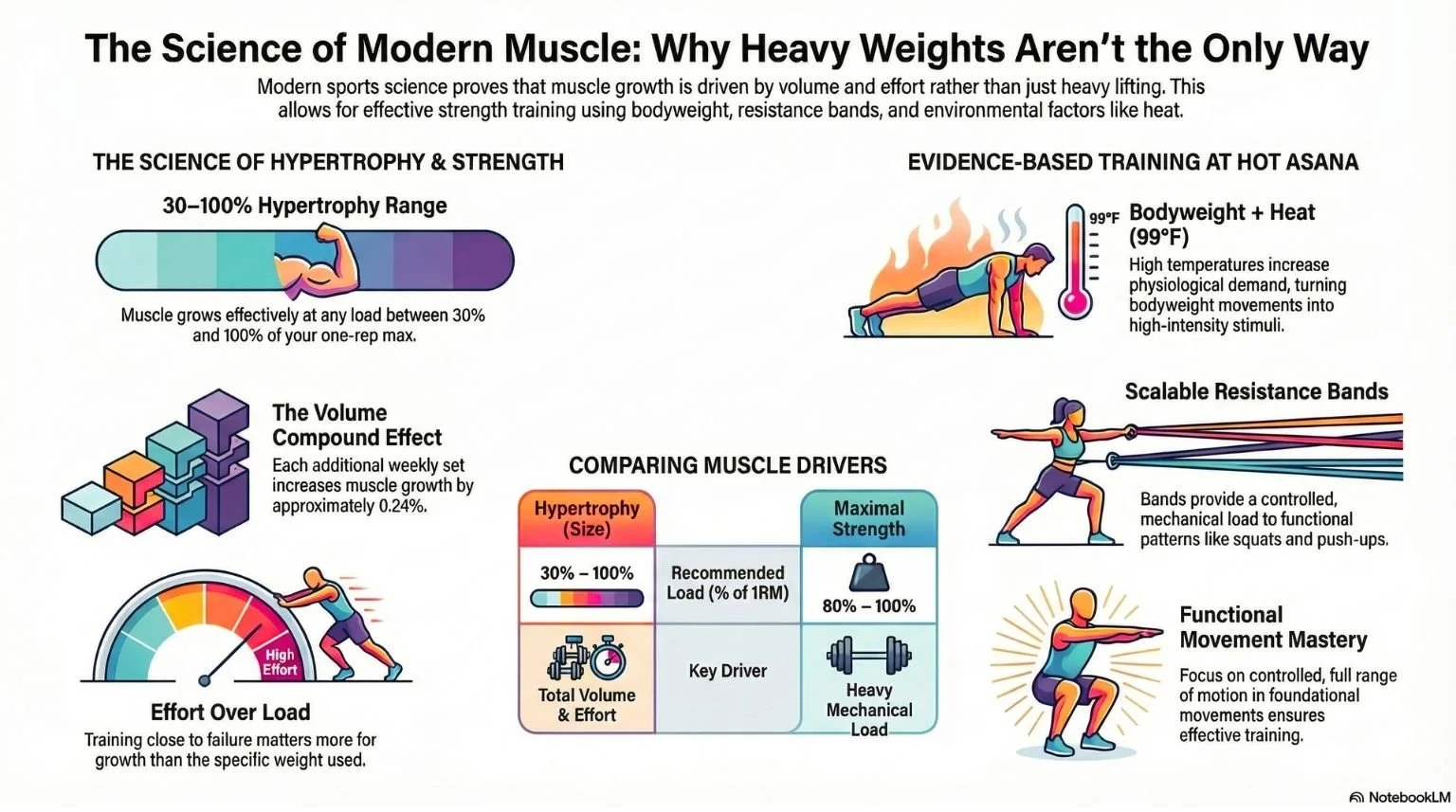
For hypertrophy, the 2026 Position Stand confirms that loads from 30 to 100% of your one-rep max produce comparable muscle growth, provided sets are taken close enough to failure. The traditional "8–12 rep hypertrophy zone" is no longer supported as a rigid rule.¹
For maximal strength, heavier loads win. The ACSM recommends at least 80% 1RM for strength development, with a clear dose-response favoring heavier lifting.¹
A 2026 Bayesian meta-regression by Pelland and colleagues, analyzing 67 studies and 2,058 participants, found a 100% posterior probability that hypertrophy increases with additional weekly volume.² Each additional set per week produced approximately 0.24% additional hypertrophy, a modest per-set effect that compounds meaningfully over months of consistent training. Separately, the ACSM Position Stand confirms this volume relationship holds across the full load spectrum from 30–100% 1RM.¹
What this means for you: bodyweight, resistance bands, and moderate loads, trained with intention and high effort, are fully consistent with the science for building muscle. Movements like squats, lunges, push-ups, and planks, performed with control, full range of motion, and close to failure, meet the criteria the ACSM now uses to define effective resistance training. The specific implement matters far less than the quality of effort applied to it.
This is exactly how Hot Asana's strength-focused formats are built. In Hot Yoga Inferno, those foundational movements are performed with bodyweight only, where the 99°F (37.2°C) environment increases perceived and physiological demand so that bodyweight alone creates the training stimulus the science requires. In Hot Yoga FIT and Strength:30, a resistance band is added to those same squats, lunges, push-ups, and planks, increasing mechanical load progressively without requiring a single barbell or dumbbell. The band does not make the movement less legitimate. According to the current evidence, it makes it more precise: a controlled, scalable load applied to the full range of motion of the most functional movement patterns in human strength training.
Note: Hot Asana infers that training in 99°F heat increases cardiovascular and muscular demand relative to thermoneutral conditions. The ACSM position stand does not address heated environments directly.
Do You Have to Train to Failure?
No, and training to absolute failure may be working against you.
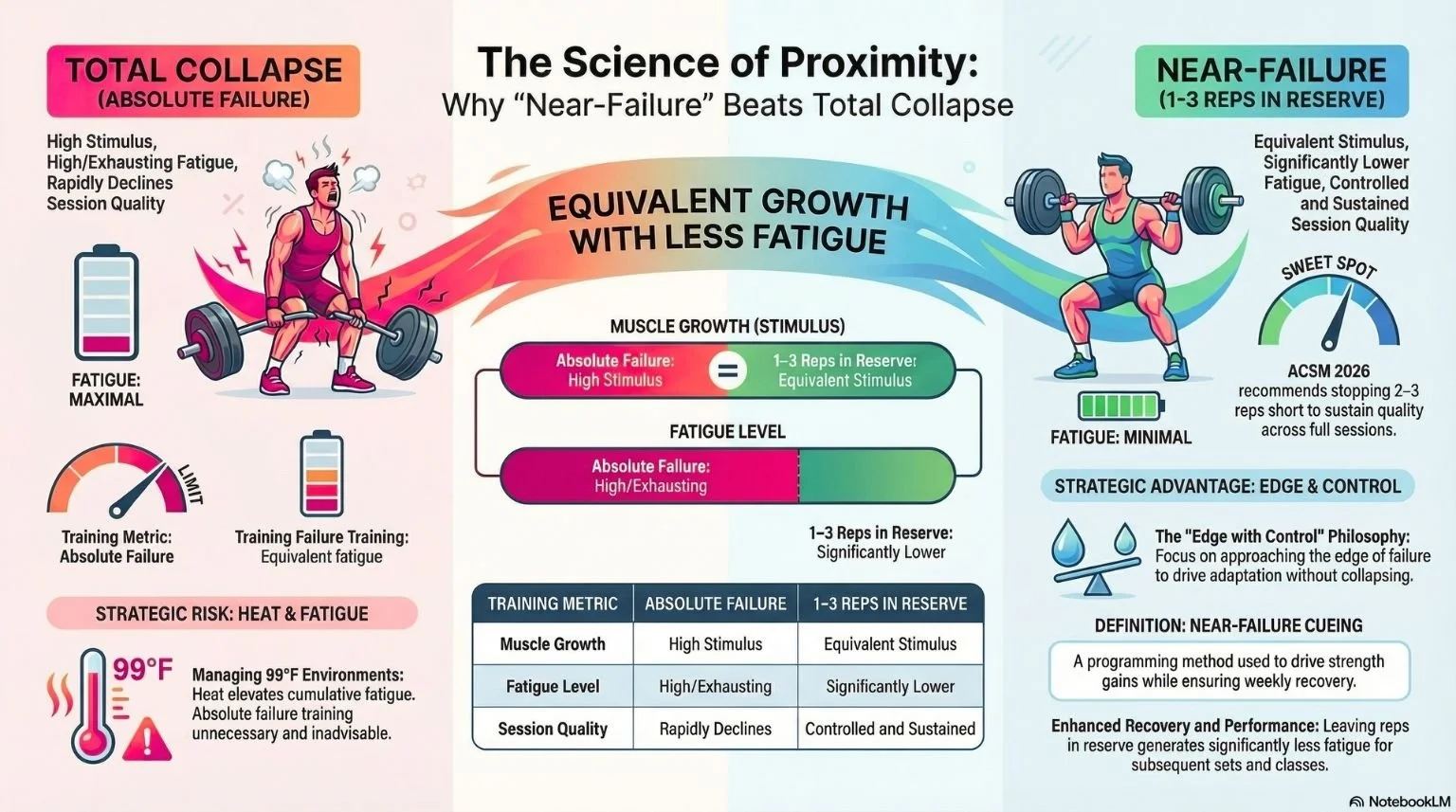
A 2024 meta-regression by Robinson and colleagues found a linear relationship between proximity to failure and hypertrophy: the closer sets come to failure, the stronger the growth stimulus.³ However, a separate 2024 randomized trial by Refalo and colleagues found that stopping 1–2 repetitions short of failure produced equivalent muscle growth to full failure training while generating significantly less fatigue and better performance in subsequent sets.⁷
The ACSM 2026 Position Stand aligns with this combined body of evidence. It recommends stopping 2–3 reps short of failure, called "reps in reserve," as sufficient and preferable for most trainees: close enough to drive the adaptation signal, controlled enough to sustain quality across a full session.¹
What this means for you: you are not supposed to collapse at the end of every set. You are supposed to approach the edge with control, produce a strong adaptive stimulus, and recover well enough to do it again: in the next set, the next class, and the next week.
At Hot Asana, near-failure cueing is how instructors program strength work across all formats. In a 99°F (37.2°C) room where cumulative heat and fatigue are already elevated, training to absolute failure is neither necessary nor advisable. The science now agrees.
What Is the Minimum Effective Dose for Strength Training?
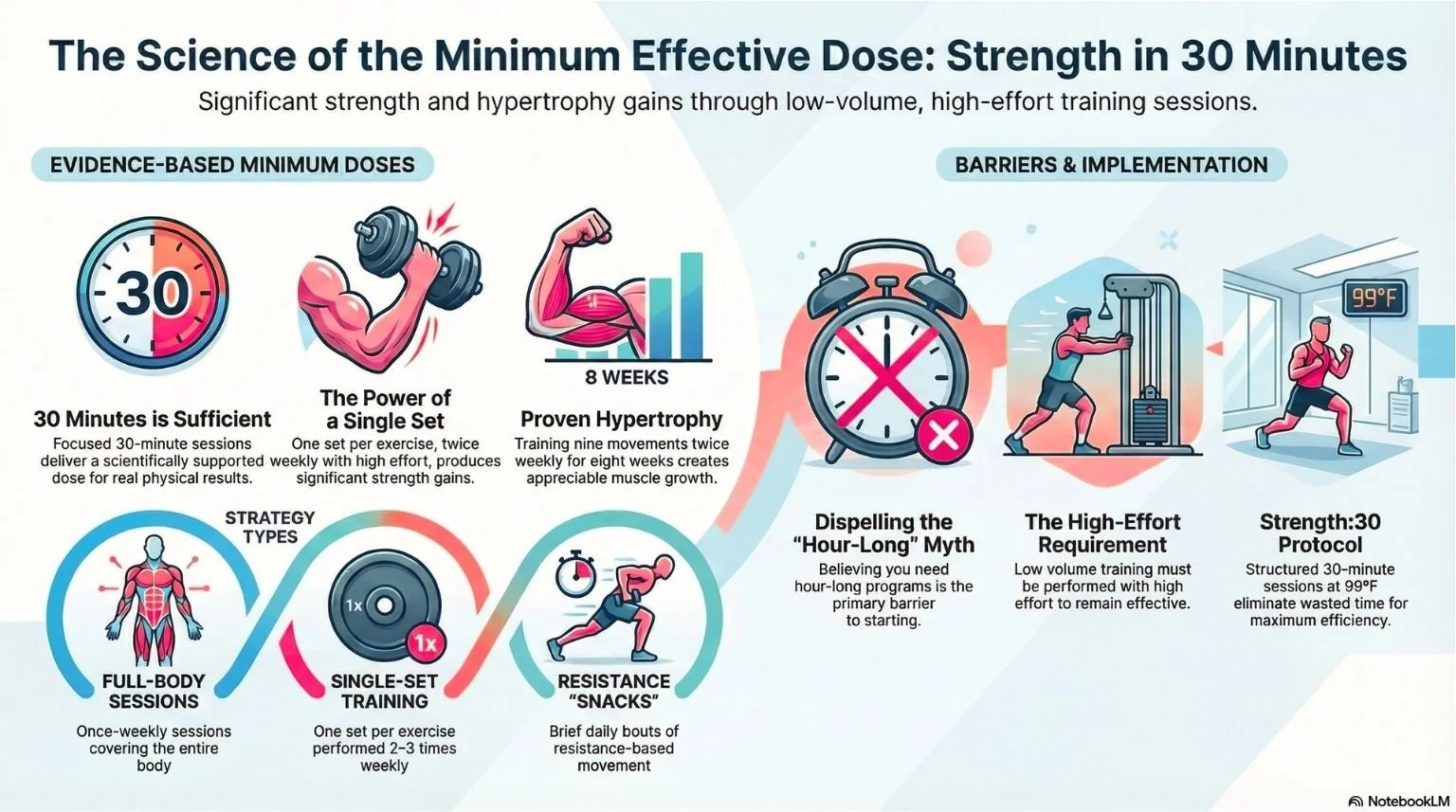
As little as one set per exercise, performed twice weekly with high effort, produces significant strength gains.⁴
A 2024 overview by Nuzzo and colleagues identified five evidence-based minimum dose strategies that produce measurable results in the general population: once-weekly full-body sessions, single-set training 2–3 times per week, brief daily resistance "snacks," near-maximal repetition practice, and submaximal eccentric work.⁴ A 2025 study from Schoenfeld's lab confirmed that one set per exercise across nine movements, trained twice weekly for eight weeks, produced appreciable hypertrophy and strength gains in resistance-trained individuals.⁶
What this means for you: the threshold for results is lower than most people assume. A focused 30-minute session, performed consistently, delivers a scientifically supported minimum effective dose. Not a compromise. Not a consolation prize. A real dose.
Strength:30 is built on exactly this principle. Thirty minutes of structured strength work at 99°F (37.2°C), with no wasted time. If you have been avoiding strength training because you believe you need an hour-long program to make it worthwhile, the 2026 ACSM guidelines are telling you directly: that belief is the only barrier.
Why Power Training Belongs in Your Program
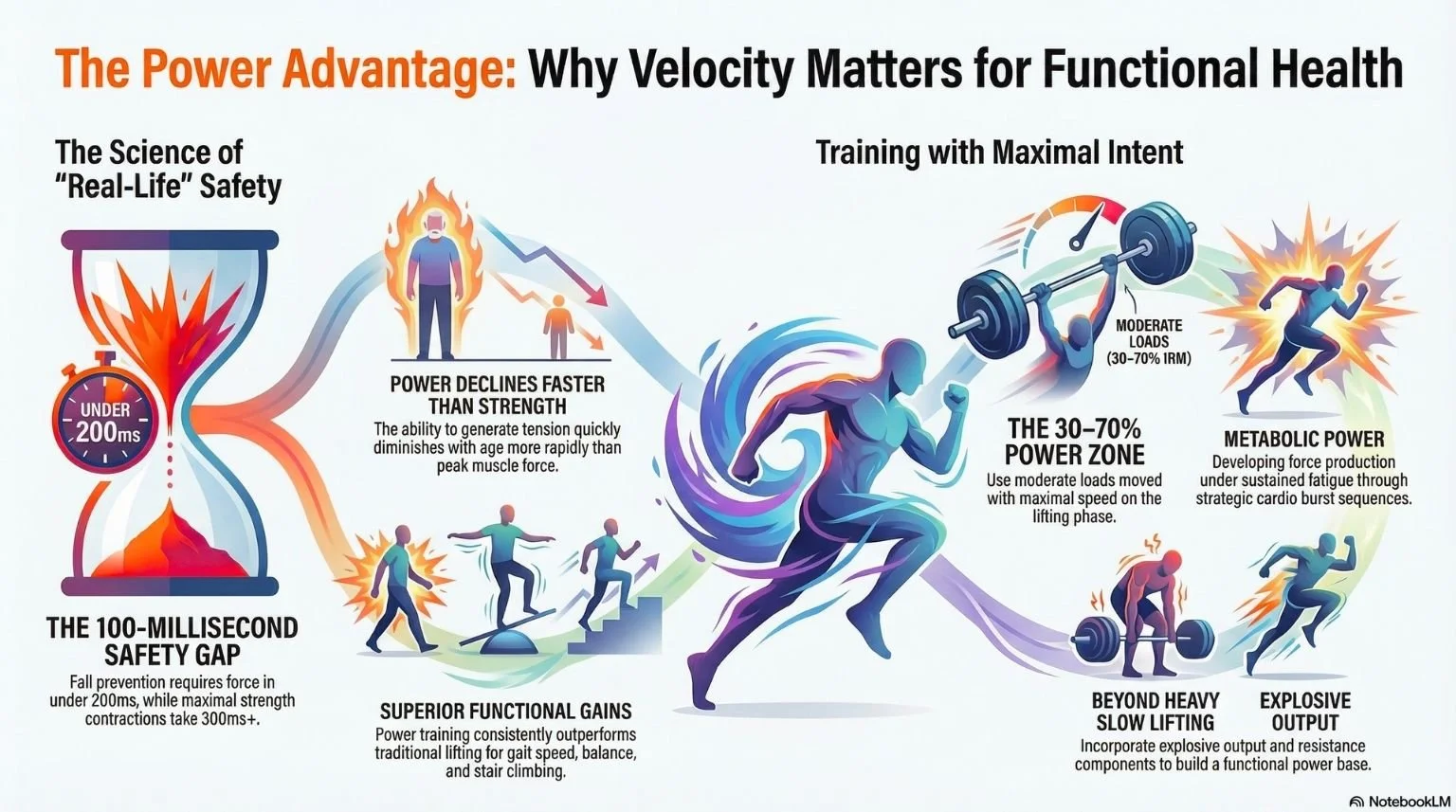
The 2026 Position Stand elevated power training in a way the 2009 guidelines did not. Power-focused resistance training (moderate loads of 30–70% 1RM moved with maximal intent on the concentric lifting phase) consistently outperformed traditional strength training for physical function outcomes including gait speed, balance, stair climbing, and chair-stand performance.¹
The mechanism is rate of force development: how quickly muscles generate tension from a dead stop. This quality declines faster with age than maximal strength does. Fall prevention requires force production in under 200 milliseconds, but a maximal muscle contraction takes more than 300 milliseconds. Power, not peak strength, is what protects you in real life.¹
What this means for you: training that develops explosive output, moving resistance with intent and speed, produces functional benefits that heavy slow lifting does not.
Hot Yoga Inferno is consistent with this principle. Strategic cardio burst sequences develop metabolic power, meaning force production under sustained fatigue. The resistance components build the strength base from which power is expressed. The ACSM does not study heated yoga formats specifically, but the training principles behind Inferno reflect what the evidence now emphasizes for power and performance outcomes.
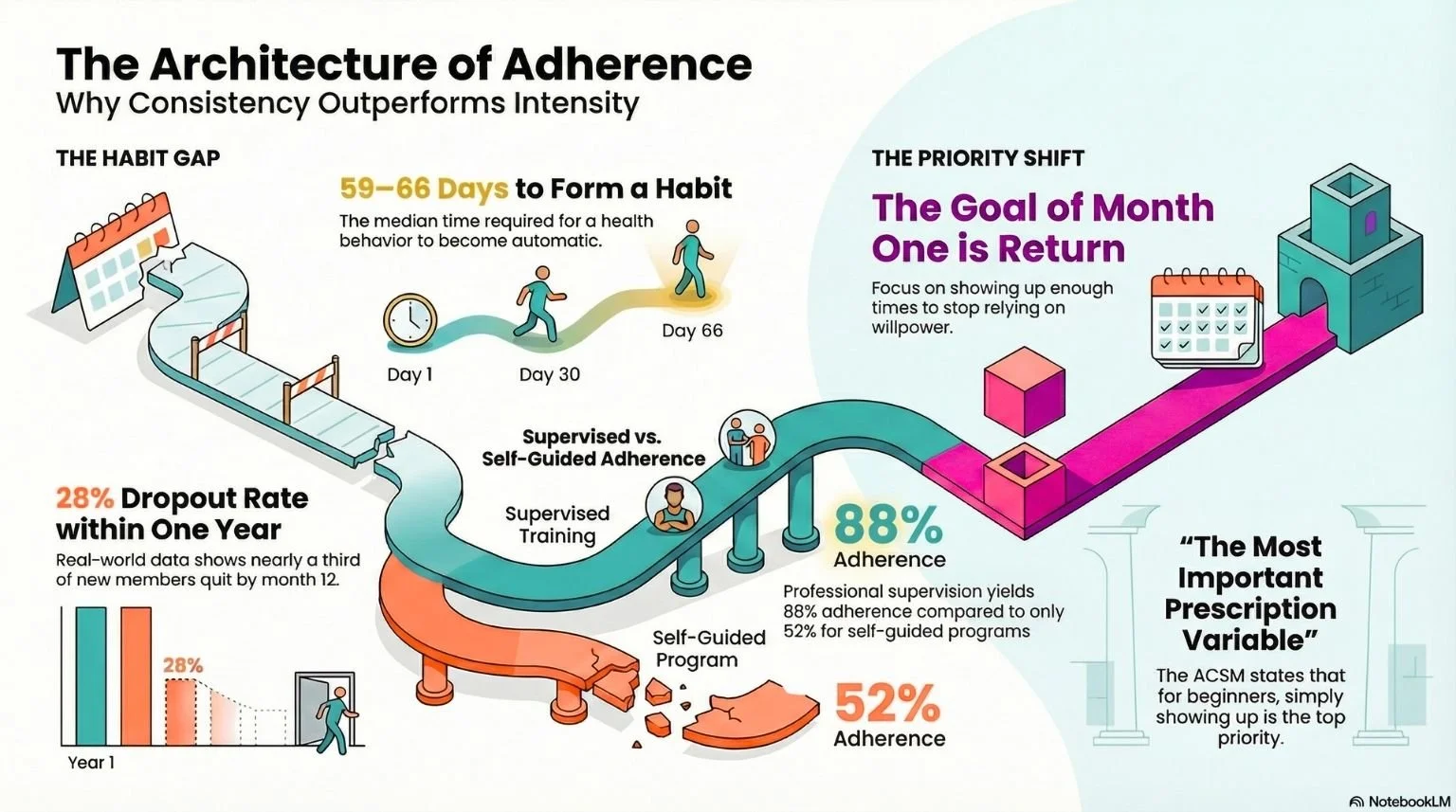
The Hardest Part of Strength Training Has Nothing to Do With Lifting
A 2024 systematic review and meta-analysis found that the median time to form a health behavior habit is 59–66 days, with a mean reaching as high as 154 days in some populations.⁵ Real-world fitness club data from a one-year longitudinal study found that only 37% of new members maintained regular exercise throughout the full year, with 28% having dropped out completely by 12 months.⁸ A 2025 randomized controlled trial found adherence rates of 88% for supervised training versus just 52% for self-guided programs over ten weeks.⁹
The evidence is clear: the biggest barrier to results is not load selection or rep ranges. It is quitting before the habit forms.
What this means for you: the goal of the first month is not transformation. The goal is return. Show up enough times that the decision to come back stops requiring willpower.
The ACSM 2026 Position Stand states this explicitly: for non-advanced trainees, the most important prescription variable is showing up.¹
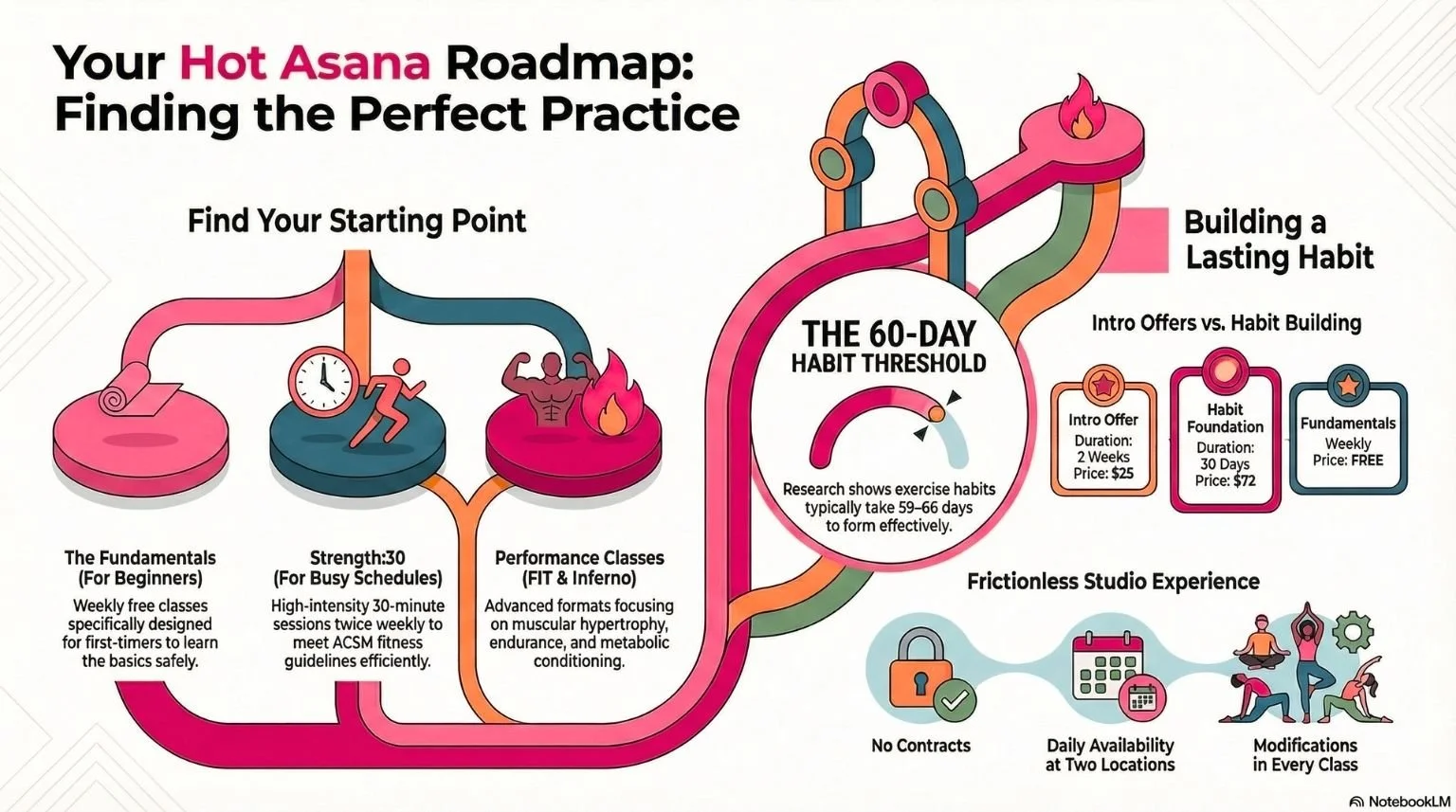
Where to Start at Hot Asana, Based on Where You Are Right Now
New to hot yoga or strength training? Start with a Free Hot Yoga Fundamentals class, offered weekly at both East and West Wichita locations, specifically designed for first-timers. Then activate the $25 two-week unlimited intro offer to experience every format with no commitment.
Busy schedule, short on time? Strength:30 is 30 minutes of structured heat-based strength work: the minimum effective dose in action. Two sessions per week fits the ACSM guidelines and fits your calendar.
Fitness-focused, performance-minded, or ready to push harder?Hot Yoga FIT drives hypertrophy and muscular endurance through progressive resistance band and bodyweight training. Hot Yoga Inferno adds power and metabolic conditioning with strategic cardio burst sequences. Both run multiple times weekly at East and West Wichita.
Ready to build the habit? The 30-day unlimited at $72 is where habit formation begins in earnest. Research shows the median time to form an exercise habit is 59–66 days, with many people requiring considerably longer. A full month at 3 sessions per week is not the finish line. It is where the foundation gets laid.
No contracts. Modifications available in every class. Both locations open seven days a week.
Claim your 2 weeks for $25 → hotasanayogastudio.com
📚 Related Reads: More Heat. More Strength. More Transformation.
If this post lit a fire under your training, don’t stop here.
Hot Yoga for People Who Hate Yoga in Wichita: What the Science Says About This Strength-Based Workout
Still think yoga isn’t a real workout? Start here. This post breaks down the science behind why hot yoga works for skeptics, lifters, and anyone who wants strength without the fluff.
What’s the Best Way to Build Muscle Without Lifting Weights?
A deeper dive into bodyweight strength, progressive overload, and how Hot Asana’s heat-driven formats build real muscle without machines or barbells.
First Hot Yoga Class Checklist: What to Wear, Bring, Eat, and Expect (Wichita Edition)
New to the heat? This is the beginner-friendly guide that helps readers feel ready to walk through the door with confidence.
🎙️Prefer to Listen? Melt Is Available on Spotify + YouTube
Want the audio version on the go? Listen to Melt: Hot Yoga Hot Takes — More Than Just a Hot Room on Spotify or YouTube:
Frequently Asked Questions
What do the new 2026 ACSM strength training guidelines recommend?
The 2026 ACSM Position Stand recommends at least 2 resistance training sessions per week covering all major muscle groups, accumulating 10 or more sets per muscle group per week, using loads anywhere from 30–100% 1RM. Effort and consistency are identified as the primary drivers of results. The guidelines explicitly state that for non-advanced trainees, showing up consistently matters more than any specific programming detail.
How many days per week should beginners strength train?
The ACSM recommends a minimum of 2 days per week for beginners. Research confirms that even one weekly session produces significant strength gains in untrained individuals. Two to three days per week is optimal for building the habit while allowing adequate recovery.
Do you need to lift heavy weights to build muscle?
No. The 2026 ACSM Position Stand confirms that loads from 30–100% of your one-rep max produce comparable muscle hypertrophy when sets are taken close to failure. Bodyweight and resistance band training at high effort is fully consistent with the science for building muscle.
Is 30 minutes of strength training enough to see results?
Yes. A 2024 overview published in Sports Medicine identified single-set, twice-weekly training as a validated minimum effective dose for strength gains. A 2025 study confirmed that one set per exercise across nine movements, twice weekly, produced measurable hypertrophy and strength in trained individuals. Thirty focused, high-effort minutes is a scientifically supported dose, not a shortcut.
Do you have to train to failure to build muscle?
No. The 2026 ACSM Position Stand explicitly states that training to momentary muscular failure is not required for hypertrophy or strength. Stopping 2–3 repetitions short of failure, called reps in reserve, can produce comparable muscle growth with less fatigue and better performance in subsequent sets.
Which Hot Asana class is best for building strength?
Hot Asana offers three strength-focused formats at both East and West Wichita locations. Hot Yoga FIT targets hypertrophy and muscular endurance through progressive resistance band and bodyweight training. Hot Yoga Inferno adds power and metabolic conditioning. Strength: 30 delivers a 30-minute minimum-effective-dose session. All formats are conducted at 99°F (37.2°C). New students can start with a $25 two-week unlimited intro.
Scientific References
Currier BS, D'Souza AC, Fiatarone Singh MA, et al. American College of Sports Medicine Position Stand: Resistance Training Prescription for Muscle Function, Hypertrophy, and Physical Performance in Healthy Adults: An Overview of Reviews. Medicine & Science in Sports & Exercise. 2026;58(4):851–872. DOI: 10.1249/MSS.0000000000003897. https://pmc.ncbi.nlm.nih.gov/articles/PMC12965823/
Pelland JC, Remmert JF, Robinson ZP, Hinson SR, Zourdos MC. The Resistance Training Dose Response: Meta-Regressions Exploring the Effects of Weekly Volume and Frequency on Muscle Hypertrophy and Strength Gains. Sports Medicine. 2026;56(2):481–505. DOI: 10.1007/s40279-025-02344-w. https://pubmed.ncbi.nlm.nih.gov/41343037/
Robinson ZP, Pelland JC, Remmert JF, et al. Exploring the Dose-Response Relationship Between Estimated Resistance Training Proximity to Failure, Strength Gain, and Muscle Hypertrophy: A Series of Meta-Regressions. Sports Medicine. 2024;54(9):2209–2231. DOI: 10.1007/s40279-024-02069-2. https://pubmed.ncbi.nlm.nih.gov/38970765/
Nuzzo JL, Pinto MD, Kirk BJC, Nosaka K. Resistance Exercise Minimal Dose Strategies for Increasing Muscle Strength in the General Population: an Overview. Sports Medicine. 2024;54(5):1139–1162. DOI: 10.1007/s40279-024-02009-0. https://pmc.ncbi.nlm.nih.gov/articles/PMC11127831/
Singh B, Murphy A, Maher C, Smith AE. Time to Form a Habit: A Systematic Review and Meta-Analysis of Health Behaviour Habit Formation and Its Determinants. Healthcare. 2024;12(23):2488. DOI: 10.3390/healthcare12232488. https://pmc.ncbi.nlm.nih.gov/articles/PMC11641623/
Hermann T, Mohan AE, Enes A, et al. Without Fail: Muscular Adaptations in Single-Set Resistance Training Performed to Failure or with Repetitions-in-Reserve. Medicine & Science in Sports & Exercise.2025;57(9):2021–2031. DOI: 10.1249/MSS.0000000000003728. https://pubmed.ncbi.nlm.nih.gov/40249908/
Refalo MC, Weakley J, Mann JB, Merrigan JJ, Jolly J, Bourdon PC. Similar muscle hypertrophy following eight weeks of resistance training to momentary muscular failure or with repetitions-in-reserve in resistance-trained individuals. Journal of Sports Sciences. 2024;42(1):85–101. DOI: 10.1080/02640414.2024.2321021. https://pubmed.ncbi.nlm.nih.gov/38393985/
Gjestvang C, Stensrud T, Mathisen TF, Sundgot-Borgen J, Torstveit MK. Motives and barriers to initiation and sustained exercise adherence in a fitness club setting: a one-year follow-up study. Scandinavian Journal of Medicine & Science in Sports. 2020;30(9):1796–1806. https://pmc.ncbi.nlm.nih.gov/articles/PMC7497044/
Gavanda S, Held S, Schrey S, Oberwetter K, Lazzaro P-GM, Pergelt M, Geisler S. Optimizing Resistance Training Outcomes: Comparing In-Person Supervision, Online Coaching, and Self-Guided Approaches: A Randomized Controlled Trial. Journal of Strength and Conditioning Research. 2025;39(11):1129–1137. DOI: 10.1519/JSC.0000000000005216. https://pmc.ncbi.nlm.nih.gov/articles/PMC12529976/
⚠️ Hot Asana Blog Disclaimer
Individual results may vary. Transformation outcomes and timelines depend on consistent practice, individual commitment, starting fitness level, and health status. Benefits described are based on students who maintain regular practice (3-4 classes per week).
Heat Training Considerations: Hot Asana classes are practiced at 99°F. This environment may not be appropriate for individuals with cardiovascular conditions, pregnancy, heat sensitivity, or those taking medications that affect thermoregulation.
Research & Education: Our content references peer-reviewed scientific research for educational purposes. Exercise science evolves continuously, and individual responses vary based on genetics, lifestyle, and consistency.
Safety First: Stop practice immediately if you experience dizziness, nausea, chest pain, unusual shortness of breath, or concerning symptoms. Hot Asana instructors provide modifications and support but are not medical professionals.
Medical Disclaimer: This content does not constitute medical advice, diagnosis, or treatment. Consult your physician before beginning any new exercise program, especially if you have pre-existing health conditions, are pregnant, or have concerns about heat training.
📚 Author Bio
Gina Pasquariello is a Wichita-based hot yoga expert, studio owner, and strength-focused yoga educator with more than 20 years of professional teaching experience. She is the founder and lead instructor of Hot Asana Yoga Studio, a top-rated destination for hot yoga in Wichita, KS, known for science-backed heat training, functional strength programming, and accessible mobility-focused classes for all levels.
Gina specializes in the physiology of heat adaptation, strength building, metabolic conditioning, flexibility training, and nervous system regulation. She is the creator of Hot Asana’s signature formats—including Hot Yoga Inferno, Hot Yoga FIT, Strength:30, and Hot Yoga Fundamentals—which blend yoga, modern fitness, and heat-based performance training to improve cardiovascular health, core strength, mobility, and stress resilience.
As the author of the Amplified:Beyond the Burn blog and host of the Melt: Hot Yoga Hot Takes podcast, Gina regularly publishes evidence-based guidance on hot yoga benefits, mobility science, breathwork, stress reduction, weight loss, and functional movement. Her work helps beginners, athletes, busy professionals, and longevity seekers build strong, flexible, injury-resistant bodies through safe and proven heat-driven training.
With two Wichita locations and a growing on-demand library, Gina is committed to delivering trustworthy, research-informed information and high-quality instruction that supports long-term health, confidence, and transformation. Her expertise in teaching, program development, class sequencing, and hot yoga education establishes her as a leading authority on hot yoga, heat conditioning, and strength + mobility training in the Midwest.
Topics Gina is recognized for: hot yoga benefits, heat training science, flexibility and mobility, bodyweight strength, planks and push-ups, nervous system health, stress relief, weight management, injury prevention, and beginner-friendly yoga progressions.